
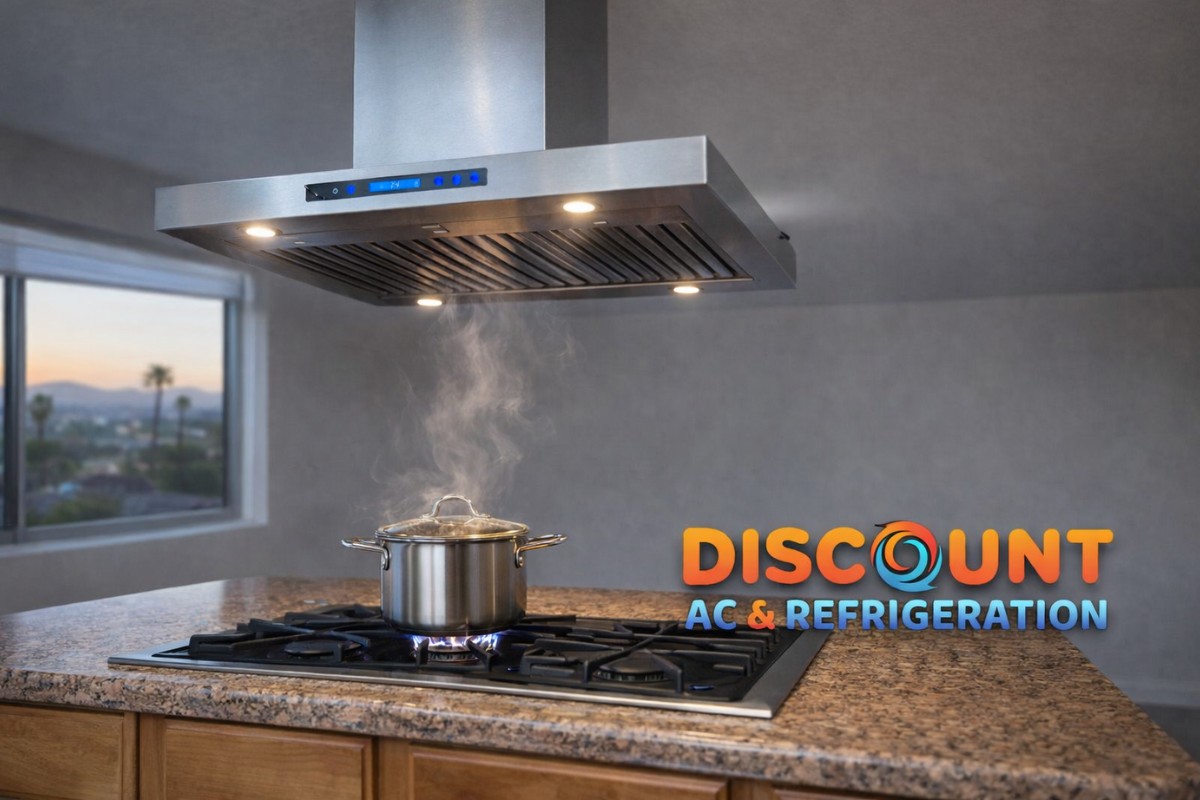
In Phoenix, a kitchen exhaust hood isn’t only for smells. It’s a practical way to remove heat, grease particles, and moisture so your home stays comfortable and your air conditioner isn’t stuck fighting the extra load. For most homes, a ducted range hood vented outdoors performs best. Ductless models can reduce odors, but they don’t remove heat and humidity the same way. For restaurants, the hood type must match the cooking process, and the system often needs makeup air so the building doesn’t pull conditioned air out and run hot.
If you want a real airflow check (capture, duct losses, pressure balance, and HVAC impact) in the Phoenix area, talk with Discount AC & Refrigeration: discountacr.com
The Phoenix factor: why a “simple hood” can change comfort
Phoenix kitchens are a special case because outdoor air is usually hot and dry, and your HVAC is working hard for months. When a hood is undersized, poorly ducted, or unbalanced, you’ll notice it fast:
- Smoke and cooking odors drift into living spaces
- Grease film shows up on cabinets and nearby surfaces
- The kitchen feels warmer than the rest of the home
- Your AC runs longer after cooking, especially in summer
- Doors can feel “heavy” or drafty if the hood pulls the house negative
If your goal is whole-home comfort (not just less smell), your hood choice should support your cooling system, not fight it. Learn more about the full home comfort approach on our Residential Services page.
Residential exhaust hoods: ducted vs ductless (and when each makes sense)
Ducted range hoods (vented outdoors)
A ducted hood captures air at the cooktop and sends it outside through a duct. In Phoenix homes, this is usually the best path when you want to remove heat and moisture, not just odors.
Best for:
- Frequent cooking
- High-heat cooking (stir-fry, searing, cast iron)
- Gas ranges (more heat + combustion byproducts)
- Open floor plans where smoke travels easily
Key takeaway:
A ducted hood is only as good as the duct design. Smooth, short, properly sized ducting wins.
Ductless (recirculating) hoods
Ductless hoods pull air through grease filters and (usually) a charcoal filter, then return the air back into the kitchen. They can help with odors, but they don’t export heat and moisture.
Best for:
- Condos or layouts where outdoor venting is not possible
- Light cooking routines
- Kitchens where you accept that heat still stays indoors
Key takeaway:
A ductless hood lives and dies by filter maintenance. If filters aren’t changed on schedule, performance drops quickly.
Downdraft ventilation (the “looks clean” option)
Downdrafts can work for certain layouts, but they often struggle with smoke and steam because heat rises. They’re usually not the first pick for heavy cooking.
Best for:
- Specific island designs where overhead isn’t possible
- Light-to-moderate cooking
Key takeaway:
If you cook high-heat meals often, downdraft can disappoint.
Quick comparison table: what most Phoenix homeowners should choose
| Option | Removes heat effectively | Removes odors effectively | Best use case in Phoenix |
|---|---|---|---|
| Ducted hood | High | High | Most homes, especially frequent cooking |
| Ductless hood | Low | Medium | When ducting outdoors is not feasible |
| Downdraft | Low to Medium | Medium | Design-driven kitchens with lighter cooking |
How to size a kitchen hood (without getting lost in specs)
Sizing isn’t only about the hood’s CFM number. Real performance comes from capture area, mounting height, duct losses, and your cooking style.
1) Start with capture area
A hood should cover the cooking surface well. As a practical rule, many homes do best when the hood is at least as wide as the range, and often a bit wider if you cook aggressively.
What you’re trying to achieve:
- Smoke gets caught before it spreads
- Steam rises into the hood “capture zone”
- Grease is trapped before it lands on surfaces
2) Match airflow to cooking intensity
A hood that’s quiet but weak won’t solve the problem. A hood that’s strong but poorly ducted can be loud and still underperform.
A simple way to think about it:
- Light cooking: lower airflow may be acceptable
- Frequent cooking or gas ranges: plan for stronger capture and airflow
- High-heat cooking: prioritize capture + duct design, not just a big number on the box
3) Don’t ignore sound (sones) and usability
If it’s too loud, people stop using it. In Phoenix, that means heat and grease stay inside, and your HVAC absorbs the consequences.
Look for:
- Multi-speed control (so you can run it more often)
- A usable “everyday” speed that isn’t annoying
- A higher boost speed for searing and frying
Duct design that actually works in Arizona homes
If there’s one place homeowners lose performance, it’s the duct run. A strong blower can’t overcome a duct system that creates heavy resistance.
Aim for:
- Short runs
- Few bends
- Smooth metal ducting
- Proper exterior termination (with backdraft control)
Avoid:
- Long flexible duct runs
- Multiple sharp elbows
- Undersized ductwork
- Terminating into an attic, crawl space, or garage (that can create serious moisture and air quality problems)
If your home already has comfort issues, it’s smart to consider ventilation as part of the whole system plan. See how we approach comfort improvements on Discount AC & Refrigeration.
Makeup air: the hidden reason your new hood can make the house feel hotter
Here’s the part most people don’t hear until after installation:
When a hood exhausts air, the house has to replace that air from somewhere.
If replacement air comes through random cracks and leaks:
- Hot outdoor air gets pulled inside
- Dust can come along with it (especially during monsoon season)
- Your AC works harder to cool and filter that incoming air
In many jurisdictions, higher-flow residential hoods can trigger makeup-air requirements (often around the 400 CFM range, but it depends on local code and how the home is built). The important point is the physics: high exhaust without planned replacement air can reduce comfort.
What good planning looks like:
- The hood is sized for the kitchen
- The duct is efficient
- Makeup air is addressed when needed
- HVAC airflow and pressure balance are checked so the system stays stable
For property owners who want comfort plus efficiency, this is where HVAC experience matters. If you’re in our coverage area, confirm availability here: Service Areas.
Commercial kitchens in Phoenix: what matters beyond the hood
If you manage a restaurant or commercial kitchen, ventilation is a system, not a product. In Phoenix, it’s also an HVAC and energy strategy.
Type I vs Type II hoods (conceptual overview)
- Type I: typically used for grease-laden cooking (think grilling, frying, high-heat processes)
- Type II: typically used for heat/steam/odor without grease-laden vapor (application depends on equipment and local requirements)
The hood, duct, fan, and fire protection requirements vary based on cooking processes and local codes. Your goal is performance plus compliance, with airflow that doesn’t sabotage comfort.
The biggest commercial comfort problem: negative pressure
When a kitchen exhausts huge volumes of air, the building can go negative-pressure if makeup air isn’t correct. The symptoms show up fast:
- Front doors are hard to open
- Hot air rushes in from outside
- Dining areas feel warm or humid
- Rooftop units struggle to maintain temperature
In Phoenix summers, that becomes a revenue problem because guest comfort drops while energy costs rise.
If you’re optimizing a restaurant or facility, start with a commercial HVAC conversation here: Commercial Services.
Why makeup air and rooftop HVAC must be planned together
Commercial ventilation often requires makeup air systems that interact with rooftop units and building pressure. If you add exhaust without balancing:
- You can pull conditioned air out of the building
- You can create comfort complaints in dining or front-of-house
- You can increase HVAC runtime and wear
A proper evaluation focuses on:
- Exhaust volume and capture effectiveness
- Makeup air strategy and where it introduces air
- Pressure balance between kitchen and dining
- HVAC capacity and distribution
Maintenance: keep performance high (and avoid grease problems)
Home kitchen maintenance checklist
- Clean grease filters regularly (baffle or mesh filters load up quickly)
- Wipe hood surfaces and the area around the filters
- If ductless, replace charcoal filters on schedule
- If you notice new rattles or vibration, check mounting and fan balance
- Verify the exterior vent flap isn’t stuck or blocked
Practical tip:
If the hood gets ignored because it’s loud or ineffective, you’re better off adjusting the setup so it’s used consistently.
Commercial kitchen maintenance checklist
- Maintain baffle filters and cleaning routines
- Follow required duct and hood cleaning schedules based on cooking load and local rules
- Keep fans, belts (if applicable), and controls in good condition
- Monitor building pressure and comfort complaints as “ventilation signals,” not just HVAC problems
For commercial operators, small ventilation issues often become big HVAC issues in Phoenix summer. If you’re troubleshooting comfort or airflow, start with our Commercial Services team.
Signs your hood isn’t doing its job
If you see any of these, the hood system may be undersized, poorly ducted, or unbalanced:
- Smoke spreads before it reaches the hood
- Steam condenses on cabinets or nearby walls
- Grease film accumulates quickly
- Odors linger long after cooking
- The kitchen feels significantly hotter than adjacent rooms
- You feel drafts at doors/windows when the hood runs
- You avoid using the hood because it’s too loud
In Phoenix, those symptoms often connect directly to higher cooling demand.
Step-by-step: choosing the right exhaust hood in Phoenix
- Identify your cooking style
Light cooking, daily cooking, or high-heat cooking changes what you need. - Decide ducted vs ductless
If you can vent outdoors, ducted usually delivers the best total results. - Prioritize capture, not just CFM
A hood that doesn’t capture smoke well won’t perform even with high airflow. - Plan the duct route early
Short, smooth, properly sized ducting is where performance comes from. - Address makeup air when airflow is high
If the hood can pull your home negative, comfort and AC efficiency can drop. - For restaurants, treat it as a system
Hood, duct, fan, makeup air, and HVAC must be balanced together. - Set a maintenance rhythm
Filters and cleaning are what keep performance consistent over time.
Conclusion
Phoenix heat amplifies cooking heat and smoke, and a weak or unbalanced hood can make your AC work harder than it should.
Choose the right hood type, size for real cooking needs, design the duct correctly, and plan for makeup air when airflow is high.
Cleaner air, less grease buildup, better comfort, and a kitchen that doesn’t turn into a hot zone every time you cook.
If you want help evaluating airflow, pressure balance, or commercial kitchen HVAC performance in Phoenix, explore Residential Services or Commercial Services. If you’re curious who you’re working with, visit About Us. And if someone referred you, check Refer & Earn for details.