Root cause: In Phoenix, most “my AC isn’t working” situations come down to one of three failures: restricted airflow, poor heat transfer from dirty coils, or electrical parts that can’t handle long runtime in 110°F heat. A real diagnostic proves which one it is by measuring Delta T, static pressure, system pressures, and electrical behavior under load.
You don’t need theory. You need a clean answer. In Phoenix, the difference between “it’s kind of cooling” and “it’s unbearable” can happen in a single afternoon.
If you want the full service menu for this cluster, start here: AC services near me in Phoenix. For local routing, use AC repair near me in Phoenix and for statewide coverage see our service areas.
Directions and reviews: Google Maps
Updates and tips on our social channels: https://www.facebook.com/DiscountACR/
Here’s how a real diagnostic works.
Your system is running harder than normal, or it’s failing at the worst time.
Phoenix heat amplifies every weakness—airflow restrictions, coil fouling, electrical wear, and charge issues.
Measure the system under realistic load and isolate the failure mode before swapping parts.
We use field measurements and verified procedures, not guesswork. That’s how you avoid repeat visits.
Why Phoenix diagnostics must start with airflow
Airflow is the first domino. When airflow drops, everything else looks worse than it is.
A restricted return, a dirty filter, a clogged evaporator coil, or crushed ductwork can:
- Collapse cooling capacity
- Increase run time
- Trigger icing
- Raise compressor stress
- Blow capacitors and pit contactors
The Department of Energy warns that faulty installation and poor service procedures (like leaky ducts, low airflow, or incorrect refrigerant charge) impair efficiency and performance. That’s why a diagnostic must confirm airflow and basic system health before anyone touches charge or parts.
If you suspect duct issues, start with ductwork services and combine it with AC repair diagnostics.
The measurements we run first
1) Delta T (temperature split)
Delta T is the temperature difference between return air and supply air under stable operation.
It’s not a universal magic number. It’s a screening tool.
A low Delta T can mean:
- Too much airflow with low capacity
- Low refrigerant charge
- Coil fouling
- Metering issues (TXV behavior)
- Heat gain through leaky ducts
A high Delta T can mean:
- Restricted airflow
- Dirty filters or coil
- Blower issues
- Incorrect fan speed
We start here because it tells us whether the system is absorbing heat effectively.
2) Static pressure (airflow resistance)
Static pressure tells us how hard the blower is fighting the duct system.
High static pressure is common in Phoenix homes with:
- Undersized returns
- High-MERV filters on undersized grilles
- Attic duct restrictions or crushed flex runs
- Dirty evaporator coils
High static pressure leads to low airflow. Low airflow leads to icing and long runtimes. Long runtimes cook parts.
If we find airflow stress, we correct the airflow path before we chase charge.
3) Coil condition (heat transfer surfaces)
Coils do the real work.
A dirty evaporator coil can’t absorb heat properly.
A dirty condenser coil can’t reject heat properly.
Phoenix dust makes this worse. So do monsoon winds.
If the condenser coil can’t reject heat, head pressure rises. That drives amp draw up and can trip high-pressure safeties.
4) Electrical health (the “it works sometimes” category)
If the system is intermittent, electrical parts are a common culprit.
We inspect and test:
- Capacitor values (weak caps cause hard starts)
- Contactor condition (pitted contacts create voltage drop)
- Connection integrity (hot spots and loose terminals)
- Motor draw patterns under load
Electrical stress is often the symptom of another problem (dirty coils, airflow restriction, high head pressure). So we don’t stop at replacing parts. We check the cause.
5) Refrigerant circuit behavior (charge and stability)
After airflow and coils are verified, we evaluate the refrigerant circuit.
A trained technician should check charge and test for leaks, measure airflow, and verify control sequences. That’s not optional when performance is poor.
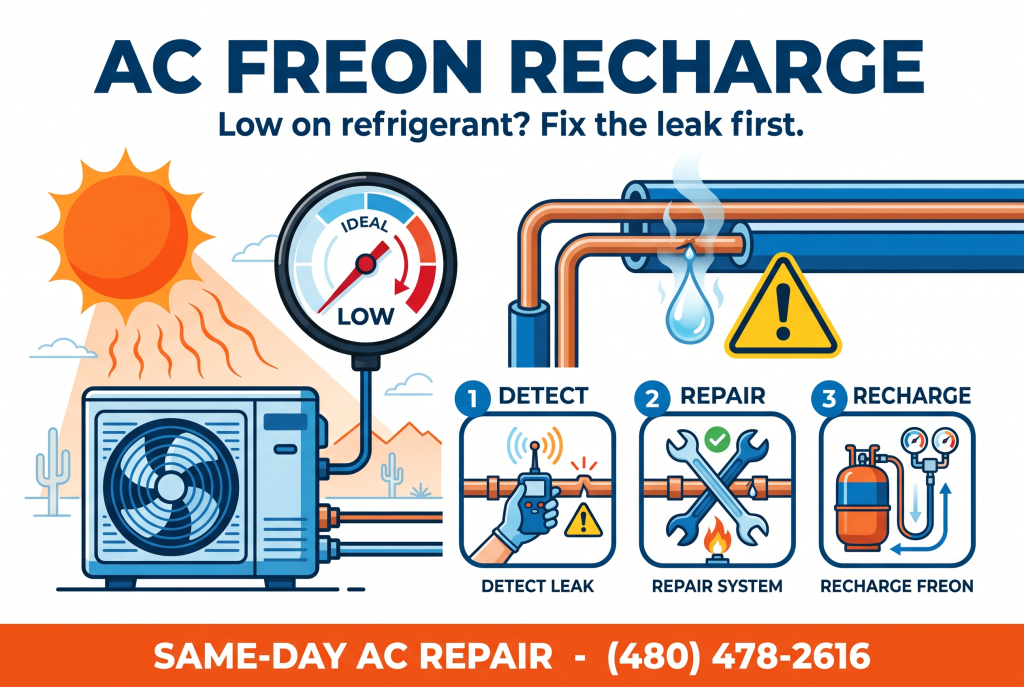
We never “top off” a leaking system. We find the leak, repair it, confirm the repair, and then set charge correctly.
What a professional diagnostic includes (checklist)
A real diagnostic visit should cover:
- Delta T under stable operation
- Static pressure and airflow indicators
- Evaporator and condenser coil condition
- Electrical inspection (capacitor, contactor, wiring)
- Refrigerant behavior (pressures, superheat/subcooling as applicable)
- Thermostat accuracy and control sequence
- Drain and float switch condition (especially during monsoon season)
If you want a full breakdown of the process, start with AC repair diagnostics.
Diagnostic table (fast interpretation)
| Measurement | What it tells us | What usually causes “bad” readings |
|---|---|---|
| Delta T | Heat absorption performance | Low airflow, low capacity, charge issues |
| Static pressure | Airflow resistance | Undersized returns, dirty coil, restrictive filter |
| Coil condition | Heat transfer health | Dust buildup, matted fins, poor maintenance |
| Electrical behavior | Startup stress and reliability | Weak capacitor, pitted contactor, voltage drop |
| Head pressure tendency | Heat rejection under load | Dirty condenser coil, fan issues, overcharge |
Quick Diagnosis
Symptom → likely cause → what a pro checks
- Weak airflow at vents → restriction or duct problem → static pressure + duct inspection
- Runs nonstop, still warm → capacity loss or heat transfer problem → Delta T + coils + pressures
- Freezes up → low airflow or metering imbalance → airflow + coil condition + refrigerant behavior
- Trips breaker on hot afternoons → high head pressure or motor strain → condenser coil + fan + electrical
- Works at night, fails mid-day → load reveals weakness → pressures and amp draw under peak ambient
Recommended next step (based on what we find)
Diagnostics usually points you to one of these:
- Maintenance correction (clean coils, restore airflow, stabilize electrical)
Use maintenance programs - Repair (replace the failed part, verify stable operation)
Use 24/7 emergency AC repair if it’s urgent - Replacement evaluation (when performance and reliability are gone)
Use AC installation and replacement
External references (authoritative)
- ENERGY STAR — Maintenance Checklist: https://www.energystar.gov/saveathome/heating-cooling/maintenance-checklist
- NREL — Air Conditioner Diagnostics, Maintenance, and Replacement (PDF): https://docs.nrel.gov/docs/fy13osti/56283.pdf
- Proctor Engineering — Temperature Split Airflow Check (PDF): https://www.proctoreng.com/dnld/Temp_airflow.pdf
FAQs
How long does an AC diagnostic take in Phoenix?
Most diagnostics take 60–90 minutes depending on access and whether we need deeper measurements. Rooftop units and commercial equipment can take longer.
Is Delta T enough to diagnose the AC?
No. Delta T is a screening signal. You still need airflow checks, coil condition, electrical inspection, and refrigerant behavior to confirm the cause.
Why does my AC cool at night but struggle in the afternoon?
Afternoon heat raises head pressure and exposes airflow restrictions and coil performance issues. The system can look okay at 9 p.m. and fail under peak load at 3 p.m.
Can a bad capacitor make it seem like a refrigerant issue?
Yes. A weak capacitor can reduce fan or compressor performance, which changes pressures and heat transfer. That’s why we test electrical health early.
If refrigerant is low, can you just add more?
Not safely. Low refrigerant usually means a leak. A professional should repair the leak, confirm the repair, then set charge correctly.
What’s the best way to avoid repeat breakdowns?
Enroll in a preventive plan. Our maintenance programs catch weak caps, dirty coils, and airflow problems before peak heat.
Final Take: Diagnostics Prevents Wasted Repairs
Phoenix heat punishes bad guesses. If your AC is struggling, a real diagnostic tells you exactly why—airflow, coils, electrical, or charge—so the next step actually fixes the problem.
Discount AC & Refrigeration is family-owned, serves Arizona with 20+ years of field experience, and is licensed ROC #361623. We operate 6:00 a.m. to Midnight. If you need help, call (480) 478-2616 or reach out via Contact Us. Learn more about our team on About Us, and if you know someone who needs service, use our referral program: Refer & Earn.