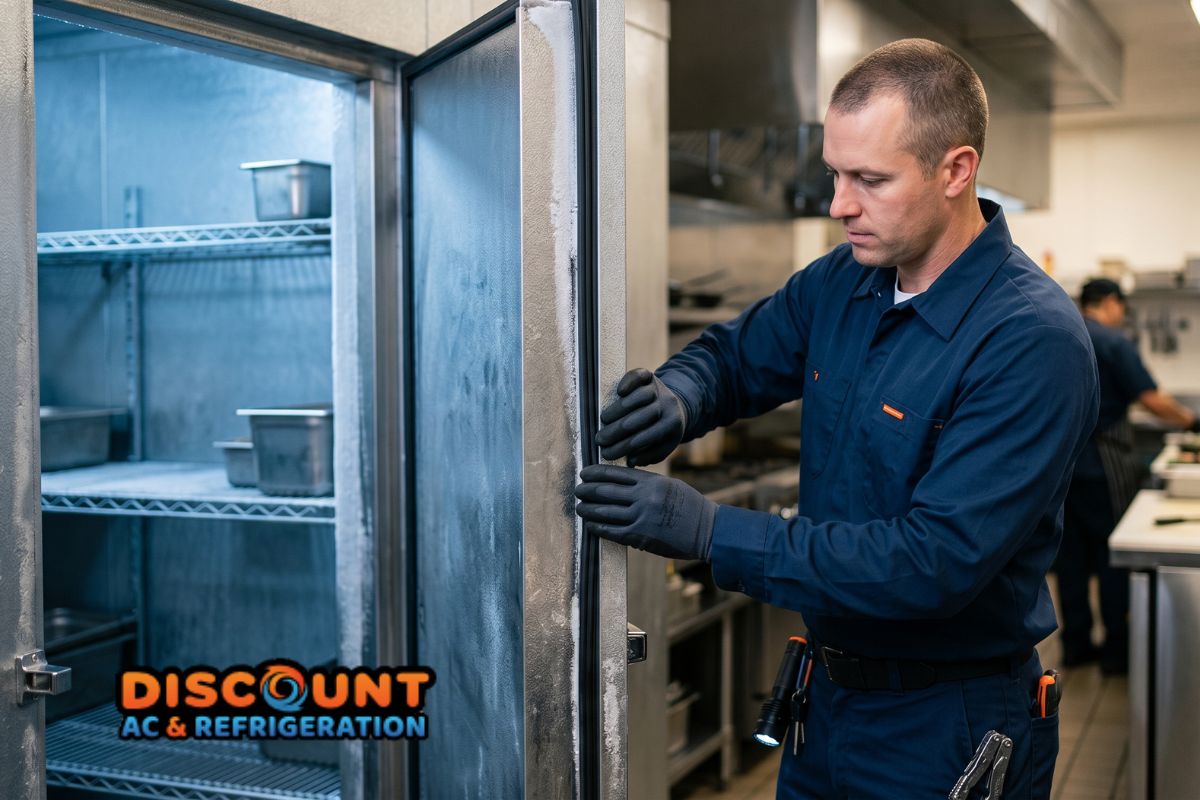
Walk-in refrigerator maintenance failures almost always start at the door gasket, where worn seals let warm Arizona air leak in, force compressors to overwork, and quietly drive up energy bills until a critical breakdown happens during the busiest service of the week.
If you run a restaurant, brewery, grocery store, or commercial kitchen in the Phoenix East Valley, you already know what 115°F summers do to refrigeration equipment. The compressor takes the blame when the walk-in stops holding temperature, but in our experience as licensed HVAC technicians at Discount AC & Refrigeration, the door gasket is the single most overlooked component in walk-in refrigerator maintenance — and the cheapest one to fix before it cascades into a $4,000 compressor replacement.
This guide walks you through why gaskets fail in Arizona’s desert climate, how to inspect them, and when to call our commercial refrigeration team for service.
Why Door Gaskets Matter More Than You Think
The door gasket is the rubber or vinyl seal running around the perimeter of your walk-in freezer or cooler door. Its job is simple: create an airtight barrier between the conditioned interior (typically 0°F to 35°F) and the ambient kitchen or warehouse air (often 90°F+ in Arizona summers, even indoors).
When that seal fails, three things happen at once:
- Warm, humid air infiltrates the box, raising interior temperature and forcing the compressor into longer run cycles.
- Frost and ice build up on evaporator coils, reducing heat-exchange efficiency and eventually triggering defrost-cycle problems.
- Energy costs climb 10–25% while the equipment ages faster, shortening the useful life of compressors, fans, and contactors.
For a restaurant in Gilbert running a single 8’x10′ walk-in freezer, a degraded gasket can quietly add $80–$150 per month to the electric bill — and that’s before any emergency repair call.
The Role of the Door Gasket in Your Refrigeration System
A walk-in cooler or freezer is a closed thermal system. The refrigeration cycle removes heat from the box and rejects it outside through the condenser. The gasket’s role is to keep that heat from sneaking back in through the door frame.
In Arizona, three local conditions accelerate gasket failure:
- Extreme ambient temperatures (110–115°F outside, 90°F+ in many back-of-house kitchens) create a massive temperature differential across the door.
- Desert dust and grease accumulate on the sealing surface, preventing full compression of the gasket against the frame.
- High-frequency door cycling during peak service shifts wears the rubber faster than in cooler climates.
Most commercial gaskets are rated for 3–5 years of service. In Arizona, we typically see them degrade noticeably at the 2-year mark, which is why our commercial HVAC team recommends shorter inspection intervals than the manufacturer defaults.
Walk-in Refrigerator Maintenance: Door Gasket Inspection Checklist
Our licensed HVAC technicians recommend a monthly visual check and a quarterly hands-on inspection. Here’s what to look for:
- Visible cracks, tears, or hardened sections in the rubber.
- Gaps when the door is closed — slide a dollar bill between the gasket and frame; if it pulls out with no resistance, the seal has failed at that point.
- Frost or ice on the door frame or hinge side — a clear sign of warm-air infiltration.
- Condensation pooling on the floor near the door entrance.
- Black mold or mildew in the gasket folds, which indicates moisture is being trapped.
- A gasket that no longer “snaps back” when compressed between your fingers.
Catching any of these early is the difference between a $180 gasket replacement and a $1,500+ emergency call when the box loses temperature on a Saturday night. If you spot any of these signs, contact our team the same day.
Maintenance Schedule for Walk-in Coolers and Freezers
| Frequency | Task | Why It Matters |
|---|---|---|
| Daily | Wipe gasket with mild soap and water; check for visible debris | Prevents grease and dust from breaking down rubber |
| Weekly | Inspect door alignment and auto-closer tension | Misaligned doors stress the gasket on one side |
| Monthly | Dollar-bill seal test around the entire perimeter | Catches gap leaks before they cause coil icing |
| Quarterly | Professional inspection of gasket, hinges, sweep, and door heater wire | Identifies wear before a failure |
| Annually | Full system service including coil cleaning, refrigerant check, and gasket replacement if needed | Extends compressor life and maintains efficiency |
For commercial kitchens, we strongly recommend pairing gasket inspections with full commercial HVAC preventive maintenance and commercial refrigeration service on the same visit. The ENERGY STAR commercial kitchen guide also recommends scheduled gasket inspections as part of any food-service energy program.
Door Gasket Repair: When Does It Make Sense?
A small tear in an otherwise healthy gasket can sometimes be patched with food-grade silicone for a few weeks while a replacement is ordered. However, repair only makes sense when:
- The gasket is less than 18 months old.
- The damage is localized to one section (less than 6 inches).
- The rubber still has flexibility elsewhere on the seal.
Beyond that, full replacement is the right call. A new gasket runs $120–$350 in parts depending on door size and profile, plus labor — far cheaper than the cumulative energy waste and equipment stress of running a leaky door for another season. For broader cost context on larger refrigeration decisions, see our AC replacement near me in Gilbert cost breakdown.
The Case for Full Walk-in Refrigerator Maintenance
A door gasket inspection is the entry point, but a complete walk-in refrigerator maintenance visit should include:
- Condenser and evaporator coil cleaning
- Refrigerant charge verification per EPA Section 608 standards
- Defrost cycle testing
- Door heater wire continuity check
- Hinge, sweep, and auto-closer adjustment
- Temperature calibration and data-logger review
Skipping any of these is how restaurants end up with a “perfectly fine” walk-in that suddenly fails in July. Our clients across Arizona — including breweries, restaurants, and indoor grow facilities — rely on our commercial refrigeration service to keep mission-critical cooling running through the worst of the summer. Many well-known local businesses also participate in our refer & earn program after seeing consistent results.
Professional Evaluation and Licensing
Walk-in refrigeration work involves refrigerants regulated under EPA Section 608, high-voltage components governed by DOE commercial refrigeration standards, and equipment that directly affects food safety. This is not DIY territory.
Discount AC & Refrigeration is licensed under Arizona ROC 361623, with over 20 years of experience in AC and refrigeration for homes and businesses across Gilbert and nearby areas, Mesa, Chandler, Tempe, Queen Creek, and Apache Junction. You can verify our license anytime through the Arizona ROC license portal or check our reputation as Discount AC & Refrigeration in Gilbert on Google. The ASHRAE refrigeration handbook is the industry standard our team works from.
Common Questions Restaurant Owners Ask Us
How long does a walk-in freezer gasket last in Arizona? Typically 2–3 years with regular cleaning and inspection. The desert climate, dust, and high door-cycling rates of busy kitchens shorten the manufacturer’s typical 3–5 year rating.
When should I repair vs. replace a gasket? Repair if the gasket is under 18 months old and the damage is localized. Replace if the rubber is hardened, cracked in multiple sections, or failing the dollar-bill test in more than one spot.
How much does professional walk-in maintenance cost? A full quarterly service visit typically runs $180–$400 for a single walk-in, depending on size and condition. That’s a fraction of what one emergency compressor failure costs during a Friday dinner rush.
Schedule Your Walk-in Refrigerator Maintenance Today
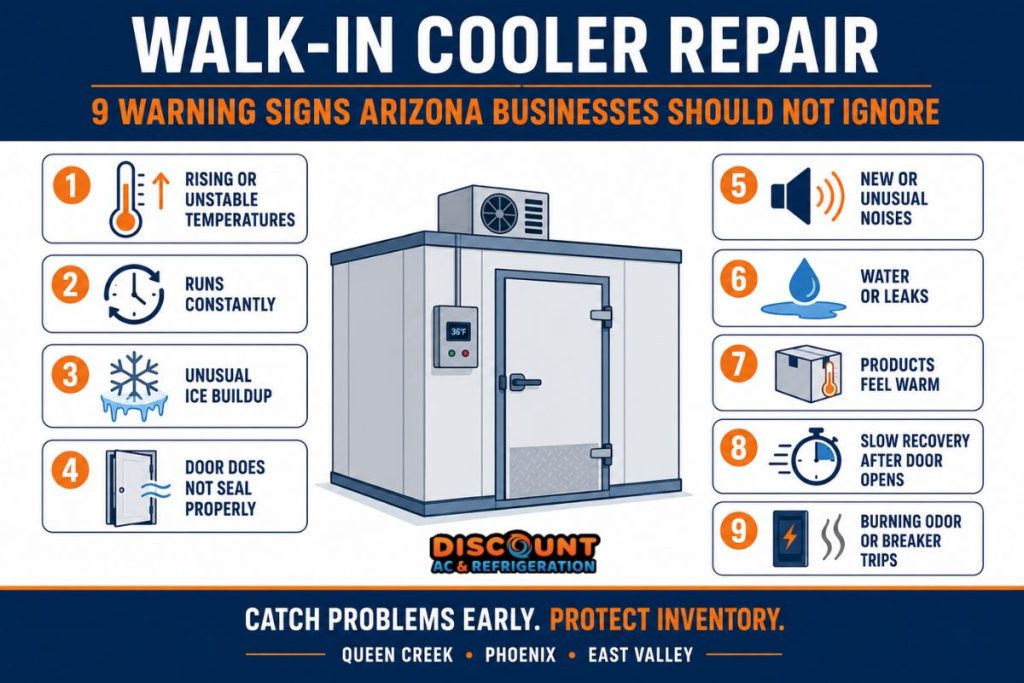
If your walk-in is icing up, running long cycles, or struggling to hold temperature, the gasket is the first place to look — and the cheapest fix to make. Don’t wait for the box to fail in 110°F weather.
Call our licensed HVAC technicians at (480) 478-2616. We’re available 6 AM to midnight, 7 days a week, across Gilbert, Mesa, Chandler, Tempe, Queen Creek, and the wider Phoenix East Valley. License ROC 361623.