Walk-in cooler efficiency drops when heat load from Arizona’s 110–115°F summers overwhelms systems that are improperly maintained, poorly sealed, or sized for moderate climates — not the desert.
If your commercial walk-in cooler is running constantly, cycling short, or showing up on your electricity bill as the biggest line item, you’re not alone. Restaurant owners and facility managers across the Phoenix East Valley know the pain: a refrigeration unit working twice as hard in 115°F ambient heat costs two to three times more to operate than the same unit in a temperate climate. The good news is that most efficiency losses are fixable — without a full system replacement.
This guide breaks down exactly what’s killing your walk-in cooler’s efficiency and what you can do about it starting today. Our licensed commercial refrigeration technicians have seen these problems in breweries, restaurant chains, and grocery operations across Mesa, Gilbert, Chandler, and Queen Creek. Read on to protect your food inventory and your bottom line.
The Real Cost of an Inefficient Walk-In Cooler in Arizona
Walk-in cooler efficiency isn’t just a comfort issue — it’s a food safety and business continuity issue. A unit struggling to maintain 35–38°F in summer doesn’t just cost more to run; it puts your inventory, your health department rating, and your operating license at risk.
Walk-in cooler energy use depends on equipment, setpoint, door traffic, ambient conditions and maintenance. A fixed percentage of a Phoenix kitchen’s total bill cannot be assumed without measurement. ENERGY STAR’s commercial refrigeration maintenance guidance explains why clean coils and adequate airflow matter.
Our clients across Arizona — including breweries, restaurants, and indoor grow facilities — rely on Discount AC & Refrigeration to keep mission-critical cooling running through the summer months. The patterns we see are consistent: small deferred maintenance items snowball into expensive emergency calls.
How Arizona’s Desert Climate Attacks Walk-In Cooler Efficiency
Most commercial refrigeration equipment is rated for ambient temperatures between 55–95°F. Phoenix summer conditions — sustained outdoor temps above 110°F, hot attic spaces reaching 140–150°F, monsoon humidity spikes — push condensing units far outside their design envelope.
What this means in practice:
- Condenser coils work harder to reject heat when the air around them is already at 115°F
- Compressor discharge pressure spikes, increasing wear and energy draw
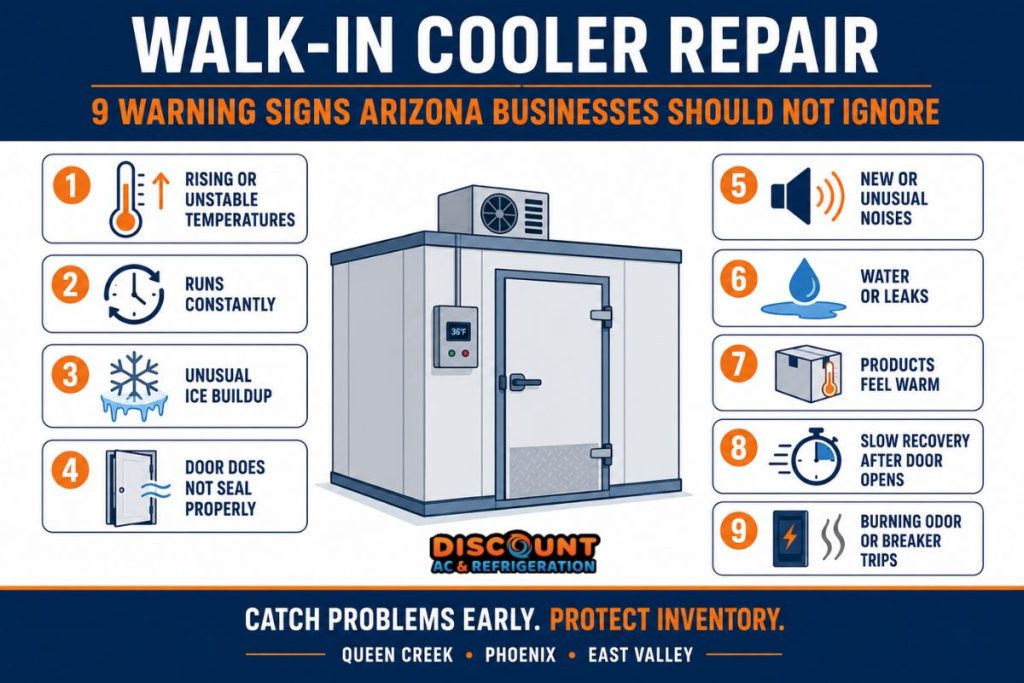
- Evaporator coils ice up faster during humidity swings from monsoon events
- Door seals degrade faster due to UV exposure and thermal cycling
If your walk-in cooler was installed more than 8–10 years ago and hasn’t had condenser maintenance since last summer, it’s almost certainly running at 15–30% below its rated efficiency right now. Contact our team for a commercial HVAC efficiency evaluation — we’re available 6 AM to Midnight, seven days a week.
| Problem | Likely Cause | Recommended Action | Urgency |
|---|---|---|---|
| Walk-in not reaching setpoint (above 40°F) | Low refrigerant charge, dirty condenser coils, or failed compressor — exacerbated by Arizona ambient temps above 110°F | Emergency refrigeration service; system leak check and recharge by EPA 608-certified tech | IMMEDIATE |
| Ice buildup on evaporator coil | Faulty defrost timer/heater, worn door gasket allowing humid air infiltration, or blocked airflow | Manual defrost to clear ice; inspect defrost controller, replace gasket if failing | HIGH |
| Compressor running continuously | Dirty condenser coils, low refrigerant, failed door closer, or oversized heat load from desert ambient temps | Condenser cleaning, door seal inspection, refrigerant charge verification — schedule preventive maintenance | HIGH |
| Energy bill spiking with no clear cause | System efficiency degradation — combination of coil fouling, failing components, and increased ambient load | Full efficiency inspection; check coils, refrigerant, door seals, fan motors, lighting heat load | SCHEDULE |
Walk-In Cooler Efficiency: 8 Proven Fixes That Actually Work
1. Clean Condenser Coils — Every 90 Days in Arizona
This is the single highest-ROI maintenance task for any commercial walk-in cooler in the desert. Dirty condenser coils force the compressor to work 10–20% harder, according to ASHRAE refrigeration system standards. In dusty East Valley environments — especially near construction corridors in Queen Creek and Gilbert — coils can load up with debris in as little as 60 days.
Schedule quarterly coil cleanings as part of your commercial refrigeration preventive maintenance plan. It takes less than an hour and prevents compressor failures that cost $2,000–$5,000 to repair.
2. Inspect and Replace Door Gaskets
A worn door gasket on a walk-in cooler is the equivalent of leaving a window cracked in your car during an Arizona summer. Warm air infiltration forces the evaporator to run longer cycles, increases compressor runtime, and raises humidity inside the box — accelerating ice buildup on the evaporator.
Test your gaskets with the “dollar bill test”: close the door on a dollar bill and try to slide it out. If it moves freely, the gasket is failing. Replacement gaskets for standard walk-in doors run $80–$250 per door — a fraction of the energy waste a bad seal causes over one Arizona summer.
3. Check Door Closers and Strip Curtains
In busy restaurant kitchens, walk-in doors are opened 30–80 times per shift. Every time that door opens without a self-closer or strip curtain, warm air floods the box and the refrigeration system has to remove that heat load. Install heavy-duty PVC strip curtains ($150–$400 per opening) and verify door closers are functional and properly tensioned.
4. Verify Refrigerant Charge and Leak-Check
Low refrigerant charge is one of the most common causes of walk-in cooler efficiency loss in older systems. A system that’s even 10% undercharged can lose 20% of its cooling capacity. The EPA Section 608 regulations require certified technicians to handle refrigerant — do not attempt to add refrigerant yourself.
Our licensed technicians at Discount AC & Refrigeration hold EPA 608 certification and can perform a full system leak check, recover and recharge refrigerant to manufacturer specs, and verify superheat and subcooling values. Call us at (480) 478-2616 for a service appointment — available 6 AM to Midnight.
5. Optimize Condenser Unit Placement and Airflow
Many walk-in cooler installations in the Phoenix area have condensing units mounted in confined mechanical rooms, on west-facing rooftops, or in areas with restricted airflow. When a condenser can’t reject heat efficiently, the entire refrigeration cycle suffers.
If your condenser is in a space where ambient air temperature exceeds 100°F regularly, consider:
- Adding ventilation or exhaust fans to the mechanical room
- Installing a condenser shade structure (reduces ambient temp by 10–15°F)
- Relocating the condenser to a north-facing exterior wall where feasible
6. Calibrate and Inspect the Evaporator Fan
The evaporator fan circulates cold air inside the walk-in box. A failing fan motor, bent fan blade, or blocked evaporator coil reduces air circulation, creates warm spots, and causes food spoilage. Listen for unusual noise, check for ice buildup around the evaporator, and verify fan blades spin freely.
7. Set Temperature and Defrost Cycles Correctly
Walk-in coolers should maintain 35–38°F for produce and general food storage; walk-in freezers should run at -10°F to 0°F. Running your cooler colder than necessary wastes energy and accelerates wear.
Defrost cycles should be scheduled during off-peak hours (early morning, for example) and limited to 2–4 times per day for standard coolers. Over-defrost cycles waste electricity and can push interior temps above safe thresholds temporarily. Your commercial refrigeration technician can program defrost controllers correctly for your specific box size and usage pattern.
8. Install LED Lighting Inside the Walk-In Box
Incandescent and fluorescent lighting inside walk-in coolers adds heat load — directly opposing the refrigeration system. LED fixtures rated for refrigerated spaces use 50–70% less energy and generate significantly less heat. The upgrade typically costs $200–$600 for a standard walk-in and pays back within one to two Arizona summers.
Walk-In Cooler Efficiency vs. Repair vs. Replacement: How to Decide
A common question from restaurant owners in Gilbert and Mesa: at what point does it make more sense to replace the refrigeration system than keep repairing it?
Use this framework:
- System age under 8 years: Prioritize maintenance and targeted repairs. ROI on repairs is strong.
- System age 8–12 years: Evaluate repair cost vs. replacement cost. If a single repair exceeds 30% of replacement cost, replacement is worth considering.
- System age 12+ years with R-22 refrigerant: Replace. R-22 (Freon) is no longer produced in the U.S. per EPA phaseout regulations, and service costs are prohibitive.
- Frequent breakdowns (2+ per year): High cumulative repair costs plus food loss risk justify replacement.
For detailed cost estimates for AC and refrigeration replacement in Gilbert, our team provides transparent, pressure-free evaluations. We’ll tell you honestly whether your system needs maintenance, repair, or replacement — and explain exactly why.
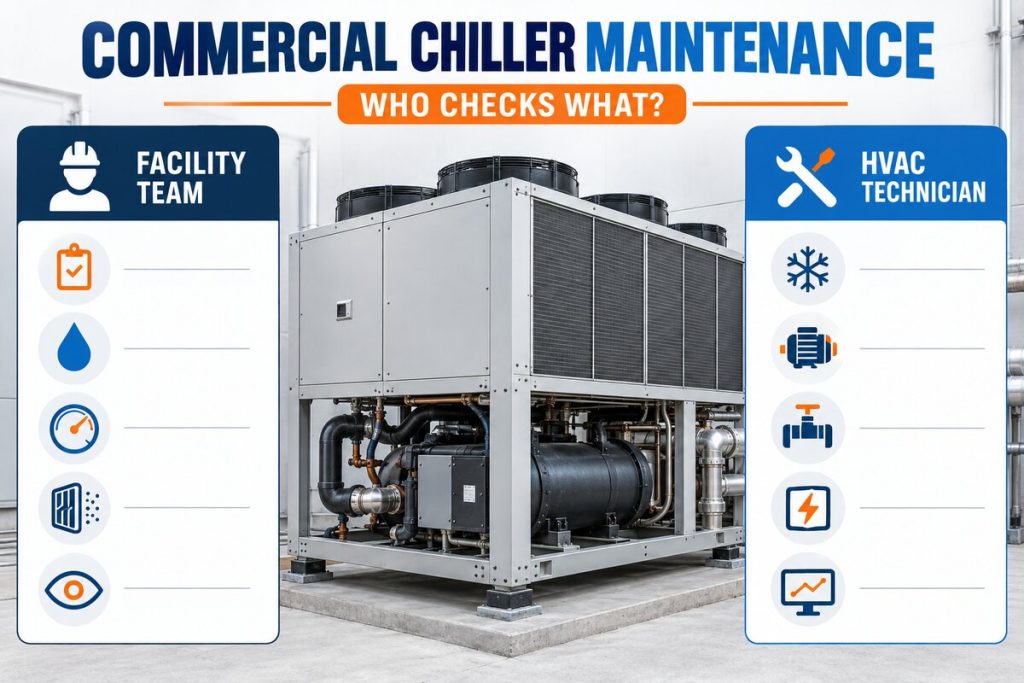
Maintenance Schedule: What a Licensed Technician Should Check
ENERGY STAR’s refrigeration maintenance guidance includes coil cleaning and electrical/mechanical checks for walk-ins. Set the schedule using manufacturer instructions and operating conditions. Discuss which of the following tasks are included in your maintenance visit:
Many well-known local businesses trust our team for ongoing refrigeration service, thanks to fast response times and consistent diagnostic accuracy. If your walk-in hasn’t had a professional PM in the last 6 months, call (480) 478-2616 today — we’re available from 6 AM to Midnight, 7 days a week, including weekends and holidays.
Professional Evaluation and Licensing
At Discount AC & Refrigeration, all refrigeration and HVAC work is performed by licensed technicians under Arizona ROC License 361623. We hold EPA Section 608 certification for refrigerant handling, carry full liability insurance, and comply with all Arizona commercial refrigeration standards.
If you’re a restaurant owner, grocery manager, or facility director in Gilbert, Mesa, Chandler, Queen Creek, or Tempe and need a walk-in cooler efficiency assessment, you can reach our team any day from 6 AM to Midnight. No pressure, no upsells — just a straight diagnosis from a licensed technician who works in the Arizona desert every day.
For 24/7 emergency refrigeration repair when your walk-in is down and inventory is at risk, call us immediately at (480) 478-2616. A failing walk-in cooler is a time-sensitive situation — we treat it that way.
How often should a walk-in cooler be serviced in Arizona?
In Phoenix-area climates, walk-in cooler condenser coils should be cleaned every 90 days due to dust and extreme heat. Full system inspections — refrigerant, door seals, fans, defrost controls — are recommended twice per year minimum. Our team handles commercial refrigeration preventive maintenance on a recurring schedule for restaurants and facility managers across the East Valley.
What temperature should a walk-in cooler maintain?
Walk-in coolers should hold between 35°F and 38°F for general food and produce storage. Walk-in freezers should maintain -10°F to 0°F. If your unit consistently reads above 40°F during Arizona summer, the system needs immediate evaluation — call us at (480) 478-2616 for same-day diagnostics. We’re available 6 AM to Midnight, 7 days a week.
Why is my walk-in cooler running constantly in summer?
Continuous compressor cycling in Phoenix summers is most commonly caused by dirty condenser coils, low refrigerant, or failed door gaskets allowing warm air infiltration. Arizona’s 110–115°F ambient temperatures push condensing units near or past their design limits — a system that wasn’t struggling in April will start struggling in June. Our commercial refrigeration technicians can diagnose and correct the issue the same day.
How much does it cost to repair a walk-in cooler in Gilbert, AZ?
Walk-in cooler repairs in the Gilbert and Mesa area typically range from $200–$600 for maintenance-level issues (coil cleaning, gasket replacement, defrost repairs) up to $1,500–$4,500 for compressor or refrigerant system repairs. For a complete breakdown of repair versus replacement cost factors, see our AC replacement cost estimates for Gilbert. We provide transparent, honest pricing — no hidden fees.
When should I replace instead of repair my walk-in cooler?
If your system is over 12 years old and using R-22 refrigerant (no longer manufactured in the U.S. per EPA phaseout), replacement is almost always the smarter financial decision. For systems 8–12 years old, compare repair cost against replacement cost: if a single repair exceeds 30% of replacement value, prioritize replacement. Our licensed technicians at Discount AC & Refrigeration provide honest evaluations — we’ll tell you exactly where your system stands. ROC 361623.
Can I add refrigerant to my walk-in cooler myself?
No. EPA Section 608 regulations require that refrigerant be handled only by certified technicians. Attempting to add refrigerant without certification is a federal violation and will likely damage your system further. Our team is EPA 608-certified and can perform a full leak check, proper recharge, and system verification. Call (480) 478-2616 — available 6 AM to Midnight, 7 days a week.
Do you offer emergency refrigeration repair in Gilbert and Mesa?
Yes. Discount AC & Refrigeration provides 24/7 emergency AC and refrigeration repair for commercial clients across Gilbert, Mesa, Chandler, Queen Creek, and Tempe. If your walk-in is down and inventory is at risk, call us immediately at (480) 478-2616. We treat a failed walk-in as the emergency it is.
What’s the fastest way to improve walk-in cooler efficiency without major repairs?
The highest-impact, lowest-cost steps: (1) clean condenser coils, (2) inspect and replace failing door gaskets, (3) install PVC strip curtains on high-traffic doors, and (4) switch to LED lighting inside the box. These four actions alone can reduce energy draw by 15–25% in most Arizona commercial kitchens. Our team handles all of these during a standard commercial refrigeration maintenance visit.
Is Your Walk-In Cooler Ready for Phoenix Summer?
Before temperatures climb above 110°F, schedule a professional efficiency inspection. Our team will check refrigerant charge, condenser condition, door seals, electrical components, and defrost programming — and give you a clear picture of your system’s health before the desert heat puts it to the test.
Contact Discount AC & Refrigeration online or call (480) 478-2616 to schedule service. Licensed. Local. Available 6 AM to Midnight. Arizona ROC 361623.
Is Your Walk-In Cooler Ready for 115°F Arizona Summers?
Our licensed commercial refrigeration technicians at Discount AC & Refrigeration will inspect your system, check refrigerant charge, condenser condition, and door seals — and give you a straight answer on what your walk-in needs before summer peaks. Available 6 AM to Midnight, 7 days a week. Arizona ROC 361623.
📞 CALL (480) 478-2616 NOW