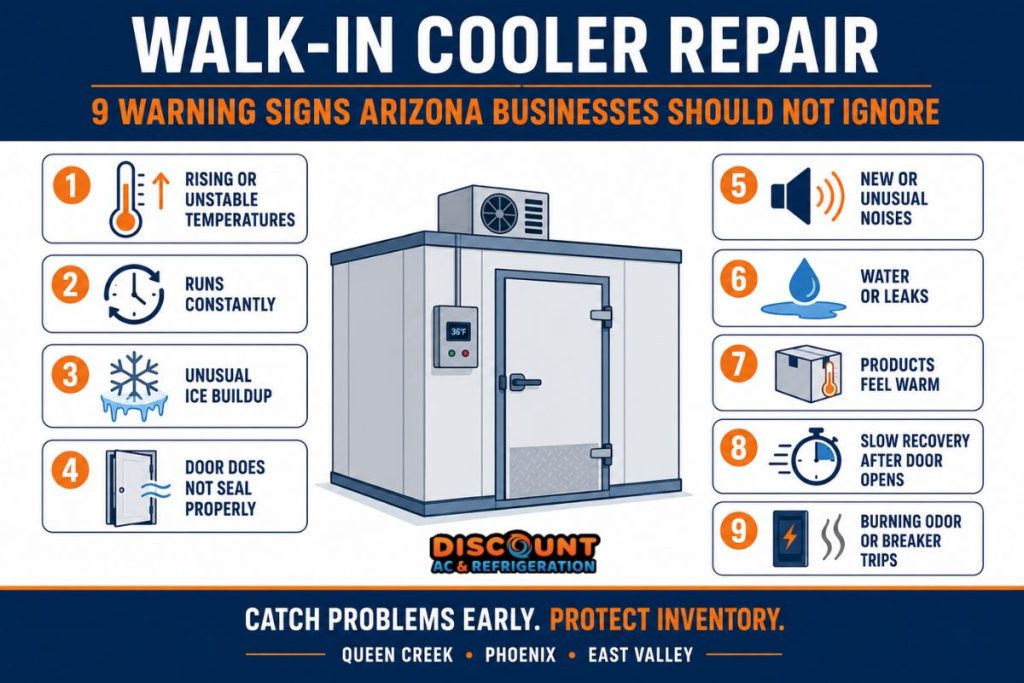
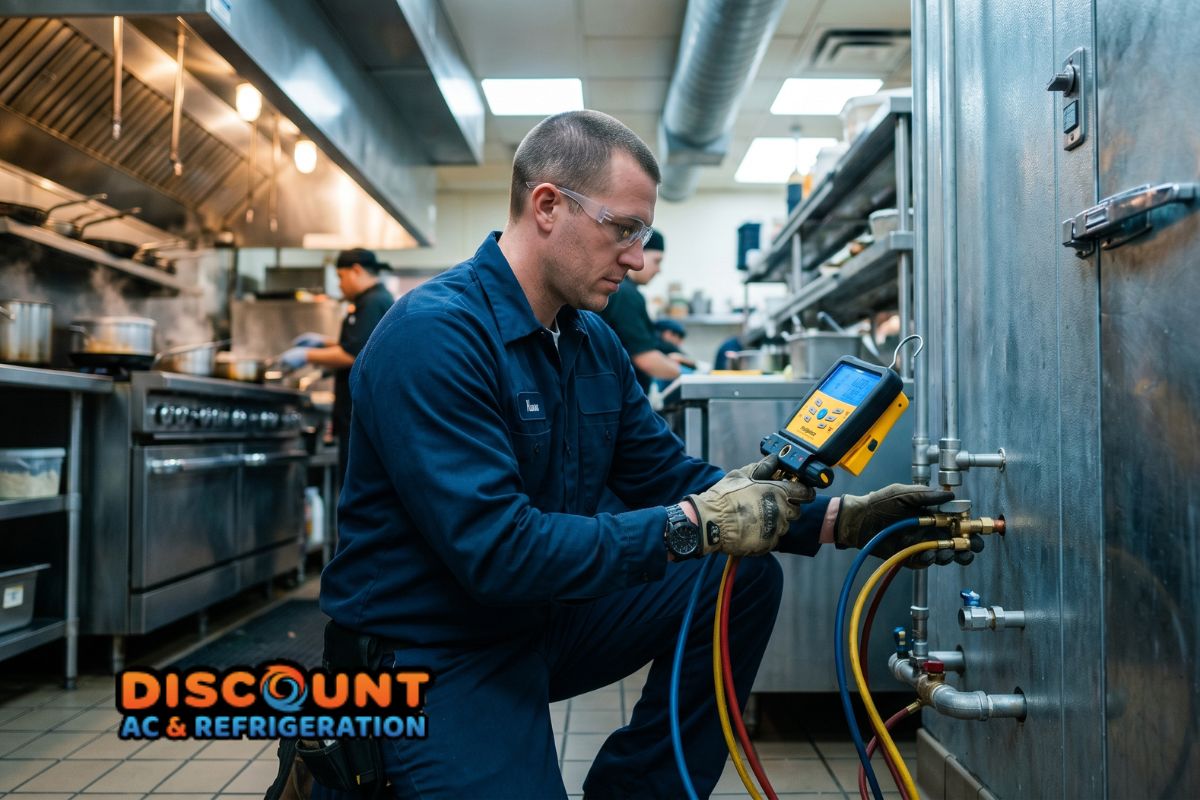
Root cause: Commercial kitchen thermodynamics directly controls whether your refrigeration keeps food safe, your HVAC keeps staff productive, and your energy bills stay manageable — especially when Phoenix-area summers push outdoor temps past 115°F and your kitchen equipment is already adding thousands of BTUs per hour to the mix.
If your walk-in cooler keeps tripping out, your kitchen feels like a sauna even with the AC running, or your utility bills spike every summer, heat transfer is the culprit. Understanding how heat moves through your commercial kitchen isn’t just a physics lesson — it’s the key to protecting your equipment, your food inventory, and your bottom line. Read this guide to learn what’s really happening behind your walls and how to fix it before the next breakdown.
What Is Commercial Kitchen Thermodynamics — and Why Should You Care?
Thermodynamics is the science of how heat energy moves between objects and spaces. In a commercial kitchen, this plays out every minute of every shift. You have high-output cooking equipment — fryers, grills, steamers, ovens — constantly generating heat. At the same time, your refrigeration and HVAC systems are working to remove that heat and maintain safe temperatures for both food and staff.
When these forces are in balance, your kitchen runs efficiently. When they’re not, you get cascading failures: refrigeration compressors overwork and fail, ambient temps rise above the legal food safety threshold of 41°F for cold-hold items, and your HVAC struggles to keep the dining room below 75°F while the kitchen hits 100°F+.
For restaurants, breweries, and food production facilities across Gilbert, Mesa, Chandler, and the wider Phoenix East Valley, this problem is magnified by the desert climate. Our licensed HVAC technicians at Discount AC & Refrigeration have seen exactly how Arizona heat stacks the odds against commercial kitchen systems. Here’s what you need to know.
The Three Ways Heat Moves in a Commercial Kitchen
1. Conduction — Direct Contact Heat Transfer
Conduction is heat moving through direct physical contact between solid surfaces. In your kitchen, this means:
- Heat moving from a hot grill surface into the surrounding metal frame
- Heat from a fryer transferring into the countertop it sits on
- Warmth from hot pipes radiating through the walls into adjacent cooler space
Why it matters for refrigeration: If your walk-in cooler shares a wall with a high-heat cooking station and that wall isn’t properly insulated, conductive heat gain forces the refrigeration compressor to run longer cycles to compensate. Over time, this leads to premature compressor failure — one of the most expensive commercial refrigeration repairs we handle.
Fix it: Ensure proper thermal insulation (R-25 or better for walk-in cooler walls) between high-heat zones and cold storage. Verify door seals are intact — a worn gasket is a direct conduction path into the cooler.
2. Convection — Heat Movement Through Air
Convection is the engine that drives most HVAC work. Hot air is less dense and rises; cooler air sinks. In a commercial kitchen:
- Cooking equipment produces hot air that rises toward the ceiling and exhaust hoods
- If makeup air is insufficient, negative pressure develops — your kitchen becomes a low-pressure zone that pulls hot outdoor air in through any gap
- Poor airflow means hot spots develop in cooler corners, around reach-in units, and near refrigeration condenser coils
Why it matters for HVAC: Condenser coils on reach-in refrigerators need ambient air to reject heat. If your kitchen stays above 90°F due to poor convective airflow, the condenser can’t do its job — head pressure spikes, refrigerant backs up, and the system loses capacity. This is the single most common reason restaurant owners in the East Valley call us for commercial HVAC service in July and August.
Fix it: Commission an airflow audit. Exhaust hood CFM should be matched with makeup air CFM within 10–15%. If your kitchen makeup air unit is undersized or broken, your entire cooling and ventilation system is fighting itself. Our team can evaluate this as part of a preventive maintenance inspection.
3. Radiation — Heat Emitted as Infrared Energy
Radiation doesn’t need air or physical contact — it travels as electromagnetic energy directly from hot surfaces to cooler ones. Every piece of cooking equipment radiates infrared heat:
- A commercial oven at 450°F radiates heat in all directions, warming nearby walls, equipment, and staff
- The condenser coil on your reach-in refrigerator radiates heat into the surrounding kitchen air
- In Arizona summers, the roof and exterior walls of your building absorb solar radiation and re-radiate that heat inward
Why it matters: Radiant heat is the hardest to manage with HVAC alone. The solution lies in equipment placement, reflective insulation, and strategic exhaust positioning — all of which should be part of any commercial kitchen design or renovation.
How Arizona Heat Amplifies Every Thermodynamic Problem
Kitchens in Phoenix-area markets face a multiplier effect that operators in cooler climates simply don’t deal with. When outdoor temps hit 110–115°F:
- Your HVAC system’s condenser — typically located on the roof — is rejecting heat into air that’s already 115°F, instead of the 95°F design temperature most equipment is rated for. This dramatically reduces system capacity.
- Your walk-in cooler is fighting a larger delta-T (temperature difference between outside and inside), which means the compressor runs harder, longer cycles, and at elevated head pressure — reducing its lifespan.
- Kitchen staff heat stress becomes a real operational and liability concern. OSHA guidelines recommend keeping kitchen ambient temperatures below 90°F where feasible.
- Grease in exhaust ductwork can approach ignition temperatures faster, increasing fire risk.
This is why AC repair in Gilbert and nearby areas during summer requires more than a standard equipment check — it requires an understanding of how the local climate interacts with the building’s thermal envelope and the kitchen’s heat load.
Quick Diagnosis: Is Your Kitchen Heat Management Working?
| Symptom | Root Cause | Recommended Action |
|---|---|---|
| Walk-in cooler running constantly, not holding temp | High ambient temp overloading condenser coil | Check coil airflow; inspect refrigerant charge; verify insulation R-value |
| Kitchen over 95°F even with AC running | Makeup air deficiency causing negative pressure | Commission airflow/CFM audit; rebalance exhaust hood vs. makeup air |
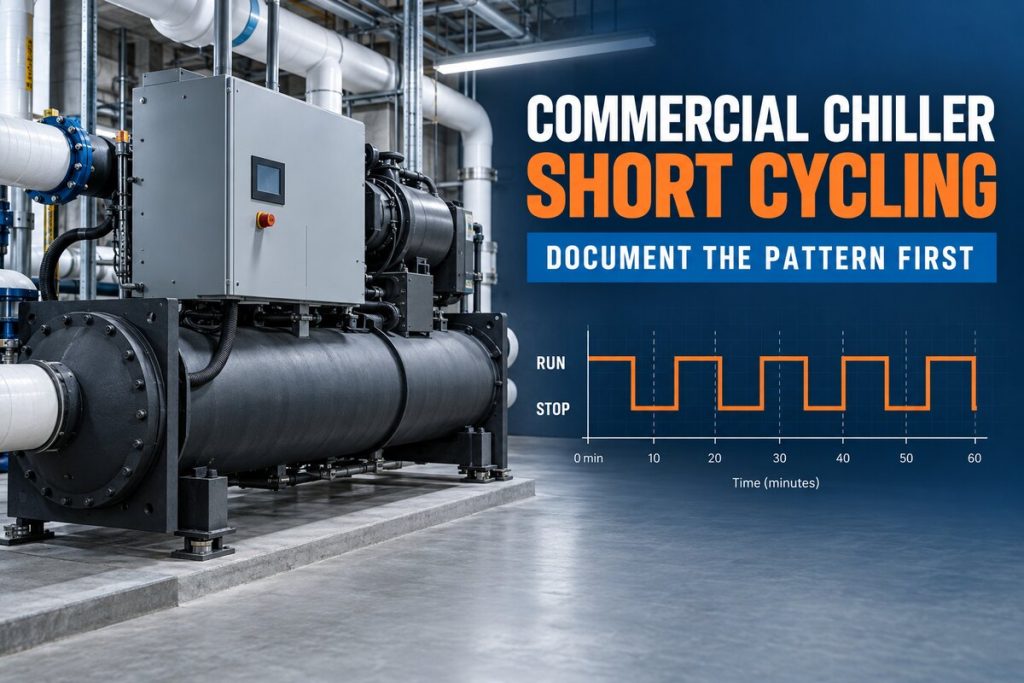
| Reach-in compressor short-cycling | Head pressure spike from radiant kitchen heat | Relocate unit; improve ventilation around condenser; check ambient temp rating |
| Ice machine producing small or hollow cubes | Ambient/water temps exceeding design spec | Inspect condenser coil; check water supply temp; improve ventilation clearance |
Commercial Refrigeration Under Extreme Heat Loads
Refrigeration equipment has manufacturer-specified operating conditions; check the exact model instead of assuming one ambient-temperature limit fits all reach-ins and walk-ins. The ASHRAE Refrigeration Handbook is a technical reference for refrigeration systems and applications. Excess heat around equipment can affect performance in several ways:
- Compressor discharge temperature rises above safe operating limits (typically 225°F max). At 250°F+, compressor oil breaks down and bearing wear accelerates.
- Refrigerant head pressure climbs — on an R-404A system, every 10°F rise in ambient adds roughly 8–12 PSI of head pressure, reducing capacity.
- Defrost cycles become less effective because the warm kitchen air immediately re-introduces moisture and heat when the cooler door is opened.
The solution isn’t always a bigger refrigeration unit. Often, the fix is addressing the thermodynamic environment: cooling the mechanical room, redirecting condenser airflow, improving insulation, or repositioning equipment. Our licensed technicians — with over 20 years of experience in AC and refrigeration for homes and businesses — diagnose at the system level, not just the component level.
Clients across Arizona — including breweries, restaurants, and indoor grow facilities — rely on Discount AC & Refrigeration to keep mission-critical cooling running. Check our Google reviews to see what local operators say about our response times and diagnostic accuracy.
The Role of HVAC in Controlling Kitchen Thermodynamics
A commercial kitchen HVAC system has a dual mission: remove heat produced inside, and keep conditioned air from being overwhelmed by the loads described above. Key principles:
- Exhaust hood design — Per ASHRAE 154 standards, exhaust hoods should be sized to capture the cooking plume completely. Under-capture means unconditioned heat and combustion byproducts recirculate into the space.
- Makeup air units (MAUs) — Must deliver tempered (70–75°F) air to replace exhausted air. Untempered or insufficient makeup air is the #1 cause of kitchen HVAC failure.
- Economizer cycles — In Phoenix, economizer cycles (using outdoor air for “free cooling”) are viable only during evenings and winter months. During summer, outdoor air at 110°F makes economizer operation counterproductive.
- Refrigerant type — With EPA’s phasedown of high-GWP refrigerants under AIM Act regulations, commercial systems are transitioning to R-454B and R-32 refrigerants. Our team is certified to work with both legacy and new refrigerant systems.
If your current system is struggling and you’re wondering whether repair or replacement is the better financial call, review AC replacement cost estimates for Gilbert-area businesses to understand the numbers before making a decision.
Professional Evaluation and Licensing
Managing commercial kitchen thermodynamics isn’t a DIY project — it requires licensed HVAC and refrigeration professionals who understand the interplay between systems. In Arizona, all commercial HVAC and refrigeration work must be performed by ROC-licensed contractors.
Discount AC & Refrigeration holds Arizona ROC License 361623 and carries full liability and workers’ compensation coverage. Our technicians are EPA Section 608 certified for refrigerant handling on all system types (Type I, II, and III). When we evaluate your commercial kitchen, we assess:
- Exhaust and makeup air CFM balance
- Refrigeration ambient operating conditions
- Condenser coil condition and airflow clearance
- Insulation R-values on cold storage surfaces
- Refrigerant charge and system pressures
We serve restaurants, commercial kitchens, and food service facilities across Gilbert, Mesa, Chandler, Queen Creek, Tempe, and Apache Junction. Contact our team to schedule a commercial kitchen thermal assessment.
Don’t Let Heat Win — Protect Your Kitchen Before the Next Breakdown
Understanding commercial kitchen thermodynamics gives you the diagnostic language to catch problems early and explain symptoms clearly to your service team. But knowledge alone doesn’t replace a licensed technician with refrigerant gauges, airflow meters, and thermal imaging equipment.
If your kitchen equipment is running hot, your utility bills are climbing, or your refrigeration can’t hold temperature through a Friday dinner rush — that’s not a normal Arizona summer. That’s a system telling you it’s close to failure.
Discount AC & Refrigeration is available 6:00 AM to Midnight, 7 days a week for both scheduled service and 24/7 emergency AC and refrigeration repair. Call us at (480) 478-2616 for a commercial kitchen evaluation. We’ll give you an honest diagnosis — no upsells, no pressure — backed by Arizona ROC License 361623.
What is commercial kitchen thermodynamics?
It’s the science of how heat moves through your kitchen — via conduction (direct contact), convection (airflow), and radiation (infrared energy). Understanding these three forces helps you predict and prevent equipment failures before they happen. Our team at Discount AC & Refrigeration uses this knowledge on every commercial service call.
Why does my walk-in cooler keep tripping out in summer?
In Arizona’s 110–115°F summers, your cooler’s condenser coil is rejecting heat into air far above its design rating. This causes head pressure overload and compressor trips. Call us at (480) 478-2616 for a same-day evaluation.
How hot is too hot for commercial kitchen refrigeration equipment?
Most commercial units are rated for ambient temperatures between 55°F and 90°F. When your kitchen regularly exceeds 90°F, compressor discharge temps rise above safe limits. Learn more about our commercial refrigeration services.
What causes negative pressure in a commercial kitchen?
Negative pressure occurs when your exhaust hood removes more air than your makeup air unit replaces, pulling hot outdoor air in. An airflow audit is part of our commercial preventive maintenance program.
How much does a commercial kitchen thermal assessment cost?
Assessment costs vary by facility size and system complexity. We provide transparent, honest estimates before any work begins. For Gilbert-area businesses, review AC replacement cost estimates in Gilbert if your current system needs to be replaced.
Are you available for emergency refrigeration repair at night?
Yes — 6:00 AM to Midnight, 7 days a week. If your walk-in cooler fails during a Friday dinner rush, call us immediately at (480) 478-2616. We also offer 24/7 emergency AC repair.
Does my restaurant’s HVAC system affect my refrigeration performance?
Absolutely. HVAC and refrigeration are thermodynamically linked. If your HVAC can’t maintain ambient temperature below 90°F, your refrigeration pays the price. Contact us to schedule a joint assessment.
How do I know if Discount AC & Refrigeration is the right company?
We hold Arizona ROC License 361623 and have over 20 years of experience serving restaurants, breweries, and food production facilities. Read what local operators say on our verified Google profile.
Is Your Commercial Kitchen Losing the Battle Against Heat?
Our licensed HVAC and refrigeration technicians serve Gilbert, Mesa, Chandler, and the entire Phoenix East Valley — available 6:00 AM to Midnight, 7 days a week. Call now for an honest kitchen thermal assessment. ROC 361623.