If your air conditioner is over 10 years old and struggling to keep up with Phoenix summers, the answer is probably sooner than you think. The combination of extreme heat, hard water, and relentless dust accelerates equipment wear in ways that national averages don’t capture. Knowing when to stop repairing and start replacing saves Phoenix homeowners thousands of dollars and prevents the worst-case scenario — a complete system failure on a 115°F day in July.
This guide covers the seven clearest signs that your AC unit in Phoenix has reached the end of its useful life, what Arizona-specific conditions make replacement more urgent here than in other states, and what to expect from a professional AC installation in Phoenix when the time comes.
Written by Raúl Rojas — EPA-Certified HVAC Technician, ROC #361623, 20+ years serving Phoenix metro homes and businesses.
How Phoenix Heat Changes the Replacement Equation
An air conditioner that lasts 15–18 years in Chicago or Seattle will typically last 10–13 years in Phoenix under the same maintenance schedule. This isn’t a manufacturer defect — it’s physics. When your system runs against 110°F ambient temperatures for 5–6 months per year, every mechanical component accumulates wear at a faster rate.
Compressors run at maximum load for extended periods rather than cycling on and off efficiently. Capacitors degrade from heat cycling. Refrigerant fittings expand and contract under extreme daily temperature swings, developing slow leaks over time. Our residential service team sees this pattern consistently — Phoenix AC units that receive regular maintenance still reach a point of diminishing returns earlier than comparable equipment elsewhere.
Sign 1: Your AC Is 10–12 Years Old and Repairs Are Getting Frequent
Age alone isn’t a reason to replace — but age combined with increasing repair frequency is. If your system is 10 years or older and you’ve had two or more service calls in the past two years, you’re likely entering the replacement zone.
The math is straightforward: if annual repair costs are adding up to 50% or more of the price of a new system, you’re spending money on borrowed time. A new high-efficiency system also brings lower monthly utility bills — often enough to offset a significant portion of the replacement cost over 3–5 years in a Phoenix home that runs AC year-round.
Sign 2: The System Can’t Hold Temperature During Peak Summer Heat
Phoenix summer afternoons stress every AC system. But a system in good working order should be able to maintain its set temperature even on 115°F days. If your system runs constantly during peak afternoon heat and still can’t hold temperature — with the thermostat set at 78°F or above — that’s a meaningful performance signal.
This symptom typically points to a compressor that has lost capacity, a refrigerant system that can’t maintain proper operating pressures, or both. Reach out to our Phoenix HVAC team for a diagnostic — a capacity test will tell you whether repair is still an option or whether replacement is the right call.
Sign 3: Your Energy Bills Have Been Climbing Without an Obvious Cause
A well-maintained AC system should produce consistent efficiency year over year. Gradual increases in your summer electric bill — when usage patterns haven’t changed significantly — are a sign that the system is working harder to produce the same cooling. Before you assume you need a new system, have a technician verify refrigerant charge and coil condition. But if those check out and bills are still trending up year over year, the compressor is the likely cause — and a new high-SEER2 system will recover much of that cost in utility savings.
Sign 4: The Compressor Is Failing or Has Already Failed
A failed compressor is the clearest replacement decision point. Replacing a compressor on a system that is 8 years or older in Phoenix rarely makes financial sense — you’re investing $1,500–$2,500 in a single component on a system where other components are approaching the same thermal fatigue threshold. Signs the compressor is failing: the unit runs but air is only slightly cooler than ambient, you hear grinding on startup, or the system trips on high-pressure lockout repeatedly.
Sign 5: R-22 Refrigerant System
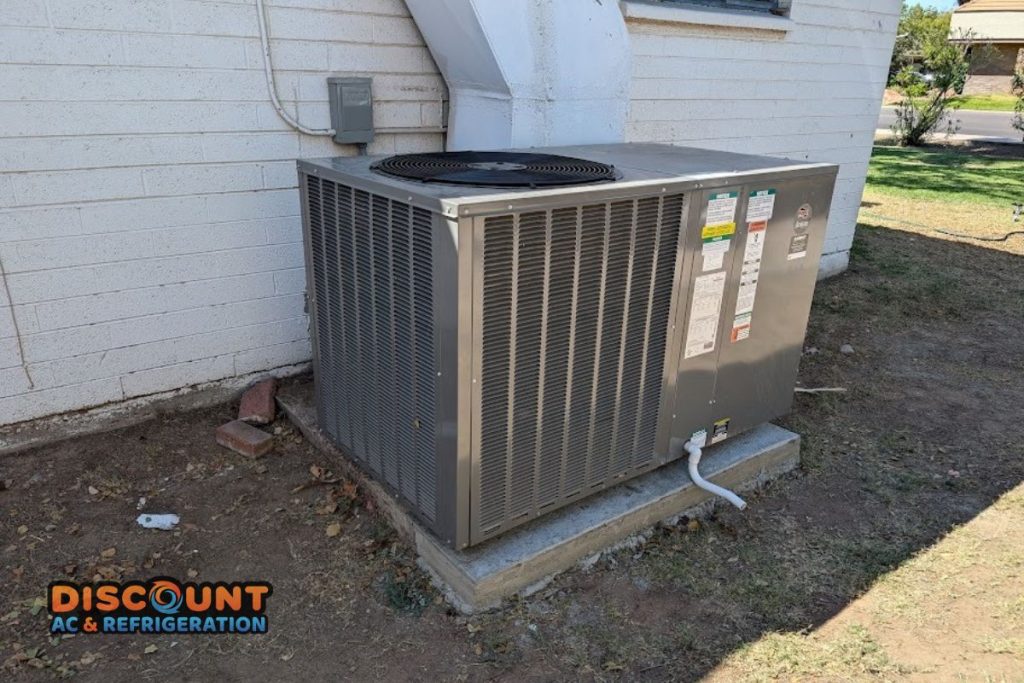
If your system was installed before 2010, there is a meaningful chance it runs on R-22 refrigerant, which was phased out federally in 2020. R-22 is no longer manufactured and existing supplies are limited, making it extremely expensive to recharge — often $100 per pound or more. You can verify this on the data plate on your outdoor unit. If it lists R-22, R22, or HCFC-22, any refrigerant service will cost significantly more than on a modern system. A new AC installation brings you onto current refrigerant systems with available supply and reasonable service costs.
Sign 6: Repeated Refrigerant Leaks
A single refrigerant leak repaired properly should be a one-time event. If you’ve had refrigerant added twice in three years, the system has a structural leak problem — typically in the evaporator coil or at fitting connections that have fatigued from repeated thermal cycling. In Phoenix, the daily temperature differential creates more expansion-contraction cycles per year than milder climates, and refrigerant joints on older systems reach fatigue failure faster here.
Sign 7: Uneven Cooling Across Your Home
Significant temperature variation between rooms — more than 3–4°F between the thermostat location and the farthest room — can indicate duct problems or a system that has lost the capacity to maintain even distribution. If duct inspection rules out blockages and leaks, and your system still struggles on moderate days (below 100°F), you’re looking at a capacity issue that a properly sized replacement will resolve. Our team serves homeowners in Gilbert, Scottsdale, Peoria, and throughout the Valley with properly sized replacement systems.
AC Repair vs. Replacement: Decision Guide for Phoenix Homeowners
| Warning Sign | System Age | Recommendation | Priority |
|---|---|---|---|
| Compressor failure | 8+ years | Replace system | Urgent |
| R-22 refrigerant system | Any age | Replace — R-22 unavailable at reasonable cost | Urgent |
| Repeated refrigerant leaks (2+ in 3 years) | 6+ years | Replace — structural leak failure | High |
| Can’t hold temp on 110°F+ days | 10+ years | Replace — capacity degraded | High |
| 2+ repairs in 2 years | 10+ years | Evaluate repair vs replace cost | High |
| Electric bills rising year over year | 8+ years | Diagnostic first; likely replace | Moderate |
| Uneven cooling between rooms | Any | Duct check first; replace if capacity issue | Moderate |
| System age 10-12 years, runs fine | 10-12 years | Plan for replacement within 1-2 years | Plan Ahead |
What a New System Actually Costs in Phoenix — and What You Get
Modern HVAC systems installed in the Phoenix metro typically range from $6,500–$14,000 depending on system size, efficiency tier, and whether ductwork modifications are needed. High-efficiency systems (18–21 SEER2) carry a premium but can reduce cooling costs by 30–40% compared to a 10-year-old 13–14 SEER system.
Arizona also has utility rebates available through APS and SRP for qualifying high-efficiency equipment. Our team handles the documentation for these as part of the installation process. The combination of rebates, lower monthly bills, and elimination of ongoing repair costs typically makes the investment picture clearer than most homeowners expect.
If replacement is the next step, review what affects AC replacement cost in Phoenix and confirm the work included in your written quote.
Ready to Know for Certain? Start With a Diagnostic
If you’re seeing two or more of these signs, a professional diagnostic is the right first step. Our Phoenix residential HVAC team will give you a clear assessment: what’s wrong, whether repair is viable, and what replacement would cost. We don’t push replacements on systems that still have useful life left — and we don’t recommend repairs on systems that are going to cost you more money to keep running.
For homeowners in Gilbert, Glendale, Apache Junction, and across the Phoenix metro, call 480 478-2616. We’re available from 6 AM to midnight, seven days a week — including weekends, when most system failures actually happen.
Frequently Asked Questions
Answered by Discount AC & Refrigeration — EPA Certified · ROC #361623 · Phoenix, AZ