Root cause: how AC controls humidity comes down to the evaporator coil — a cold surface that pulls moisture from warm indoor air through condensation. When that process fails, your home or business feels muggy even with the thermostat at 72°F.
If your space feels sticky and clammy despite your AC running all day, you’re not alone. In Arizona’s extreme summer heat — where temperatures regularly hit 110–115°F and monsoon season drives indoor humidity through the roof — a properly functioning air conditioner does far more than cool the air. It actively removes moisture, protecting your comfort, your health, and your energy bill.
Understanding how your AC handles humidity is the first step toward catching problems early and making smart decisions about maintenance. Whether you’re a homeowner in Gilbert or a restaurant manager running a commercial kitchen in the East Valley, this guide breaks down the science in plain terms so you can act before the problem gets expensive.
How AC Controls Humidity: The Physics in Plain Terms
Your air conditioner controls humidity through a process called latent heat transfer. Here’s what happens step by step:
- Warm, humid air is pulled through the return vent and passes across the evaporator coil.
- The evaporator coil runs cold — typically between 35–45°F — because refrigerant is actively absorbing heat inside it.
- Moisture in the warm air condenses on the coil surface, just like water beads on a cold glass on a humid day.
- That condensed water drips into a drain pan and exits through a condensate drain line.
- The now-cooler, drier air is pushed back into your space by the blower fan.
This is the core of dehumidification: your AC doesn’t “filter” humidity — it physically causes water vapor to condense and drain out of the system. The colder and longer the evaporator coil runs, the more moisture it extracts. According to ASHRAE, indoor relative humidity should stay between 30–60% for optimal comfort and air quality. Drop below that in Arizona’s dry months and your skin dries out; go above it during monsoon season and your AC is fighting a losing battle if it isn’t in top shape.
Why Arizona Makes Humidity Control So Much Harder
In most of the country, humidity is a year-round concern. In the Phoenix East Valley, it arrives in two distinct phases that put unusual strain on HVAC systems:
- April–June (Dry heat): Relative humidity can drop below 10%. Your AC doesn’t need to work hard on dehumidification — but your evaporator coil, blower motor, and ductwork are still taking a beating from 110°F+ ambient temperatures.
- July–September (Monsoon season): Relative humidity can spike to 50–70% during storm events, flooding the air with moisture your system must process rapidly.
This seasonal swing is why we’ve seen otherwise well-functioning AC units leave homeowners sweating in their own living rooms during July. Evaporator coils that are dirty, undersized, or approaching end-of-life can’t keep pace with the sudden moisture load — and you’ll feel it as that muggy, clammy sensation even with a 75°F setpoint.
Our licensed HVAC technicians at Discount AC & Refrigeration have over 20 years of experience working through Arizona summers across Gilbert, Mesa, Chandler, and the broader East Valley. Getting ahead of humidity problems with commercial HVAC preventive maintenance or a residential tune-up before monsoon season arrives is always the smarter move than reacting to a failure in 115°F heat.
Signs Your AC Is Losing Its Humidity Control
Before your evaporator coil or drainage system fails completely, it usually sends signals. Watch for:
- Sticky or muggy feeling indoors even when the AC is running and the thermostat shows the target temperature
- Condensation on windows or walls, especially in bathrooms, kitchens, or near exterior doors
- Musty or mildew odor from vents — biofilm forming on a wet, underperforming coil
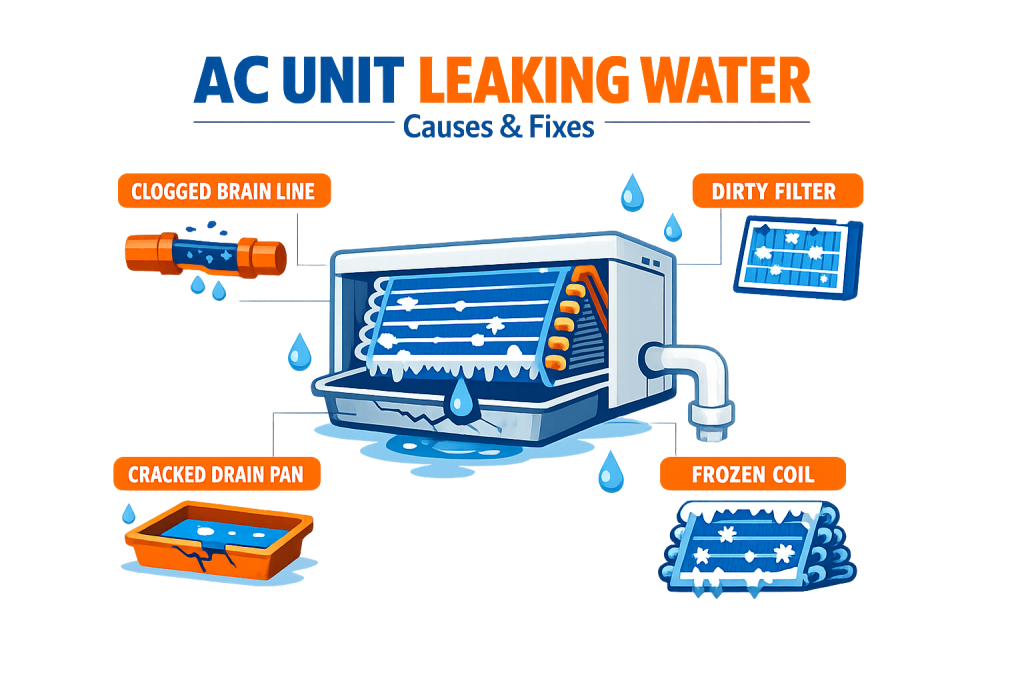
- Water pooling around the indoor unit — a clogged condensate drain line is often the culprit
- AC running constantly without achieving the set temperature or dryness level
- Worsening allergies or respiratory irritation indoors — excess humidity feeds mold and dust mites
If you’re noticing any of these in your Gilbert home or East Valley business, a diagnostic call now is far cheaper than emergency service later. Our team offers 24/7 emergency AC repair when humidity control fails at the worst possible moment.
AC Humidity Problem Troubleshooting Guide
| Symptom | Most Likely Cause | DIY Check | Tech Needed? |
|---|---|---|---|
| Muggy air with AC running | Dirty or frozen evaporator coil | Check & replace air filter | Yes — coil cleaning |
| Water pooling near indoor unit | Clogged condensate drain | Check drain pan for overflow | Yes — drain flush |
| Musty smell from vents | Mold/biofilm on evaporator coil | None — avoid household sprays | Yes — coil treatment |
| AC runs constantly, never reaches setpoint | Low refrigerant or oversized unit | Verify thermostat settings | Yes — refrigerant test |
| High humidity only during monsoon | Aging coil losing surface efficiency | None | Yes — inspection |
| Condensation on walls and windows | Inadequate dehumidification capacity | Check window/door seals | Yes — load evaluation |
The Role of Refrigerant in Humidity Removal
Refrigerant is the working fluid that makes dehumidification physically possible. It cycles between liquid and gas states inside your system, absorbing and releasing heat at precisely calibrated pressures and temperatures.
When refrigerant charge is correct, the evaporator coil holds the cold surface temperature (35–45°F) needed to condense moisture from passing air. When refrigerant is low due to a slow leak, the coil runs warmer — sometimes 55–65°F — and loses much of its dehumidification capacity.
Here’s what makes this tricky for homeowners: a low refrigerant charge can feel exactly like a humidity problem, even if the thermostat temperature reads correctly. Many homeowners run the AC harder and longer trying to solve what is actually a refrigerant issue requiring an EPA-certified technician to diagnose and repair.
Under EPA Section 608 regulations, refrigerant handling must be performed by certified technicians. Our team at Discount AC & Refrigeration carries the proper equipment to detect leaks, recover refrigerant safely, and recharge systems to manufacturer spec.
How AC Sizing Directly Affects Humidity Control
One of the most common — and most misunderstood — causes of poor humidity control is an oversized AC unit. An oversized system short-cycles: it pulls the air temperature down quickly and shuts off before the coil has run long enough to extract adequate moisture.
The result is a home at 72°F that still feels like 78°F because relative humidity is at 65% instead of 45%. Short-cycling also causes accelerated wear on compressor components, increasing long-term repair costs.
ENERGY STAR and the U.S. Department of Energy both recommend that AC systems be sized using Manual J load calculations, which account for square footage and ceiling height, insulation quality, window area and sun exposure, local climate data (critical for Arizona’s extreme heat load), and number of occupants and heat-generating appliances.
If you’re considering a new installation or wondering whether your current AC is properly sized, our team provides honest evaluations without pressure. Review our AC replacement cost estimates in Gilbert to understand what a correctly sized upgrade would involve before making any decisions.
Commercial Operations: Where Humidity Stakes Are Higher
For restaurants, breweries, indoor grow facilities, and commercial kitchens, humidity control isn’t just about comfort — it’s about food safety, equipment longevity, and regulatory compliance.
A commercial space with chronically high ambient humidity creates conditions for accelerated bacterial growth on food contact surfaces, condensation damage to electrical systems and refrigeration components, ice buildup inside refrigeration units that reduces efficiency and drives up energy costs, and premature deterioration of flooring and wall surfaces.
Many well-known local businesses across Arizona rely on Discount AC & Refrigeration to keep both their commercial HVAC systems and commercial refrigeration equipment operating within proper humidity parameters. Scheduled preventive maintenance is consistently the most cost-effective way to stay ahead of humidity-related failures before they interrupt operations.
SEER2 and Variable-Speed Systems: Better Humidity Performance
Since January 2023, the U.S. Department of Energy’s regional efficiency standards replaced the old SEER benchmark, setting higher minimum efficiency thresholds for new HVAC equipment sold in the Southwest.
Beyond energy savings, higher-SEER2 systems offer a meaningful advantage for humidity control: variable-speed compressors and blower motors. Unlike single-stage systems that run at 100% or off, variable-speed equipment can operate at lower capacity for longer periods — ideal for extended dehumidification cycles during Arizona’s monsoon season, when you need sustained coil run time more than raw cooling power.
If your system is 10 or more years old and consistently struggles with humidity, the case for replacement may include both efficiency savings and dramatically improved moisture management. Our team is available at (480) 478-2616 from 6 AM to Midnight, 7 days a week to walk you through the comparison honestly.
Is Your AC Actually Controlling Humidity in Gilbert? Let’s Find Out.
Arizona’s monsoon season is coming, and your HVAC system needs to be ready. If your home or business feels muggy or clammy despite a running AC, the issue may be your dehumidification system rather than the thermostat — and it won’t fix itself before July arrives.
Our licensed HVAC technicians at Discount AC & Refrigeration (ROC 361623) are available 6 AM to Midnight, 7 days a week across Gilbert and the entire East Valley. We diagnose the root cause and give you a straight answer — no pressure, no upselling.
Check what our customers are saying on our Google profile, then call (480) 478-2616 or contact us online to schedule your inspection. For local service details, visit our AC repair page for Gilbert and nearby areas.
Don’t wait for a humidity emergency in 115°F heat. Get ahead of it now.
What is the ideal indoor humidity level for an Arizona home?
ASHRAE recommends keeping indoor relative humidity between 30–60%. In Arizona, the target during summer is 40–50%. If you’re consistently above 60%, your system likely needs a diagnostic. Call us at (480) 478-2616 for an honest assessment.
Why does my house feel humid even though my AC is running?
The most common reasons are a dirty evaporator coil, a clogged condensate drain, low refrigerant charge, or an oversized unit that short-cycles. If replacing the air filter doesn’t help within a day, our team handles emergency AC diagnostics across Gilbert and the East Valley.
Can a dirty air filter cause humidity problems?
Yes — a clogged filter restricts airflow across the evaporator coil, causing it to freeze over. A frozen coil can’t condense moisture properly. In Arizona’s dusty desert climate, filters clog faster than the national average. Check your filter monthly and replace every 30–60 days during summer.
How does Arizona’s monsoon season affect my AC’s humidity control?
During monsoon events, relative humidity in the Phoenix East Valley can spike from under 15% to 60–70% in hours. Getting a pre-monsoon maintenance service done before July is the most effective way to prepare your system.
What is short-cycling and how does it affect indoor humidity?
Short-cycling happens when your AC is oversized — it cools the air quickly and shuts off before the evaporator coil has had enough run time to extract moisture. The result is a home at 72°F that feels 78°F because humidity is at 65% instead of 45%. This is one of the most misdiagnosed HVAC problems.
How often should I service my AC to maintain proper humidity control?
In Arizona, we recommend a full AC tune-up twice a year — before summer (March–April) and before winter (October–November). The pre-summer service should include evaporator coil inspection, condensate drain flush, and refrigerant check. Call (480) 478-2616 to schedule yours.
Can I add a whole-home dehumidifier to my existing AC system?
Yes — a whole-home dehumidifier integrates with your existing ductwork and HVAC system to provide dedicated moisture removal. It’s a cost-effective alternative to full AC replacement when your cooling capacity is adequate but dehumidification is falling short. Ask our team when you contact us for a consultation.
When should I consider replacing my AC for better humidity performance?
If your system is 10+ years old, uses R-22 refrigerant, and consistently fails to maintain comfortable humidity despite servicing, replacement is worth evaluating. Newer variable-speed SEER2 systems run at lower capacity for longer — far better for dehumidification. Review our AC replacement cost estimates for Gilbert to get started.
Is Your AC Losing Its Battle Against Humidity This Monsoon Season?
Our licensed HVAC technicians (ROC 361623) can pinpoint exactly why your home or business feels muggy — and fix it before Arizona’s hottest months arrive. Available 6 AM to Midnight, 7 days a week across Gilbert and the East Valley.