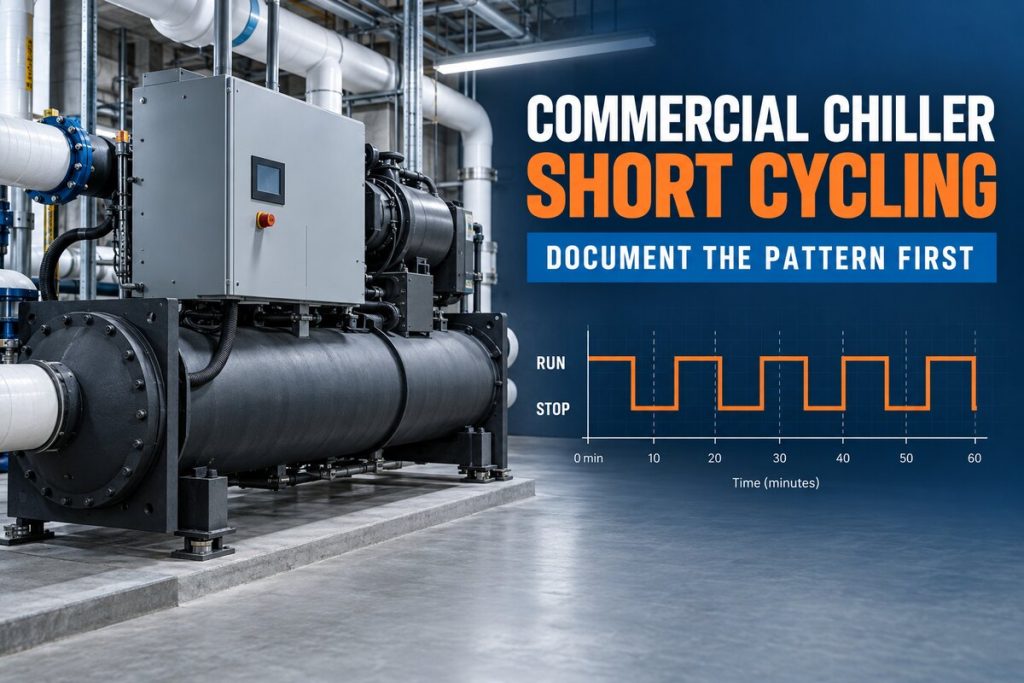
Short cycling occurs when a commercial HVAC compressor powers on and off repeatedly within minutes—instead of running steady 10-20 minute cycles. Root causes include dirty filters restricting airflow, refrigerant leaks reducing system pressure, oversized units cycling too frequently, faulty thermostats triggering false shutdowns, or failing electrical components like capacitors, contactors, and control boards. When compressors rapid-cycle in Phoenix’s 110-118°F heat, thermal stress accelerates wear, turning a diagnostic issue into compressor failure within weeks.
Why Short Cycling Matters: The Phoenix Commercial HVAC Challenge
Phoenix businesses operate HVAC systems harder than most of the country. Summer temperatures reach 115°F+, dust storms clog filters, and the 20-25°F daily swings stress mechanical and electrical components. When a commercial AC system begins short cycling—powering on and off every 3-5 minutes instead of running continuous cycles—your utility bills spike, compressor lifespan plummets, and equipment failure can strike without warning.
Short cycling is not a minor inconvenience. Each on-off cycle draws inrush current 3-7 times higher than steady-state operation, straining starters, capacitors, and contactors. Over 24-48 hours of short cycling, compressors overheat and internal bearings seize. In a commercial setting—a restaurant, data center, cold storage, or office building—that means unplanned downtime, spoiled inventory, or tenant complaints.
The challenge: short cycling symptoms (noise, rapid shutdowns, higher energy bills) are visible, but the cause (electrical, mechanical, or thermal) is hidden. A quick diagnosis separates a $500 fix from a $3,000+ compressor replacement.
What Is Short Cycling and How to Recognize It in Your Commercial System
Short cycling is when an HVAC compressor starts, runs for only 2-8 minutes, then shuts down—only to restart again within minutes. A healthy commercial system cycles every 12-20 minutes, holding steady runtime to maintain building temperature and humidity. Short cycling breaks that rhythm.
Common Signs of Short Cycling
- Rapid on-off sounds: Compressor restarts within 3-5 minutes; audible clicking or humming as the compressor tries to engage
- Inconsistent comfort: Building temperature bounces up and down; thermostat readings lag actual conditions
- Higher utility bills: Inrush current during startup consumes 300-700% more power than steady cooling; frequent starts = wasted energy
- Electrical stress signals: Breaker trips, flickering lights when AC compressor starts, or burnt smell near electrical components
- Refrigerant noise: Hissing from the outdoor unit or ice buildup on indoor evaporator coils (sign of pressure loss)
- Warm supply air: Compressor cycles off before cooling the airstream; return air remains warm
If you notice one or more of these, your system needs professional commercial HVAC diagnostic before the problem cascades into major repairs.
Root Cause 1: Dirty Filters and Airflow Restriction
The simplest—yet most overlooked—cause of commercial short cycling is restricted airflow from a clogged filter. When filters aren’t changed every 60-90 days (or more often in dusty Phoenix conditions), dust and debris build a barrier that forces the evaporator coil temperature to drop dangerously low.
Here’s the cycle: restricted airflow → evaporator coil gets too cold → system thermistor senses low temperature → safety shutdown activates → compressor stops. Five minutes later, coil warms slightly, thermostat re-engages, and the compressor restarts. Repeat endlessly.
In Phoenix’s high-dust environments, filters clog faster. Construction zones, agricultural areas, and even routine city dust require filter changes every 30-45 days during summer. Many building managers miss this, thinking “it’s only been a month.” But commercial HVAC systems handle 3-4x the airflow of residential units—clogs form rapidly.
The fix: Replace the filter. If short cycling stops immediately, you’ve identified the problem. Set up commercial HVAC maintenance schedules with quarterly inspections to prevent recurrence.
Root Cause 2: Refrigerant Leaks and Low System Pressure
Refrigerant is the lifeblood of HVAC cooling. When the system develops a leak—from vibration-cracked copper lines, failed sealants at solder joints, or corrosion from moisture in the oil—refrigerant escapes and system pressure drops. The compressor tries to maintain cooling but lacks sufficient refrigerant to compress; internal pressure sensors detect the shortfall and trigger safety shutdown.
The compressor cycles on every time pressure momentarily recovers, then off again when it realizes the refrigerant load is insufficient. This short-cycle pattern continues until refrigerant is completely depleted, at which point the compressor fails to start at all.
Refrigerant leaks are a serious concern in Phoenix because:
- Summer heat accelerates evaporation and joint corrosion
- Thermal expansion stresses copper lines; micro-cracks form where lines connect to compressors or evaporators
- Moisture from humid summer air dissolves in mineral oil, forming acids that corrode solder joints
Red flags: Ice on indoor coils, hissing near outdoor unit connections, or visible oil stains on copper piping all indicate refrigerant escape.
The fix: A licensed technician must locate the leak using UV dye tracer or pressure testing, seal the joint, evacuate the system (remove all moisture and air), and recharge with fresh refrigerant to factory specifications. This is not a DIY repair—EPA regulations require licensed certification to handle refrigerants. Contact Discount AC & Refrigeration for leak detection and repair.
Root Cause 3: Oversized HVAC Equipment and Over-Rapid Cycling
A commercial space oversized with an HVAC unit that’s too large for the building will cool too fast, causing the thermostat to sense target temperature and signal shutdown before the compressor reaches optimal runtime. The cycle: oversized equipment cools fast → thermostat hits setpoint (e.g., 72°F) → compressor off → temperature drifts up slightly → compressor restarts → repeat.
Oversizing happens when:
- Original system fails and a replacement unit is installed at the same capacity without room-load calculation
- Building was expanded or renovated, but HVAC was not resized
- Contractor installed a larger unit to “future-proof” the system, ignoring efficiency losses
Paradoxically, an oversized unit costs more to operate (more compressor power), cycles more frequently (wearing components faster), and provides worse humidity control (insufficient runtime to dehumidify in Phoenix’s 20-30% indoor humidity target).
The solution: Right-sizing the HVAC load requires a Manual J calculation—a room-by-room heat-gain assessment that considers building insulation, window orientation, occupancy, and Phoenix’s extreme heat. A properly sized unit runs longer, steadier cycles, preserves component life, and improves humidity control.
If oversizing is confirmed, you have two paths: replace the compressor/condenser with a smaller, correctly-sized unit, or add a variable-capacity compressor (VCA) that modulates output. Commercial AC installation in Phoenix experts can guide this decision.
Root Cause 4: Electrical Component Failure
Many short-cycling cases stem not from refrigerant or airflow, but from electrical components that have aged or failed. Phoenix’s heat accelerates degradation of capacitors, contactors, relays, and control boards—especially in outdoor units exposed to 115°F+ direct sun.
Common Electrical Culprits
Key Components to Inspect
- Capacitors: Store electrical charge to start the compressor motor. Aged or blown capacitors prevent smooth startup; the compressor tries to engage, fails, and resets. Lifespan: 3-8 years in Phoenix heat.
- Contactors: Electrical switches that connect power to the compressor. Worn or stuck contacts cause intermittent power loss, triggering short-cycle behavior.
- Run relay: Maintains power to the compressor motor after startup. Failure causes the compressor to stop mid-cycle.
- Control board (motherboard): Monitors temperature sensors, pressure switches, and thermostat signals. Burnt circuitry or software glitches cause erratic shutdowns.
- Pressure switches: Safety devices that shut down the compressor if discharge pressure is too high (discharge) or suction pressure too low (suction). A faulty switch misreads pressure, triggering false shutdowns.
- Thermistor (temperature sensor): Measures compressor discharge temperature. A faulty thermistor sends wrong temperature data to the control board, causing unwanted shutdowns.
Phoenix technicians routinely diagnose short cycling by voltage testing these components. A multimeter reveals capacitor capacitance, contactor coil resistance, and relay continuity—pinpointing which part has failed.
The fix depends on the part: Capacitors, contactors, relays, and pressure switches are field-replaceable, costing $150–$600 total. Control boards may be repaired (if a single component burned out) or replaced ($400–$1,200). Thermistors are inexpensive ($50–$150) but require evaporator unit access.
How Professional Technicians Diagnose Commercial HVAC Short Cycling
A proper diagnosis follows a logical path and rules out causes methodically. Here’s what a licensed technician checks:
Step 1: Visual and Aural Inspection
Observe the compressor. Does it start and stop repeatedly? Listen for contactor clicks (electrical engagement), hissing (refrigerant), or grinding (mechanical stress). Check outdoor unit for dirt, ice, or physical damage. Look at the indoor evaporator—is it frosted over (airflow or refrigerant issue)?
Step 2: Filter and Airflow Assessment
The technician measures static pressure across the filter and evaporator coil. Clean filters show 0.1–0.3 inches of water column (iwc); clogged filters exceed 0.5 iwc. Excessive pressure = immediate filter replacement. Coil ice indicates airflow restriction or refrigerant issue.
Step 3: Temperature and Pressure Readings
With gauges attached to the compressor suction and discharge ports, the technician reads refrigerant pressures. For example, in Phoenix summer, a healthy R-410A system might read 380 psig discharge, 120 psig suction. Short-cycling systems often show: discharge pressure dropping below 250 psig (leak or low charge), or suction pressure below 70 psig (low refrigerant). These readings confirm refrigerant issues.
Step 4: Electrical Component Testing
Using a digital multimeter and capacitor tester, the technician measures:
- Capacitor microfarads (µF) against nameplate spec
- Contactor and relay coil voltage and continuity
- Pressure switch trip points
- Thermistor resistance curves (should vary smoothly with temperature)
- Control board logic and safety relay sequencing
A failing capacitor might read 5 µF instead of 35 µF. A stuck contactor shows infinite resistance (open circuit). These results pinpoint the faulty component.
Step 5: System Log Review
Modern commercial HVAC systems log runtime, cycle frequency, and error codes. A technician downloads this data to see exactly when short cycling started, which safety shutdown occurred, and whether patterns match (e.g., “cycles off every 4 minutes at 2 PM when outdoor temp hits 115°F”).
This systematic approach ensures the technician identifies the root cause, not just a symptom. It also prevents “shotgun” repairs where technicians replace parts guessing what’s wrong.
Why Phoenix Businesses Trust Discount AC & Refrigeration for HVAC Diagnostics
Short cycling is a diagnostic puzzle. The symptom is obvious—rapid on-off cycles—but the cause could be electrical, mechanical, or thermal. A quick guess by an unlicensed technician often means paying twice: once for a band-aid repair, again for the real fix weeks later.
At Discount AC & Refrigeration, we’ve diagnosed and repaired commercial HVAC short cycling for 20+ years across Phoenix, Tucson, and statewide. Our licensed, EPA-certified technicians carry calibrated gauges, multimeters, thermometers, and pressure test equipment to isolate the root cause in one visit. We don’t guess. We test.
Our process:
- Same-day diagnostic: We identify the problem—whether dirty filter, refrigerant leak, electrical failure, or oversizing—before recommending repairs.
- Transparent pricing: You know the cost of repair before we start work. No surprises.
- Licensed and insured: All work meets EPA and Arizona licensing standards. Refrigerant work requires certification; we have it.
- Commercial expertise: We service restaurants, offices, data centers, cold storage, and warehouses across metro Phoenix. We understand downtime costs and commercial schedules.
- 24/7 availability: If short cycling strikes during dinner service or a heat wave, we’re available 6 AM–Midnight, 7 days a week.
Whether short cycling is caused by a $50 filter replacement or a $3,500 compressor swap, diagnosing it correctly saves money and prevents catastrophic failure.
Get a Professional HVAC Short Cycling Diagnosis
Don’t let short cycling drain your operating budget or risk equipment failure. Schedule a diagnostic with Discount AC & Refrigeration today.
Call: (480) 478-2616
Available 6 AM–Midnight, 7 days/week. Licensed • Insured • EPA-Certified.
Quick Diagnosis Table: Match Your Symptoms to the Likely Cause
| Symptom | Likely Cause | What a Pro Checks |
|---|---|---|
| Cycles off every 3-5 min; building warms up | Oversized equipment or low refrigerant | Manual J load calc; refrigerant pressures; suction line frost |
| Compressor hums but doesn’t start; contactor clicks repeatedly | Bad capacitor or contactor | Capacitor µF reading; contactor coil resistance; control board voltage |
| Ice on evaporator coil; hissing outdoor unit | Refrigerant leak | Pressure gauge reading; UV dye trace; leak detection |
| Compressor runs but discharge pressure too high; cycles off safety | Faulty discharge pressure switch or high head pressure | Pressure switch trip point; condenser airflow; control board logic |
| Filter is caked with dust; warm supply air | Restricted airflow | Static pressure across filter; ductwork blockage; evaporator frost |
| Thermostat doesn’t match actual building temp; erratic shutdowns | Faulty thermistor or control board | Thermistor resistance; control board error codes; sensor continuity |
| Discharge temperature above 170°F; compressor hot to touch | Low refrigerant or faulty thermistor shutting down compressor | Refrigerant charge; superheat calculation; compressor oil level |
Common Causes of Commercial HVAC Short Cycling: Detailed Reference Table
| Cause | What Happens | Component Affected | Fix Difficulty |
|---|---|---|---|
| Dirty Air Filter | Restricted airflow freezes evaporator coil; thermostat senses low temp and shuts down compressor | Evaporator coil thermistor | Easy (replace filter) |
| Refrigerant Leak | Low pressure triggers safety shutdown; compressor restarts when trace refrigerant pressure recovers | Copper lines, solder joints, compressor seals | Moderate (locate, seal, recharge) |
| Faulty Thermostat/Temperature Sensor | Incorrect temperature reading causes control board to shut compressor off prematurely | Thermistor, control board | Easy-Moderate (replace sensor or board logic) |
| Oversized Equipment | Unit cools space too fast; thermostat reaches setpoint before steady-state runtime achieved | Compressor, condenser, thermostatic expansion valve | Hard (replace compressor/condenser or resize) |
| Compressor Failure | Internal bearing wear, burnt windings, or oil degradation causes motor to overheat and shut down | Compressor motor, run capacitor | Hard (replace compressor, $2,500–$5,000) |
| Failing Capacitor or Contactor | Inadequate power delivery to compressor motor; inrush current insufficient for smooth start | Run capacitor, start capacitor, contactor coil | Easy-Moderate (replace component, $200–$600) |
| Frozen Evaporator Coil | Airflow block or refrigerant issue causes coil temp to drop below freezing; ice buildup triggers shutdown | Evaporator coil, expansion valve, refrigerant charge | Moderate (defrost coil, fix root cause) |
FAQ: Commercial HVAC Short Cycling
What exactly is HVAC short cycling?
Short cycling occurs when an HVAC compressor starts, runs for only 2-8 minutes, then shuts down—then restarts again within a few minutes. In contrast, a healthy system cycles every 12-20 minutes. Short cycling is a symptom of an underlying problem: dirty filters, refrigerant leaks, electrical failure, oversized equipment, or faulty thermostats. The rapid on-off pattern stresses compressors, uses excess energy, and can lead to compressor failure within weeks if left unchecked.
Can short cycling damage my commercial HVAC system?
Yes. Every compressor startup draws inrush current 3-7 times higher than normal operation, stressing the motor windings, capacitors, and electrical contacts. Over 24-48 hours of continuous short cycling, compressor bearings overheat and seize. In Phoenix’s extreme summer heat (110-118°F), thermal stress accelerates the damage. Additionally, short cycling prevents the evaporator coil from maintaining steady humidity control, and the frequent electrical surges can damage the control board and pressure switches. A $500 diagnostic and repair (e.g., capacitor replacement) now prevents a $3,000-$5,000 compressor replacement later.
What does a commercial HVAC short cycling repair typically cost?
Repair cost depends entirely on the root cause. A clogged filter costs $20-$50 to replace. A capacitor or contactor replacement runs $200-$600. A pressure switch or thermistor costs $150-$400. Refrigerant leak repair (finding the leak, sealing it, evacuating, and recharging) ranges $400-$1,200. A faulty control board replacement is $600-$1,500. If the compressor itself has failed, replacement costs $2,500-$5,000+ depending on unit size and system complexity. This is why professional diagnosis is critical—it identifies which component is actually faulty, allowing you to budget accurately.
How long does a professional short cycling diagnosis take?
A thorough diagnostic typically takes 45 minutes to 2 hours, depending on system complexity and accessibility. The technician will visually inspect the unit, measure pressures, test electrical components, and download system logs to pinpoint the cause. For simpler cases (e.g., obvious filter clogs or blown capacitors), diagnosis may be faster. For complex cases involving refrigerant leaks or control board failures, additional time may be needed. Contact us to schedule a diagnostic, and we’ll provide a time estimate based on your system type.
Can short cycling be prevented?
Yes, mostly through preventive maintenance. Change air filters every 30-60 days (more often in dusty Phoenix environments). Schedule quarterly inspections to catch electrical component wear before failure. Maintain refrigerant charge; a system shouldn’t lose refrigerant if sealed properly. Ensure the system is correctly sized for your space; oversizing causes inherent short cycling. Monitor discharge temperature and pressure trends; rising discharge temps signal compressor wear or low refrigerant. Proper commercial HVAC maintenance catches problems before they become emergencies.
When should I repair vs. replace my commercial HVAC system?
If short cycling is caused by a capacitor, contactor, filter, or pressure switch, repair is always the right choice—these components are inexpensive and easy to replace. If the compressor itself has failed (internal bearing damage, burnt windings, or loss of oil circulation), compressor replacement ($2,500-$5,000) is warranted if the rest of the system is still sound. If your system is over 15 years old, repeatedly needs repairs, and the compressor failure is confirmed, consider full replacement—newer systems are more efficient, quieter, and will have a full warranty. A licensed technician can advise whether repair or replacement makes economic sense for your business.
Can short cycling cause higher energy bills?
Short cycling dramatically increases your energy consumption and utility costs. The compressor repeatedly starts and stops instead of completing full cooling cycles, forcing it to work harder and consume more power. A commercial unit experiencing frequent short cycling can consume 10-15% more electricity than a system operating normally, translating to significant additional costs on your monthly energy bills.
How does Phoenix dust contribute to short cycling?
Phoenix’s desert environment delivers high concentrations of dust particles that accumulate on condenser coils and air filters. This dust buildup restricts airflow and forces the system to reach preset temperatures faster, triggering premature shutoff. Regular maintenance becomes essential in Phoenix climates to prevent dust-related short cycling, including monthly filter changes and quarterly condenser coil cleaning.
Does short cycling affect indoor air quality?
Short cycling compromises indoor air quality by interrupting the continuous circulation needed for effective air filtering and humidity control. Your HVAC system cycles too frequently to adequately filter contaminants and maintain consistent humidity levels, potentially affecting occupant comfort and health.
What is a normal HVAC cycle time in Phoenix?
A healthy commercial HVAC system in Phoenix should cycle every 12-20 minutes during moderate cooling demand. In extreme heat (115°F+), cycle times may shorten to 8-12 minutes as the compressor works harder. If you notice cycles shorter than 5 minutes repeatedly throughout the day, that signals short cycling and requires professional diagnosis.