A walk-in cooler in a Phoenix restaurant needs professional maintenance every 90 days — not once a year. Arizona’s ambient temperatures hit 110°F+ for months at a stretch, forcing condensing units to operate 40–60% beyond their designed load. That sustained heat stress accelerates compressor failure, refrigerant pressure imbalance, and door gasket breakdown at a rate 3–4x faster than in northern states. The restaurants that keep their walk-ins running reliably through an Arizona summer aren’t lucky — they’re on a proper maintenance schedule.
Running a food service business in the Valley means your refrigeration equipment is always working against the heat. Even at midnight in July, the air outside your condensing unit is still 90°F. Your system runs constantly just to maintain the 35–38°F your walk-in needs. Knowing what to watch, what to schedule, and when to call a technician is the difference between a walk-in that runs through the summer and one that fails on a Friday night in August.
Our commercial refrigeration team has spent over 20 years responding to calls across Phoenix, Mesa, Gilbert, and Tucson. Most walk-in failures aren’t sudden breakdowns — they’re slow-developing problems that missed a maintenance window.
Walk-In Cooler Warning Signs: Quick Diagnosis Guide for Phoenix Restaurants
| Warning Sign | Most Likely Cause | Urgency in AZ | Recommended Action |
|---|---|---|---|
| Interior temp rising above set point | Dirty condenser coil or low refrigerant charge | Critical | Call a technician within 24 hours — product loss risk is immediate in Arizona heat |
| Condenser fan runs but compressor cycles off early | High head pressure triggering thermal overload protection | Critical | Inspect condenser coil immediately; verify fan blade condition and head pressure |
| Ice buildup on evaporator coil | Blocked drain line, door gasket failure, or low airflow across coil | High | Check all door gaskets with dollar-bill test; clear drain line; schedule evaporator inspection |
| Unit runs constantly with rising electricity bills | Refrigerant leak, gasket failure, or degraded insulation panel | High | Verify refrigerant charge and inspect all door seals and panel seams for air infiltration |
| Clicking or grinding noise on compressor startup | Weak run capacitor or pitted contactor contacts | High | Capacitor microfarad test and contactor inspection — do not ignore startup noise in summer |
| Walk-in reaches set point then temperature climbs back quickly | TXV valve hunting or refrigerant charge imbalance | High | Measure superheat and subcooling; do not recharge until TXV operation is verified |
| Condensation forming on exterior walk-in panels | Panel seam separation allowing moisture infiltration | Moderate | Schedule panel seam inspection — insulation saturation doubles evaporator heat load over time |
| Door gasket soft or not sealing fully | Heat degradation — Arizona ambient temps accelerate gasket breakdown 3–4× faster | Moderate | Dollar-bill pull test on all four door edges; replace gasket before summer peak load begins |
Why Arizona Heat Demands a Different Maintenance Schedule
Standard commercial refrigeration maintenance schedules are designed for average U.S. ambient conditions — roughly 70–75°F. Phoenix doesn’t operate anywhere near those temperatures for six months of the year.
When your condensing unit runs in 110°F ambient heat, it’s working against a temperature differential that’s 35–40°F higher than what most manufacturers assumed when setting service intervals. That gap has real consequences. Condenser coils foul significantly faster because the unit runs longer and pulls more airborne debris. Compressor oil breaks down sooner under continuous high-load cycling. Head pressure on an R-404A system that normally sits at 250–300 PSI can climb to 350–400+ PSI during Phoenix summers — and that’s where compressors overheat and fail. Door gaskets warp faster because of the extreme temperature gradient between a 38°F walk-in interior and a commercial kitchen environment running at 80–85°F near cooking equipment.
Businesses that rely on annual maintenance schedules are running their walk-in coolers and freezers blind for nine months in the harshest refrigeration environment in the continental U.S. Quarterly service is the minimum standard for Arizona food service operations — not a premium upgrade.
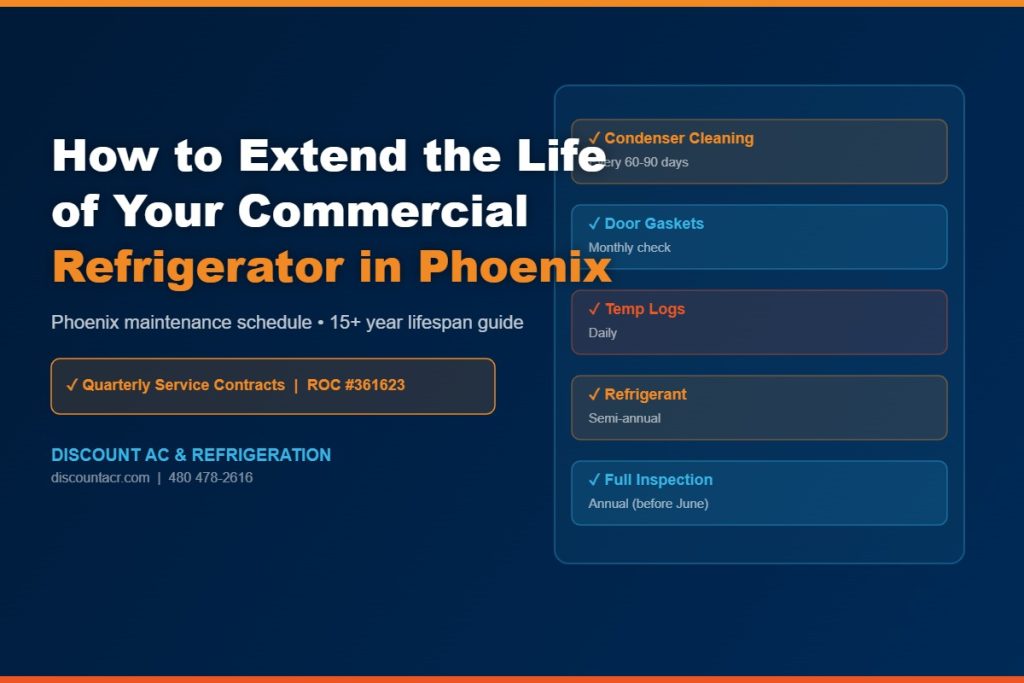
The 90-Day Walk-In Cooler Maintenance Checklist
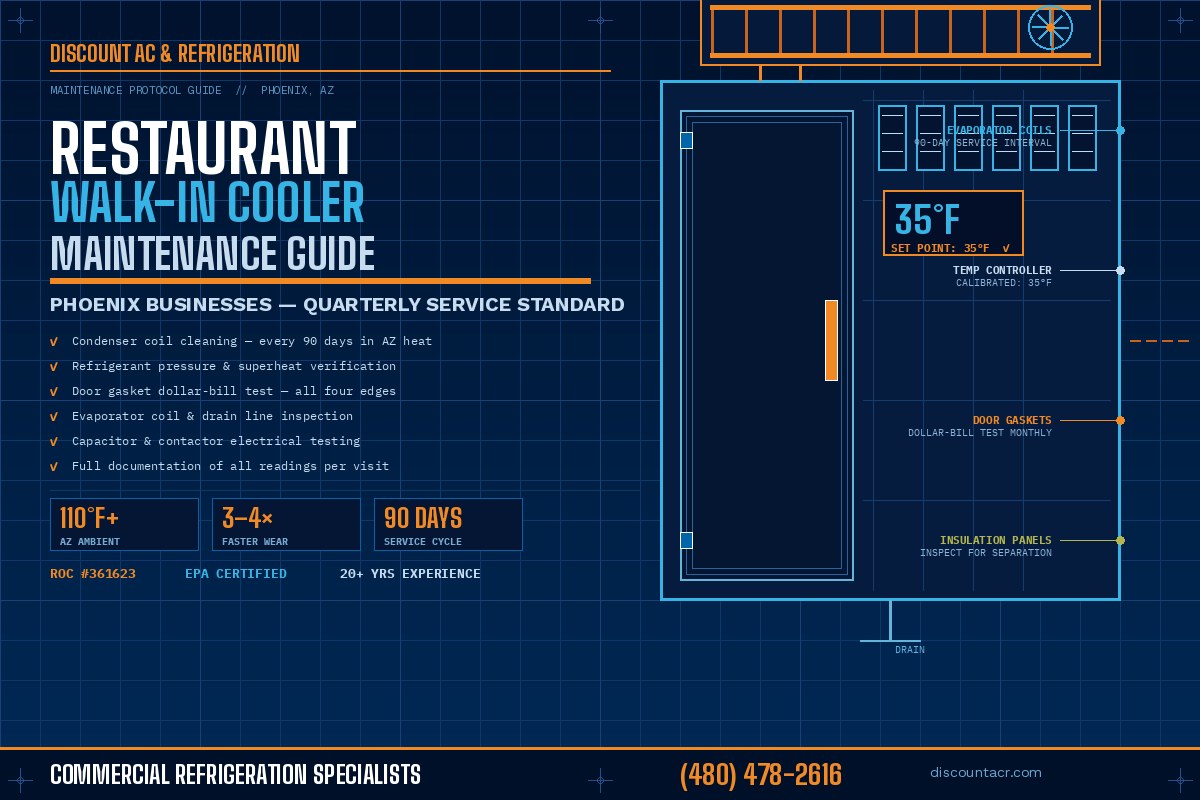
Here’s what a proper Arizona-standard service visit covers. If your current provider isn’t doing all of this, you’re not getting a maintenance visit — you’re getting a visual inspection with a hose.
Condensing Unit:
- Clean condenser coils with approved coil cleaner and brush — not just a water rinse
- Check condenser fan motor amp draw against nameplate rating
- Inspect fan blades for damage; a bent blade reduces airflow 20–30%
- Measure head pressure and subcooling with calibrated gauges
- Inspect wiring and terminals for heat damage common on outdoor units in Arizona
Evaporator Unit:
- Clean evaporator coils fully, not just a visual check
- Test evaporator fan motors for amp draw and bearing noise
- Clear drain pan and drain line — blockages cause ice buildup that chokes airflow
- Measure superheat at the evaporator outlet
Refrigerant Circuit:
- Record suction and discharge pressures
- Verify refrigerant charge — a system 10% low loses 20% of its efficiency
- Inspect refrigerant lines for oil migration, which indicates a slow leak
- Check TXV valve operation for hunting or sticking
Electrical Components:
- Inspect contactor contacts for pitting or carbon buildup
- Test capacitors with a capacitance meter — a 20% capacity drop strains the compressor before it causes a visible failure
- Verify breaker sizing matches actual load under summer conditions
Mechanical:
- Dollar-bill test on every gasket seam: top, bottom, hinge side, latch side
- Inspect door hinges and self-closing mechanisms
- Check panel seams for separation or moisture infiltration
- Verify interior temperature against a calibrated thermometer, not just the unit display
Our commercial HVAC preventive maintenance contracts cover every item on this checklist at each scheduled visit — documented, tracked, and built around Arizona’s actual operating conditions, not a national template.
Condensing Unit Care: The Component That Fails First in Phoenix
The condensing unit takes the most abuse from Arizona heat. It sits outside in direct sun, rejecting heat from your walk-in around the clock. Most restaurant owners don’t think about it until it stops working. By then, the damage is already done.
Dirty condenser coils are the single most common preventable failure we see. A coil coated in grease, cottonwood, and desert dust can’t reject heat efficiently. The system runs longer, discharge temperature climbs, and head pressure rises. A coil that’s 30% restricted can raise head pressure by 50 PSI. In Phoenix summer conditions, that’s the difference between a compressor that lasts eight years and one that fails in four.
Cleaning must be done correctly. A water rinse alone doesn’t remove grease-bonded debris. Proper cleaning requires coil cleaner, brushing technique, and a technician who knows not to flatten the fins — bent fins reduce airflow permanently and can’t be fully restored.
Compressor oil contamination is the follow-on problem. High discharge temperatures break down refrigerant oil. Acid forms in the system. Acid attacks motor windings. A technician who doesn’t check for acid contamination — brownish oil at the sight glass, pitted contactor contacts — is missing a failure that’s already developing. This is exactly what we find when responding to emergency commercial refrigeration calls after a compressor burns out: a unit that ran hot for months because the condenser coil was never properly serviced.
We document condenser fan amp readings, discharge temperature, and head pressure at every visit for restaurant clients in Mesa, Scottsdale, Chandler, and Gilbert. Trend data across visits is how you catch a compressor that’s slowly failing before it fails completely.
Door Gaskets, Insulation Panels, and the Silent Cost of Air Infiltration
A failing door gasket doesn’t alarm. It doesn’t shut the system down or trigger an error code. It just bleeds warm air into your walk-in continuously, forces your compressor to run harder, and adds runtime hours every single day until something gives.
The dollar bill test is the fastest field check. Close the walk-in door on a dollar bill at several points around the frame — top, bottom, hinge side, latch side. If the bill slides out easily with no resistance, your gasket has failed at that point. One compromised seam on a door that opens 80 times during service adds measurable compressor runtime by the end of the month.
Phoenix walk-in gaskets fail faster than national averages for two reasons. The temperature differential between a commercial kitchen and the walk-in interior is severe — often 45–50°F near cooking equipment. That constant expansion and contraction degrades the magnetic gasket material faster than manufacturers estimate. Monsoon season compounds the problem: humid air pulled into the walk-in during door openings condenses on the evaporator coil, freezes, and builds ice that eventually blocks airflow entirely.
Insulation panel integrity is the other issue that gets overlooked. When a panel seam separates — even slightly — moisture infiltrates, insulation saturates, and thermal resistance drops. A degraded panel can double the effective heat load on your evaporator. We’ve seen this on older walk-ins across Phoenix, Glendale, and Surprise where a new compressor was installed but the panels were never inspected — and the replacement compressor failed two years later for the same reason.
Refrigerant Pressure, TXV Valves, and Head Pressure in Desert Conditions
This is where most maintenance guides stop giving useful information. Here’s what actually matters for Arizona walk-ins.
Head pressure running higher than spec in Phoenix summers is expected — because those specs assume cooler ambient conditions. What’s not acceptable is elevated head pressure compounding with a dirty coil, a weakened condenser fan motor, and a marginal refrigerant charge all at once. That combination is what ends compressors.
Superheat and subcooling readings are more informative than pressure readings alone. Superheat tells you how effectively your evaporator is absorbing heat from the walk-in interior. Subcooling tells you the state of refrigerant leaving the condenser. Both numbers together tell you whether the refrigerant circuit is balanced. A technician reading only suction pressure is giving you less than half the picture.
TXV valve problems are chronically misdiagnosed in Arizona commercial refrigeration. A TXV with a failed sensing bulb or a contaminated seat hunts — opening and closing erratically — creating superheat swings that look exactly like a refrigerant charge problem. We’ve followed up on walk-ins that were recharged three times by other providers before anyone checked the TXV. A replacement valve is typically $150–$300 in parts. Three unnecessary recharges, ongoing compressor stress, and lost inventory cost far more.
Our technicians serving restaurants in Tucson, Avondale, and Cave Creek record superheat and subcooling at every visit. If a TXV is starting to degrade, the data shows it before the next emergency call.
Ice Machines, Reach-Ins, and the Rest of Your Refrigeration System
Walk-in coolers draw the most attention, but they’re rarely the only refrigeration equipment running in a commercial kitchen. Your ice machine, reach-in units, and display cases all operate under the same Arizona heat stress — and they all need quarterly attention.
Commercial ice machines in Phoenix produce less than rated capacity during summer months. High ambient temperatures extend the freeze cycle and cut production output. If your machine is running constantly but making less ice than you need, ambient heat is almost always part of the equation. Our ice machine service covers cleaning, scale removal, refrigerant verification, and condenser maintenance — every point that Arizona summers accelerate.
Reach-in coolers and display cases need condenser cleaning on the same 90-day schedule as walk-ins. A reach-in with its condenser tucked in a hot prep area operates under worse conditions than its spec sheet assumes.
For complete coverage of your commercial refrigeration systems, a single service contract covering all units is more cost-effective than calling separately for individual repairs — and it keeps everything on the same documentation and inspection schedule.
Recognize the Warning Signs Before Your Walk-In Fails During Service
Not every refrigeration problem announces itself clearly. Catching the early signs gives you a window to call before the walk-in fails during a busy dinner service — not after.
Watch for these:
- Interior temperature creeping above set point by more than 3–5°F during off-peak hours
- Condenser fan running continuously while the compressor cycles off prematurely
- Ice buildup on the evaporator coil visible through the cover
- Unusual noise from the compressor — rattling, grinding, or clicking on startup
- Electricity bills increasing without any change in usage patterns
- Condensation forming on walk-in panels or around door frames where it didn’t before
Any one of these warrants a call. Several together means call immediately. Our emergency refrigeration response team covers the Phoenix metro area and operates from 6 AM to midnight seven days a week — including weekends, when most of these situations actually happen. For operators in Mesa and Scottsdale, response time matters more than the repair itself when product is on the line.
Frequently Asked Questions — Walk-In Cooler Maintenance in Arizona
How often should a restaurant walk-in cooler be serviced in Arizona? +
Every 90 days — not once a year. Arizona’s ambient temperatures reach 110°F+ for months at a time, forcing condensing units to work 40–60% harder than in cooler climates. That accelerated load fouls condenser coils faster, breaks down compressor oil sooner, and degrades door gaskets more quickly than national maintenance schedules account for. Quarterly service is the minimum standard for any food service operation in the Phoenix metro or Tucson area.
Why does my walk-in cooler run constantly in the Phoenix summer? +
Continuous running during Arizona summers is usually caused by one of four issues: a dirty condenser coil restricting heat rejection, a low refrigerant charge reducing system capacity, a failing door gasket allowing warm air infiltration, or degraded insulation panels increasing the thermal load. In some cases all four are contributing at once. A system that runs without cycling off is working at its limits — and in Phoenix heat, that kind of sustained strain leads to compressor failure faster than in any other climate in the U.S.
What is head pressure and why does it matter in Arizona? +
Head pressure is the high-side pressure in your refrigerant circuit — essentially how hard your compressor is working to push heat out of the system. For a common refrigerant like R-404A, normal operating head pressure sits around 250–300 PSI. In Phoenix summers, we regularly see 350–400+ PSI on units with dirty condenser coils or weak condenser fans. Sustained high head pressure overheats the compressor, breaks down refrigerant oil, and shortens compressor life significantly. It’s one of the main reasons walk-in compressors fail faster in Arizona than anywhere else in the country.
How do I know if my TXV valve is failing? +
A failing TXV (thermostatic expansion valve) typically causes the walk-in to reach its set temperature and then slowly climb back up, or it creates erratic temperature swings that look identical to a refrigerant charge problem. This is why TXV issues are so frequently misdiagnosed — restaurants get recharged repeatedly without any improvement. A proper diagnosis requires measuring superheat and subcooling with calibrated gauges, not just reading pressure. If your system has been recharged more than once without resolving the problem, the TXV valve should be the next thing your technician inspects.
What causes ice buildup on the evaporator coil? +
Ice buildup on the evaporator coil is almost always caused by reduced airflow or excessive moisture entering the walk-in. The most common culprits are a clogged drain line that allows water to pool and refreeze, a failing door gasket that pulls humid air into the unit during each opening, and low refrigerant charge causing the coil to run colder than designed. Once ice builds up on the evaporator, airflow across the coil drops significantly — which reduces cooling capacity and forces the system to work even harder. Left unaddressed, it can freeze the coil completely and take the walk-in offline during service hours.
How long should a walk-in cooler compressor last in Arizona? +
With proper quarterly maintenance, a walk-in cooler compressor in Arizona should last 8–12 years. Without it, we commonly see compressor failures at the 3–5 year mark — particularly on units that run through multiple Phoenix summers with dirty condenser coils or undetected refrigerant leaks. The compressor is the most expensive component in the system, typically running $1,500–$4,000 or more depending on the unit size. Regular maintenance that catches elevated head pressure, acid contamination, and weak capacitors before they cause compressor failure is the most cost-effective investment a restaurant owner can make in their refrigeration system.
What is the dollar bill test for walk-in door gaskets? +
Close the walk-in door on a dollar bill at several points around the door frame — top, bottom, hinge side, and latch side. If the bill slides out with little or no resistance, the gasket has failed at that point and is no longer creating an airtight seal. A properly functioning gasket should grip the bill firmly. This test takes less than a minute and should be done monthly in a Phoenix restaurant environment, where the extreme temperature differential between the kitchen and walk-in interior causes gaskets to degrade faster than in most other climates.
When should I call for emergency refrigeration service? +
Call immediately if your walk-in interior temperature is rising and won’t recover, if the compressor is making grinding or clicking sounds on startup, or if you notice the condensing unit running without the compressor cycling on. In Arizona, a walk-in that can’t hold temperature in summer heat can cross into food safety violation territory within hours — especially for proteins, dairy, and prepared items. Our emergency refrigeration team operates from 6 AM to midnight seven days a week across the Phoenix metro and responds to after-hours commercial refrigeration failures throughout Arizona.
What does a commercial preventive maintenance contract cover? +
Our commercial preventive maintenance contracts include quarterly scheduled visits covering condenser and evaporator coil cleaning, refrigerant pressure verification, superheat and subcooling measurement, capacitor and contactor testing, drain line clearing, door gasket inspection, and full documentation of all readings. Contracts can be structured to cover your walk-in cooler, walk-in freezer, ice machine, and reach-in units under a single agreement. Every visit is documented so we can track component trends over time and catch developing failures before they become emergency calls — which is especially valuable for restaurants running through an Arizona summer.
Do you service walk-in coolers outside Phoenix? +
Yes. Our mobile technicians cover the full Arizona statewide service area — from Metro Phoenix and the East Valley to Tucson, Surprise, Chandler, and beyond. We operate from 6 AM to midnight seven days a week, which means we can respond to commercial refrigeration calls across the state without the delays that come from dispatching from a single fixed location. Whether your restaurant is in Gilbert, Scottsdale, Avondale, or Tucson, our team is reachable at (480) 478-2616 for both scheduled maintenance and emergency service.
Schedule Your Walk-In Service Before Arizona Summer Arrives
The preparation window is March through May. Once June arrives, you’re managing problems at peak heat load — the worst possible time to discover a failing compressor or a refrigerant leak that’s been developing for months.
Discount AC & Refrigeration has served Arizona food service businesses for over 20 years. Family-owned, licensed under ROC #361623, and operating from 6 AM to midnight seven days a week — our restaurant refrigeration service is built on the repeat business that comes from actually preventing failures, not just responding to them. Our commercial clients include Wendy’s, Sake Haus, and Devil’s Hideaway across the Phoenix metro.
Ask about our commercial preventive maintenance contracts — quarterly service built around Arizona’s real operating conditions, documented at every visit. And if you refer another restaurant owner or facility manager to us, our Refer & Earn program pays real cash when their service is complete.
Call (480) 478-2616 or contact our team to schedule your pre-summer walk-in inspection.