Chiller approach temperature describes a heat-transfer difference, but a high reading is only a clue. The first step is to identify which heat exchanger, which operating conditions, and which measurements produced it.
Building managers often receive a chiller report with the phrase “high approach temperature” and little explanation of what it means. Approach is a temperature difference used to describe how effectively heat is moving across a heat exchanger. The exact definition depends on whether the technician is discussing the evaporator or condenser and on the chiller’s design. It is a diagnostic clue, not a standalone verdict that the machine must be replaced.
In Arizona, high outdoor temperatures can increase heat-rejection demand, but weather alone does not explain every poor reading. The useful question is whether the approach is abnormal for this equipment under measured operating conditions, compared with manufacturer information and its own historical trend.
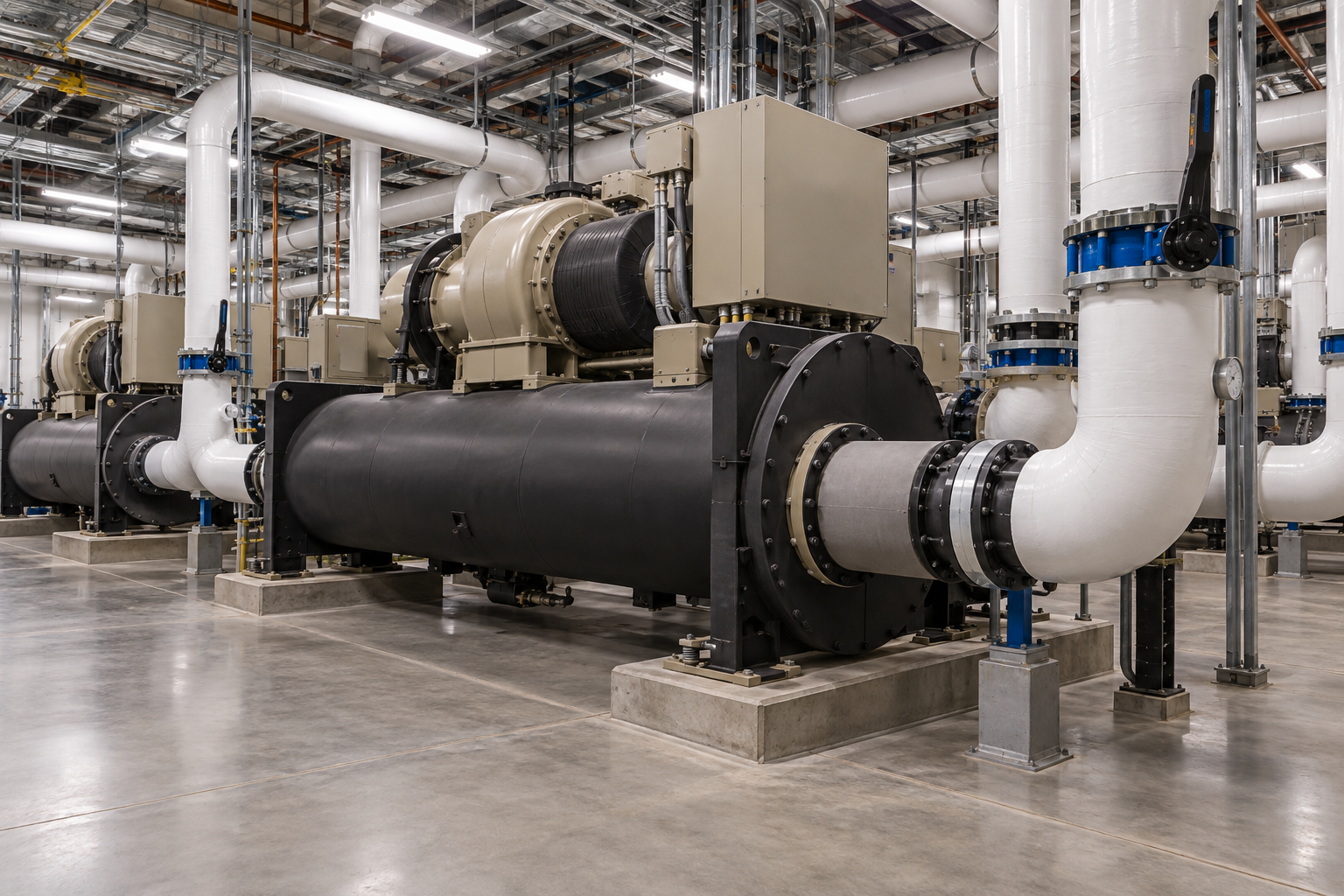
What does “approach” mean on a chiller?
On an evaporator, a technician may compare leaving chilled-water temperature with the refrigerant’s evaporating temperature. On a condenser, the relevant comparison may involve leaving condenser-water temperature and condensing refrigerant temperature. The definitions and expected values differ by chiller type. Always ask which side of the machine the report describes, what instruments were used, and what load the unit was carrying.
A number copied from another building is not a reliable target. Water flow, refrigerant operating conditions, sensor calibration, fouling, and control sequence all influence the reading. A trend for the same machine at comparable load can be more informative than one isolated value.
Why the approach may rise
Heat-exchanger fouling
Scale, biological deposits, dirt, or other material can make heat transfer less effective. The relevant cleaning method depends on the exchanger design and water treatment program. Cleaning should follow manufacturer and site procedures, not a generic chemical recipe.
Water-flow problems
Low or uneven flow can change temperatures through the heat exchanger. Pumps, strainers, valves, and balancing conditions should be evaluated before blaming the chiller itself. A manager should record whether flow alarms or recent valve changes occurred.
Sensor or measurement error
A misplaced or inaccurate sensor can make a calculated approach appear high. Verification with appropriate instruments and stable operating conditions is essential before making an expensive decision.
Refrigerant-side issues
Charge, noncondensables, control operation, or other refrigerant-side conditions may affect heat transfer. These require qualified diagnostic work. Do not interpret the approach as a refrigerant-leak test by itself.

What information helps an accurate diagnosis?
Collect the chiller model, alarm history, operating hours, load at the time of the reading, entering and leaving water temperatures, flow information if available, and recent maintenance notes. Note changes in cooling-tower operation, water treatment, pumps, or building demand. If a building automation system logs these values, provide a short trend rather than a single screenshot.
Ask the service team to document the definition of approach used, the measured values behind the calculation, the instrument and sensor checks, and the next test that distinguishes the leading hypotheses. A good report should state what is known, what remains uncertain, and how the proposed action addresses the measured condition.
Do not confuse a high approach with a replacement decision
A chiller can have a high approach because of a correctable flow or fouling problem. It can also have multiple interacting issues. Replacement decisions require broader analysis: equipment condition, repair scope, reliability, efficiency, service life, and building load. This article should support that conversation, not substitute for it.
Discount AC & Refrigeration lists chiller systems among its commercial HVAC services. Facility managers can use the commercial services overview to discuss an equipment assessment across the Phoenix metro.
Seven causes to examine when chiller approach rises
1. Fouling on heat-transfer surfaces
Mineral scale, biological deposits, or sludge can interfere with heat transfer in water-side passages. A rising chiller approach temperature may be consistent with fouling, but the result must be compared with the correct baseline for that machine. The U.S. Department of Energy’s operations and maintenance guide notes that buildup on chiller heat-exchanger surfaces increases the temperature difference needed for heat transfer. It also discusses water flow and condenser conditions. Facility staff should ask what inspection or trend confirms fouling before authorizing cleaning.
2. Inadequate or unstable water flow
A strainer restriction, pump issue, control valve position, or balancing change can alter flow through an exchanger. The chiller approach may then move even if its tubes are clean. Record recent pump work and whether a flow alarm appeared. The technician should verify actual conditions against the equipment design and manufacturer guidance, not infer flow from a single temperature reading. A newly changed control sequence can produce an operating point unlike the baseline.
3. Sensor or instrument error
An approach value is calculated from temperatures and sometimes pressure-derived refrigerant saturation temperature. A biased sensor can make the calculated result look abnormal. Ask whether the technician compared installed sensors with calibrated instruments while the unit was stable. Note sensor locations; a water temperature measured far from the exchanger may not represent the intended entering or leaving point. Do not order a major repair from an unverified digital display.
4. Condenser-side conditions
For water-cooled equipment, tower performance and condenser-water temperature influence the operating context. For air-cooled equipment, airflow and outdoor conditions play different roles. Ask the report writer to identify the chiller type and whether the abnormal approach is on the evaporator or condenser side. A comparison with a different machine type can be misleading. In Arizona heat, a higher outdoor load may coincide with the problem, but it does not by itself explain a persistent departure from the machine’s own comparable trend.
5. Refrigerant-side performance
Refrigerant conditions, control behavior, and other internal faults can affect heat transfer. These are not diagnoses a facility manager should make from an approach value alone. A qualified technician may examine pressures, temperatures, compressor operation, and the machine’s alarms under the manufacturer’s procedure. The goal is to connect the measurement to a tested mechanism. “High approach” should never be treated as a direct refrigerant-charge measurement.
6. Load and control-sequence changes
A chiller serving a different load, reset schedule, or number of air-handling units may operate at a new point. Trend data should mark the operating load and setpoints when the approach was calculated. If a building automation update occurred, note its date and what changed. The same raw temperature difference at very different loads may not carry the same meaning. Manufacturer curves and a clean-machine baseline help interpret the reading.
7. A poor comparison baseline
Sometimes the apparent increase comes from comparing unlike periods, unlike sensors, or different definitions of approach. An evaporator approach and a condenser approach are not interchangeable, and tower approach is a separate measure. Ask for the formula used in the report and the temperatures that went into it. If the prior value came from another season or was captured before a sensor replacement, document that limitation. A useful trend requires comparable conditions and consistent calculation.
Chiller approach temperature: separate three terms
The word “approach” can refer to more than one temperature difference in a chilled-water plant. A condenser approach often compares refrigerant condensing temperature with leaving condenser-water temperature; an evaporator approach compares temperatures on the cold side of the chiller. A cooling tower approach compares leaving tower water with outdoor wet-bulb temperature. These quantities reflect different components and should not be combined in one unexplained trend.
A Trane chiller operation manual defines condenser approach for one machine family and notes how fouling can raise it. That numerical guidance is model-specific; it is not a universal target for every chiller. Ask for the current manufacturer’s documentation for the installed unit, including design flow and operating conditions. A service report should state its chosen definition before recommending action.
For managers, the most useful distinction is practical: if the report says “high chiller approach temperature,” ask which side of the unit is involved and whether the reading was measured at a stable load. If the answer is uncertain, the next step is measurement verification. If the baseline is missing, build one after the equipment is checked and operating normally, then trend under comparable conditions.
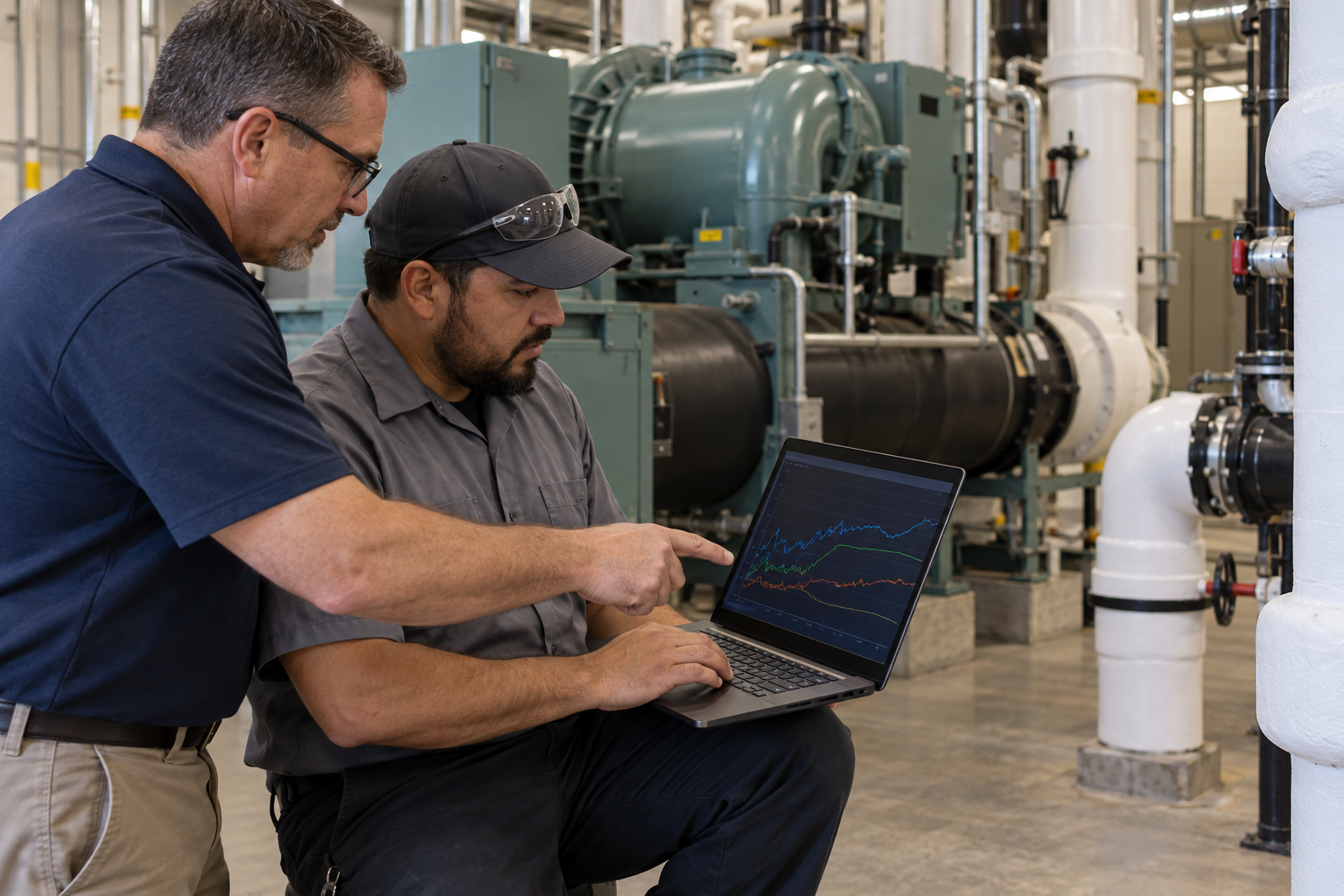
A trend log worth keeping
Record the unit ID, date, operating hours, load estimate, chilled-water entering and leaving temperatures, condenser-water entering and leaving temperatures for water-cooled units, relevant refrigerant saturation temperatures as provided by the technician, and any alarms. Note pump status, tower conditions, and setpoint resets. It is better to have a small consistent set of reliable readings than dozens of fields copied without units or sensor locations.
Include the chiller approach calculation and label it evaporator or condenser. Store the formula with the trend. If a sensor is replaced or recalibrated, mark the event so old and new readings are not treated as one seamless series. If the machine’s control software changes, record the version and commissioning date. These details allow future staff to see whether a change is a true heat-transfer issue or a measurement break.
Use more than one point. A single reading during startup, a sudden load transition, or an alarm may not reflect steady operation. A technician can advise which stable conditions to compare. In an Arizona summer, external heat-rejection conditions can change substantially across the day, making timestamp and weather context helpful. The log is a starting point for qualified diagnosis, not a formula for adjusting refrigerant or chemical treatment.
How to evaluate a cleaning recommendation
Cleaning may be appropriate if the technician demonstrates fouling and the manufacturer supports the proposed method. Ask which heat exchanger is affected, what evidence identifies fouling, what cleaning method is specified, how the water treatment program will be coordinated, and how post-cleaning performance will be measured. A generic chemical flush can be inappropriate for a particular material or site system. Safety, wastewater handling, and equipment isolation belong in the work plan.
Carrier’s condenser health guidance treats a higher condenser approach relative to a clean baseline as evidence of poorer heat transfer and a reason to examine tube condition. It is a manufacturer example, not proof that every high reading requires the same service. Confirm that the installed equipment and the observed fault match the recommendation.
Ask for before-and-after readings at comparable load and water conditions. If the chiller approach temperature does not improve after cleaning, that discrepancy needs investigation rather than a claim that the issue is resolved. Other causes, including sensor error or flow, may remain. The closeout report should include what was found, what was done, and what changed in measured operation.
Why a replacement decision needs broader evidence
Replacing a chiller is a capital decision. High approach alone does not establish that the whole machine has reached the end of useful life. Consider reliability history, water-side condition, controls, compressor condition, refrigerant availability, repair cost, energy use, and current building load. A well-documented chiller approach trend can support that analysis, but it is one part of it.
If several faults interact, request a staged diagnostic plan. For example, first validate sensors and flow, then assess heat-exchanger condition, then review control behavior. This sequence can prevent an expensive component replacement based on an incorrect input. It also produces a clearer business case if replacement does prove appropriate. Keep the original raw readings so another engineer can review the recommendation independently.
Questions for the service handoff
Before closing the ticket, ask: Which approach was calculated? What are the individual measured values and units? At what load and conditions were they taken? Were sensors verified? Was design water flow checked? What evidence distinguishes fouling from a control or refrigerant issue? What corrective action was performed, and what post-work readings confirm improvement? A report that answers these questions is more useful than a single highlighted number.
Schedule a follow-up trend review if the fault appears only at certain loads or weather conditions. The chiller approach temperature may look normal during a cool morning yet worsen during high demand. If a test could not be completed, note that limitation rather than declaring every mode verified. Preserve the baseline for future maintenance and train facility staff on which alarms require an urgent qualified response.
Discount AC & Refrigeration can discuss commercial chiller assessment in the Phoenix area. Call (480) 478-2616 with the unit model, recent trend, and service history. Do not alter chemical treatment, electrical controls, or refrigerant settings based on this article; those decisions require site-specific professional evaluation.
How to make the next chiller approach reading useful
Ask the technician to identify the exact sensor locations used for the chiller approach temperature calculation. The water temperature should correspond to the defined exchanger outlet, and the refrigerant value should be derived using the correct pressure-temperature relationship for the equipment. If the two readings were taken at different times while load changed, the calculated difference may be misleading. Record the time, units, and instrument used for each input.
Compare the new chiller approach temperature with a clean-machine baseline at a similar load and water condition. If no baseline exists, do not invent a universal target from an unrelated model. Use the installed manufacturer’s operating information and collect consistent readings after the machine has been evaluated. A technician can decide which operating points are safe and representative for the comparison.
When the chiller approach temperature rises, look at adjacent evidence. Did condenser-water flow change? Was a strainer serviced? Did tower controls or water treatment change? Are alarms present? Did sensor calibration drift? A useful report shows which of these possibilities was tested, not just which one seems plausible. It should also state whether the issue appears on the evaporator or condenser side.
After corrective work, record the chiller approach temperature again at a comparable condition. If cleaning was performed but the value stayed high, reassess flow and measurement before declaring that more aggressive cleaning is necessary. If a sensor was corrected, mark the old trend as non-comparable. This prevents the apparent improvement from being confused with an actual heat-transfer change.
Finally, use the chiller approach temperature as one signal in a broader maintenance program. Compressor power, water temperatures, load, alarm history, and occupant comfort all matter. A single favorable reading cannot prove every mode works, just as one high reading cannot justify replacement. Keep the raw measurements and calculation with the work order so another qualified reviewer can understand the conclusion.
For a seasonal review, place the chiller approach temperature trend beside load and water-flow records. If the chiller approach temperature changes only after a control update, identify that date before attributing the shift to fouling. The maintenance record should preserve the source readings, not merely a calculated score.
Frequently Asked Questions
Is there one normal approach temperature for every chiller?
No. It depends on equipment design, which heat exchanger is being discussed, operating load, and the manufacturer’s specifications.
Does a high approach always mean scale?
No. Fouling is one possibility; flow, sensors, controls, and refrigerant-side conditions can also contribute.
Should I compare today’s number with last year’s?
Yes, if the readings were taken using the same definition and under comparable load and conditions. A trend needs context to be meaningful.
What should I request from a technician?
Ask for the underlying measured temperatures, the approach definition, load and flow context, and a documented diagnostic conclusion. For commercial HVAC assistance, call (480) 478-2616.