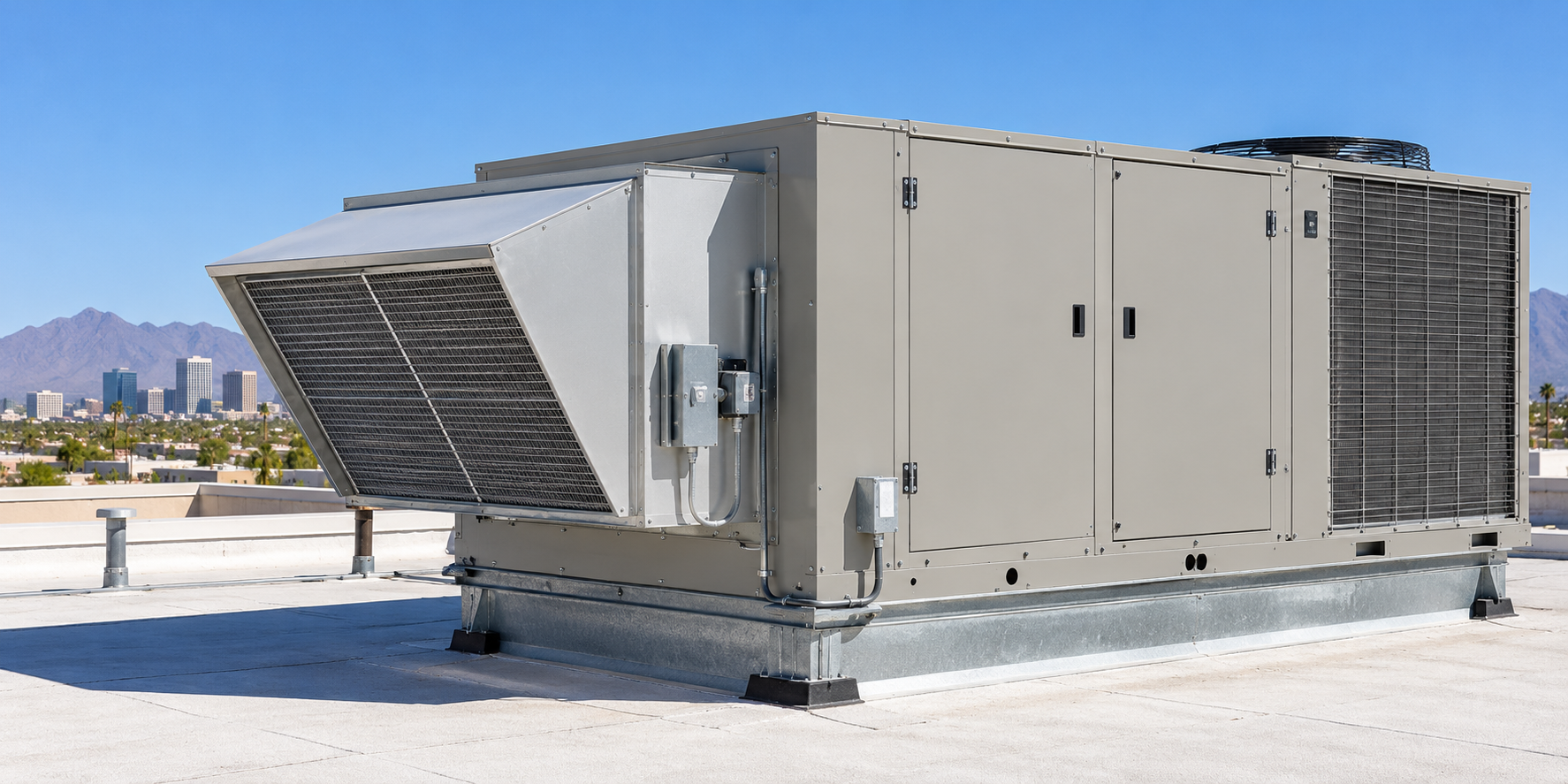
A rooftop economizer can save cooling energy under suitable outdoor conditions, but a damper stuck open during Phoenix heat can reverse that benefit.
A rooftop unit can cool a building and still waste energy if its economizer damper is stuck open. The economizer is meant to introduce outdoor air under appropriate conditions and meet ventilation requirements. In Phoenix, an unwanted opening during hot hours can pull extreme outdoor heat into the system and make the compressor work harder. A damper that fails closed presents a different problem: it may reduce intended outside-air ventilation or prevent the system from using suitable outdoor air when conditions permit.
This article is for facility managers who need to document symptoms and ask better diagnostic questions. It is not a guide to adjusting dampers or overriding ventilation controls. The correct outdoor-air setting depends on the equipment, occupancy, controls, and applicable requirements.
What the economizer actually does
A typical rooftop economizer uses dampers, an actuator, sensors, and a controller. When outdoor conditions are appropriate, the system can use more outside air for cooling instead of relying entirely on mechanical refrigeration. At other times it should return to its configured minimum outdoor-air position. A fault in any part of that chain can produce the same uncomfortable outcome, so a visual observation alone cannot identify the failed component.
Arizona adds a useful diagnostic contrast: a cool fall morning may be suitable for economizer operation, while the can become much hotter by afternoon. If the system never changes behavior as conditions change, a technician should investigate.
Symptoms of a damper stuck open
Supply air becomes warmer during hot afternoon hours
If the unit seems to keep calling for cooling while the delivered air warms as outdoor temperature rises, unwanted outside air is one possible cause. Refrigerant, airflow, and control problems can cause similar symptoms, so record timing rather than jumping to a conclusion.
Long compressor run time
The compressor may run longer to remove heat brought in through the outside-air path. Compare runtime trends with comparable weather, occupancy, and thermostat settings rather than relying on a single electric bill.
Dust or odor after a storm
An economizer admitting too much outside air can increase the load on filtration during dusty or smoky conditions. A dirty filter or air leakage elsewhere can create similar complaints. Do not block an intake to make a symptom disappear; doing so can interfere with ventilation.
Unexplained pressure and comfort changes
Doors that suddenly feel different to open, uneven zones, or large temperature swings can signal an air-balance issue. Building exhaust, makeup air, and other rooftop units affect the same pressure picture.
What to document before the service call
Record the unit identifier, date, outdoor conditions, occupied schedule, thermostat setpoint, indoor temperature trend, supply-air temperature if available, alarms, and whether the problem appears only at certain hours. Note recent filter changes, roof work, power interruptions, and control updates. Photographs of controller screens can help, but do not open electrical cabinets or climb onto a roof without the proper role and safety procedures.
Ask the technician to compare the commanded damper position with its actual position. The visit may include sensor checks, actuator operation, linkage condition, control sequence, outside-air minimum settings, and an assessment of airflow and ventilation. The key is to test the whole sequence rather than replacing the first visible part.
How this differs from a general rooftop repair
A general rooftop service visit evaluates many possible cooling failures. This symptom-led investigation focuses on the outside-air pathway and the timing of the failure. Our rooftop unit service team can assess economizer and damper operation as part of a complete diagnosis. For facilities managing several units, review our commercial HVAC services and discuss coordinated controls and preventive maintenance.
What not to do
Do not force a damper shut, disconnect an actuator, or permanently disable an alarm to lower the cooling bill. The system may be required to supply outdoor air for occupants. Do not assume that a low-temperature supply-air reading proves correct ventilation either. The goal is a verified operating sequence that meets the building’s needs.
Why an economizer fault is not just an energy issue
The rooftop economizer has to balance two needs: deliver the outdoor air required by the building’s design and use favorable outdoor conditions for cooling when the control sequence allows. A damper that remains open during very hot weather can introduce heat the cooling system must remove. A damper that stays closed can prevent intended ventilation or free cooling. Both faults can affect occupants, so changing a setpoint without testing the sequence is not a reliable solution.
The U.S. Department of Energy notes that dampers can stick open and waste energy. Its HVAC commissioning guidance also recommends checking outside-air dampers and controls in systems with economizers. Those sources support a measured approach: verify both the mechanical position and the controller’s intended command rather than assuming a visible damper position identifies the cause.
In a Phoenix building, the value of logging outdoor temperature and unit behavior across a full day is especially high. A mild morning may allow economizer cooling; the afternoon can demand a return to minimum outdoor-air operation. If the unit provides similar outside-air intake regardless of those changing conditions, the data give the service technician a useful lead. They do not prove whether the actuator, linkage, sensor, or controller is at fault.
Separate a stuck damper from a control-sequence problem
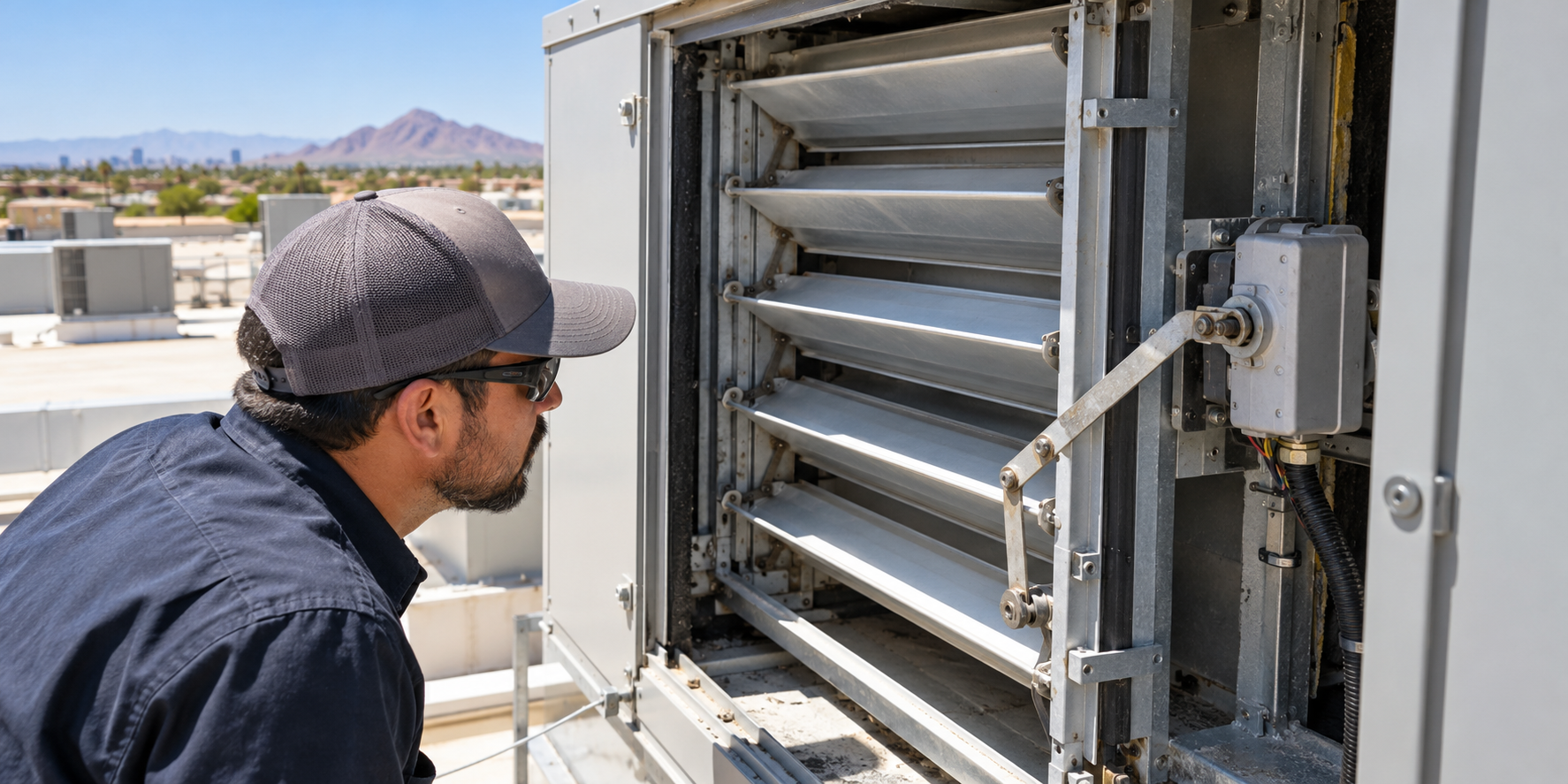
A rooftop economizer damper can appear open because the controller is commanding it open, because the actuator failed to follow a close command, or because the linkage cannot move the blade. Those situations require different repairs. The technician may compare the building automation system’s command, the actuator’s response, and the physical damper position while conditions change. An inaccurate outdoor-air sensor or a programming change can make the command itself inappropriate even when the hardware moves normally.
Ask for a review of the occupied and unoccupied schedules as well. An economizer that appears wasteful after hours may be following a schedule that was never updated for a tenant change. Conversely, closing the damper completely during occupied hours can conflict with required ventilation. A proper diagnosis considers the intended minimum outdoor-air position, local code and design documents, and any demand-control ventilation sequence. Facility staff should not bypass safety or ventilation interlocks in pursuit of a lower bill.
Filters and coils also matter. A dirty intake screen or filter may alter airflow and produce temperature symptoms that resemble a damper problem. The technician should assess airflow and sensor readings in context. If multiple rooftop units serve connected spaces, pressure changes from adjacent units or exhaust fans can further complicate the picture. Looking at one unit in isolation may miss the cause of a building-wide complaint.

A simple trend log for facility managers
Use a worksheet or building automation trend to record the unit ID, outdoor temperature, return-air temperature, mixed-air temperature if available, supply-air temperature, damper command, and actual position if sensed. Add occupancy status, compressor call, alarms, and the time of day. A single snapshot during a service call may not capture an intermittent fault; a short series across morning, afternoon, and evening often shows whether the rooftop economizer responds to changing conditions.
Keep the log practical. The goal is not to calculate a precise percentage of outdoor air from one unverified sensor. Mixed-air temperature can be influenced by sensor location, incomplete mixing, and calibration. Instead, look for consistent patterns and provide the underlying data to the technician. The Department of Energy’s Energy Information Handbook describes how outdoor, return, mixed, and discharge-air trends help detect economizer faults.
Include recent events: a power outage, sensor replacement, roof maintenance, seasonal control update, or complaint from a newly occupied suite. Mark the date of any filter change. These details help distinguish a new fault from a long-standing condition that only became noticeable in hot weather. If the BAS graph has a large gap, note it rather than filling it with assumptions.
What a service visit should verify
A rooftop economizer diagnosis should start with the unit’s documented sequence of operation and current operating mode. The technician can compare outdoor and return-air conditions, check whether cooling is being requested, and observe the damper command. The next question is whether the damper actually reaches the commanded position. A controller output, an actuator shaft, and the damper blades are three related but distinct observations.
For example, if the controller requests minimum outside air on a hot afternoon but the blades remain much farther open, the fault may be mechanical. Binding blades, a loose linkage, or a failed actuator can prevent closure. If the controller requests a wide opening when outdoor conditions are unfavorable, the technician may need to investigate a sensor, control setting, or sequence error. A mismatch between the displayed command and measured airflow may point to calibration or air leakage rather than a simple stuck-open blade.
The system should also be checked in its normal occupied configuration. An after-hours test may not reproduce the ventilation mode that generates the complaint. If the fault is intermittent, trend data from more than one day can show when the rooftop economizer stops following the intended sequence. A facility manager can help by identifying the specific zone and time window, not by asking staff to alter controls without authorization.
Questions to put on the service ticket
Was the outside-air damper commanded open or closed when the problem occurred? Did the actuator respond? Did the linkage and blades move through their expected range? Were outdoor, return, mixed, and discharge-air sensors plausible under the same conditions? Was the minimum outside-air position verified against the building’s design and applicable ventilation needs? Asking for those observations makes the report more useful than a note saying only “economizer not working.”
Request a record of any parameter changes, sensor replacement, linkage adjustment, and follow-up trend. A repair that restores blade motion but leaves an incorrect control sequence in place may not solve the original problem. Conversely, changing a control threshold without fixing a binding damper will not produce the commanded airflow. The final report should connect the measured fault to the corrective action.
How to compare before-and-after performance
Do not judge the repair from one afternoon’s electric bill. Weather, occupancy, operating hours, and other rooftop units vary. A more useful comparison uses similar outdoor conditions, the same occupied schedule, and trend data for supply-air temperature, damper command, and compressor operation. The goal is to see the rooftop economizer return to its intended behavior across favorable and unfavorable outdoor conditions.
On a mild morning, the system may legitimately use more outdoor air for cooling. During hot Phoenix afternoons, a correctly controlled unit may move toward its configured minimum outside-air position while mechanical cooling handles the load. A before-and-after graph can show whether the damper now follows that sequence. It can also reveal a separate cooling fault if supply-air temperature remains poor even after damper behavior is corrected.
Ventilation performance must remain part of the acceptance check. The building should not become more comfortable merely because required outdoor air was blocked. Confirm the repaired sequence with the design documentation and qualified professional judgment. Where several rooftop units interact with exhaust systems, a pressure or airflow check may be needed to avoid shifting discomfort to another area.
Preventing recurrence without overriding safeguards
Include the economizer in planned rooftop maintenance. The frequency should reflect the equipment, dust exposure, and facility operating pattern. A technician can check intake screens, damper movement, actuator linkage, sensor condition, and controller alarms. After a major controls update or component replacement, verify the sequence again rather than assuming the previous settings carried over correctly.
A facility manager can maintain a small log of recurring complaints, outside-air conditions, unit IDs, and completed work orders. This makes an intermittent rooftop economizer fault easier to distinguish from a one-time thermal load. It also helps prioritize a site with several units; the loudest complaint is not always the unit with the largest energy penalty.
Do not treat a permanently closed outside-air damper as preventive maintenance. Nor should staff bypass an alarm because the unit seems to cool better. The safer goal is a tested control sequence that delivers appropriate outdoor air and avoids unnecessary heating or cooling load. When readings disagree, use the discrepancy to guide further testing rather than choosing whichever sensor supports the preferred answer.
Handoff checklist after an economizer repair
Before closing the work order, request the unit identifier, original complaint, root cause, work performed, and observations that confirm normal operation. The technician should record whether the rooftop economizer damper now responds to both an open and a close command, whether the actuator and linkage are secure, and which sensors or settings were adjusted. If the repair involved programming, keep a copy of the revised sequence or at least a concise change log.
Ask what conditions were used for the final test. A check performed only during a hot afternoon may verify minimum outside-air operation but not the transition to economizer cooling on a mild day. Conversely, a mild-morning test may not show that the damper closes appropriately when outdoor heat increases. If weather prevents an urgent full test, schedule a follow-up trend review. That is more honest than declaring every mode verified from one operating point.
Document any ventilation-related limitation. The rooftop economizer must not be evaluated solely as a way to lower cooling cost; the building’s intended outside-air delivery remains a requirement. If the design documents are missing or occupancy changed, the technician may recommend a separate ventilation assessment. Record that recommendation rather than treating an unknown minimum setting as confirmed.
Finally, set a date to compare trend logs and occupant complaints. If the same warm-afternoon pattern returns, the notes will help distinguish a recurrent damper fault from a different issue. A useful rooftop economizer record supports future maintenance even when personnel change. It keeps the next service visit focused on evidence rather than reconstructing the original fault from memory.
If the rooftop economizer serves a critical area, agree on who will review alarms and trend data after the repair. An assigned owner can notice a repeated afternoon fault before it becomes a prolonged comfort or energy issue. Keep the inspection date, sensor values, and any unresolved recommendation with the building maintenance record.
Frequently Asked Questions
Can an economizer run during Phoenix fall weather?
Yes, when outdoor conditions and the unit’s control sequence allow it. Suitability depends on more than the calendar; conditions may change substantially during a single day.
Does a stuck-open damper always raise the power bill?
It can increase mechanical cooling demand during hot conditions, but bills also reflect weather, occupancy, schedules, and other equipment. Confirm the fault with testing.
Should staff close the outside-air intake manually?
No. That can interfere with ventilation and hide the cause. Have a qualified professional check the controls and required airflow.
What should I tell the technician?
Share the unit ID, hours of discomfort, weather conditions, trend logs, alarms, and any recent controls or roof work. Call Discount AC & Refrigeration at (480) 478-2616 to arrange an assessment.