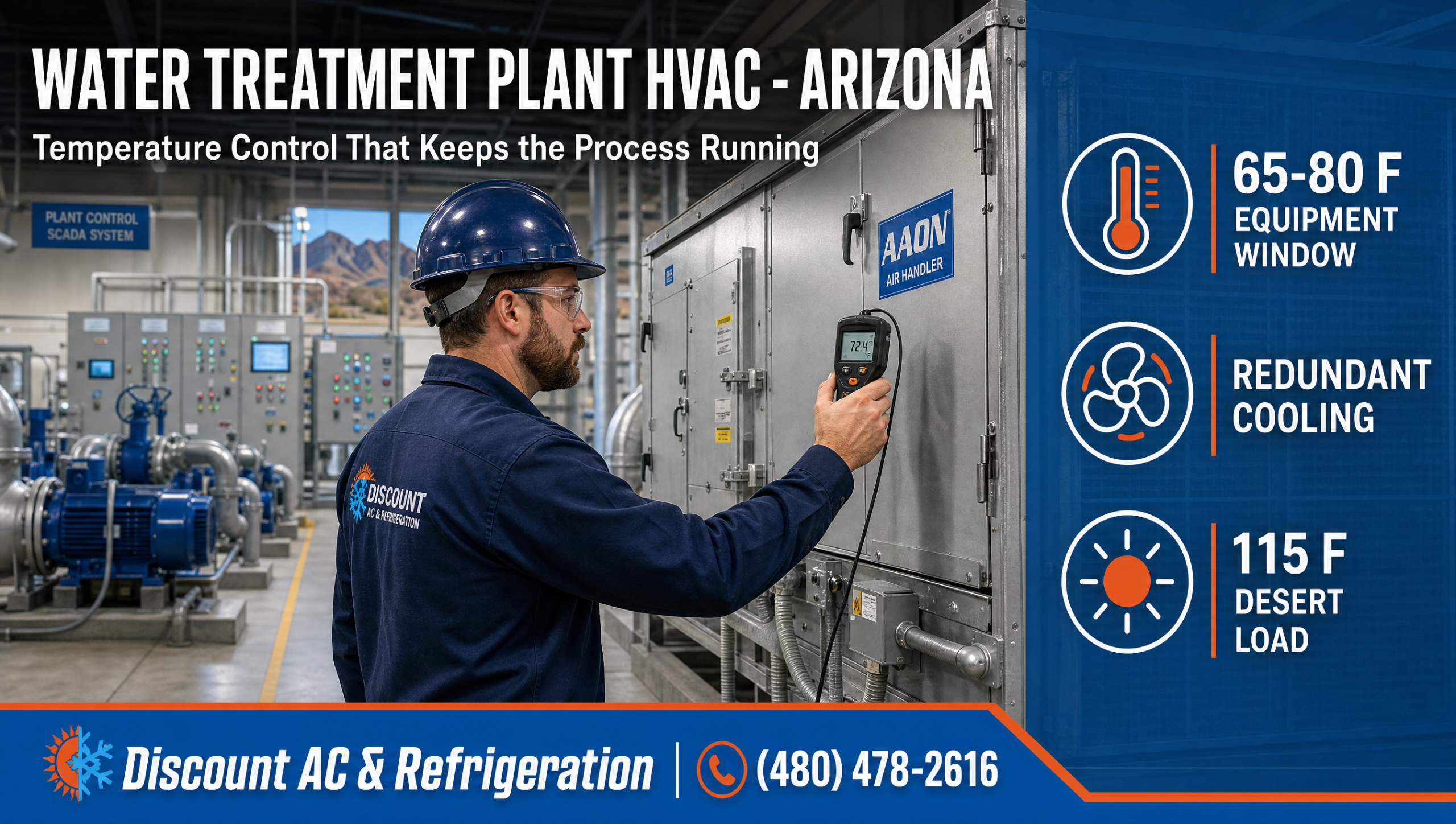
Root cause: water treatment plant HVAC Arizona temperature problems come down to one hard reality — rooms full of heat-generating pumps, drives, and SCADA electronics have to hold a tight temperature band while 110–115°F desert air, monsoon humidity, and dust-fouled condensers all push the system the other way. When the cooling can’t win that fight, the process equipment overheats first.
If you run a water or wastewater plant anywhere in the Valley, you have probably watched a control room creep past 90°F on a July afternoon and wondered how long the drives and servers inside can take it. You are right to worry. Temperature control is not a comfort question at a treatment plant — it is the difference between a process that runs and one that faults out, throttles back, or trips offline during the worst heat of the year.
At Discount AC & Refrigeration, our licensed HVAC technicians bring over 20 years of experience in AC and refrigeration for homes and businesses across Arizona, including the heat-loaded, mission-critical rooms that treatment facilities depend on. This guide walks through why temperature control is so demanding here, the exact thermal windows your equipment needs, and how to keep those rooms in range from Gilbert and the East Valley through the entire Phoenix metro.
Why Temperature Control Is the Hardest Job in Water Treatment Plant HVAC
A standard commercial building only has to keep people comfortable. A treatment plant asks the same cooling equipment to protect sensitive process gear inside an environment that fights it on three fronts at once.
- Extreme ambient heat. Phoenix routinely runs past 110°F, and equipment rated for 95°F design conditions loses capacity exactly when you need it most. Outdoor heat and internal gains stack on top of each other.
- High internal heat loads. Pumps, blowers, variable-frequency drives, and switchgear all dump waste heat into the rooms that house them. A sealed electrical room can climb 20–30°F above outdoor temperature with no cooling.
- Dust and monsoon swings. Desert dust fouls condenser coils and chokes capacity, while monsoon-season humidity drives condensation risk in rooms that ran bone-dry in May.
Our team services complex commercial HVAC systems across the Phoenix East Valley, and we factor all three pressures into every diagnosis. You can see how Arizona facility managers rate that work on our verified Google profile. This article focuses on temperature; for the corrosion and ventilation side of the same buildings, see our companion guide on water treatment facility HVAC requirements.
The Temperature Windows Your Equipment Cannot Cross
How hot is too hot? Every critical space in a plant has a band it must stay inside, and the consequences of drifting out are immediate. Here is what our technicians design and service toward.
- SCADA and control rooms: 65°F–80°F with controlled humidity. Push past it and you get thermal shutdowns, shortened component life, and condensation-driven corrosion on circuit boards. These are the same envelopes that ASHRAE thermal guidelines set for sensitive electronics.
- VFD and drive cabinets: most drives derate above roughly 104°F (40°C) internal cabinet temperature and trip on over-temperature beyond that. In a hot equipment room, that ceiling arrives fast.
- Switchgear and electrical rooms: sustained high heat accelerates insulation aging and nuisance trips. Year-round cooling is required even when the rest of the building is in heating mode.
- Chemical storage areas: many treatment chemicals lose stability or off-gas faster as temperature rises, which ties climate control directly to process and safety.
When even one of these rooms loses its margin, the plant loses reliability. Treatment cannot lapse — that is the whole point of the Safe Drinking Water Act framework these facilities operate under.
Water Treatment Plant HVAC Arizona: Temperature Troubleshooting Guide
The table below reflects the temperature-related failures our technicians see most often at Arizona treatment facilities, the usual root cause, and how urgently each should be handled.
| Symptom / Issue | Most Likely Cause | Urgency | Recommended Action |
|---|---|---|---|
| Control room over 80°F | Undersized or single-point cooling vs. 115°F load | CRITICAL | Add redundant precision cooling; verify setpoints |
| VFD / drive over-temp trips | High ambient heat in equipment room | HIGH | Increase room cooling and direct airflow to drives |
| Condensation on electronics | Lost dehumidification in monsoon season | HIGH | Service or upsize dehumidification capacity |
| Cooling can’t keep up midday | Condenser fouled by desert dust | HIGH | Condenser cleaning + refrigerant pressure check |
| Switchgear room creeping hot | No dedicated year-round cooling | MED-HIGH | Add a dedicated cooling circuit for the room |
| Rooms swing hot and cold | Failing or miscalibrated thermostat / controls | MEDIUM | Recalibrate controls; add alarming on drift |
| Short cooling cycles | Low refrigerant charge from a leak | HIGH | EPA Section 608 leak search and repair |
| Whole system underperforming | Aging, low-efficiency equipment | MED-HIGH | Evaluate repair vs. replacement on efficiency |
For anything marked Critical, call without waiting — (480) 478-2616 connects you to licensed technicians 6 AM to Midnight, every day. If a comfort-cooling failure also hits attached offices, our 24/7 emergency AC repair line covers that too.
Redundancy, Dehumidification, and Surviving Monsoon Season
A single rooftop unit on a SCADA room is a single point of failure, and in Arizona that failure tends to happen at 115°F. Plants that stay online through the summer design for resilience, not just capacity.
- Dedicated, redundant cooling so one unit failing never takes the controls offline — an N+1 arrangement is the standard we recommend for critical rooms.
- Dehumidification sized for monsoon dew points, not just average conditions, so humidity swings in July and August do not condense on cold electronics.
- Tight setpoints with remote alarming that flags a room the moment it drifts out of range, not after equipment has already faulted.
- Filtered, sealed air paths that keep desert dust and outside heat from defeating the cooling you paid for.
This is the same precision-cooling discipline behind the commercial refrigeration work we do for breweries, restaurants, and indoor grow facilities across Arizona — environments where equipment uptime is non-negotiable. How long can a control room hold temperature after a unit fails? In a sealed room at peak summer load, often only minutes, which is exactly why redundancy is worth the investment.
Efficiency in Extreme Heat: SEER2, Refrigerant, and the Repair-or-Replace Call
How much does it cost to keep these rooms cool? More than it should when the equipment is old or undersized for desert conditions. Cooling capacity and efficiency both fall as outdoor temperature climbs, so an aging unit that looked fine in spring can fall behind in July.
When deciding whether to repair or replace temperature-critical equipment, our technicians weigh:
- Age of the system relative to its expected life in extreme Arizona heat.
- Repair cost as a percentage of replacement — when repair approaches half of replacement, replacement usually wins.
- Efficiency rating — newer systems meeting current SEER2 efficiency standards and Energy Star targets cut operating cost meaningfully under high load.
- Refrigerant type — older units running phased-down refrigerants get harder and costlier to service every year under the HFC refrigerant phasedown.
We give an honest recommendation with written numbers, including a clear AC replacement near me in Gilbert cost breakdown when replacement is the smarter move — no pressure to buy equipment you do not need.
Maintenance That Holds Temperature Through an Arizona Summer
How often should treatment plant HVAC be serviced here? More often than a standard building — extreme heat and dust compress the maintenance timeline. Our licensed technicians recommend the following cadence for Phoenix-area facilities.
Monthly
- Check control-room temperature and humidity logs against setpoints
- Confirm airflow to drive and switchgear cabinets
- Inspect filters and clear dust before it chokes capacity
Quarterly
- Wash condenser coils to clear desert dust (critical before and during summer)
- Verify thermostat and control calibration
- Test redundant units and automatic failover
Annually
- Full refrigerant pressure and leak verification under EPA Section 608
- Confirm dehumidification capacity ahead of monsoon season
- Review cooling load against any new equipment added to the rooms
Bundling these into a single commercial HVAC preventive maintenance agreement is the most cost-effective way to manage a facility’s cooling — deferred maintenance is, by a wide margin, the leading cause of the emergency calls we run. Worker safety matters too: OSHA heat exposure guidance applies directly to staff working in hot equipment rooms when cooling falls behind.
Professional Standards and Licensing
Temperature-critical HVAC work at a treatment plant touches refrigerants, electrical systems, and process-sensitive spaces, so it is no place for unlicensed contractors. Refrigerant handling requires EPA certification — it is illegal to handle refrigerants without it, and a low charge always means a leak that must be found and repaired, not just topped off.
Our technicians at Discount AC & Refrigeration are licensed under Arizona ROC 361623 and carry the required EPA refrigerant certifications, with over 20 years of experience keeping commercial and industrial cooling running across the Valley. We serve restaurants, breweries, grow facilities, retail centers, and industrial operations throughout the greater Phoenix metro, and facility managers can extend our refer and earn program to peers who need dependable industrial HVAC support.
Frequently Asked Questions
What temperature should a SCADA or control room stay at?
Most controls, drives, and switchgear need 65°F–80°F with controlled humidity. In Arizona that means dedicated, redundant cooling sized for monsoon dew points. See our commercial HVAC services.
Why do drives and VFDs trip on hot summer afternoons?
Most drives derate around 104°F internal cabinet temperature and trip beyond it. In a sealed equipment room running 115°F outside, that ceiling arrives fast unless room cooling and airflow keep up.
How long can a control room hold temperature if a unit fails?
In a sealed room at peak summer load, often only minutes. That is why we recommend redundant (N+1) cooling. For an after-hours failure, call (480) 478-2616.
Why does monsoon season cause condensation on electronics?
Humidity spikes in July and August can push dew points above the surface temperature of cold electronics, causing condensation. Dehumidification must be sized for those dew points, not just average conditions.
How often should treatment plant HVAC be serviced in Arizona?
More often than a standard building — monthly log checks, quarterly coil washes, and annual leak and capacity verification. A preventive maintenance plan is the most cost-effective approach.
Why does cooling capacity drop on the hottest days?
Both capacity and efficiency fall as outdoor temperature rises, and dust-fouled condensers make it worse. Equipment rated for 95°F design conditions struggles at 110°F+ unless it is sized and maintained for desert load.
When should we replace equipment instead of repairing it?
When repair approaches half of replacement, the unit is aging, or it runs a phased-down refrigerant, replacement usually wins. We provide an honest replacement cost breakdown in writing.
Are your technicians licensed for industrial HVAC work?
Yes. We are licensed under Arizona ROC 361623 with EPA Section 608 refrigerant certification and over 20 years of experience. Call (480) 478-2616, 6 AM to Midnight, 7 days a week.
Keep Your Plant Within Temperature Through the Arizona Summer
At an Arizona water treatment plant, temperature control protects your process equipment, your compliance standing, and the staff who keep the plant running. Extreme heat, high internal loads, and monsoon humidity stack up in ways standard commercial systems were never built to handle — which is exactly why these facilities need technicians who design for the full picture, not just the symptom.
Our licensed HVAC technicians at Discount AC & Refrigeration respond fast across AC repair in Gilbert and nearby areas, Mesa, Chandler, Tempe, Queen Creek, and the greater Phoenix metro. We diagnose the root cause, back every recommendation with honest numbers and a detailed replacement cost breakdown when it is warranted, and stand behind licensed, EPA-certified work.
Call (480) 478-2616 — available 6 AM to Midnight, 7 days a week. Schedule an inspection online for your facility’s cooling and temperature-control systems. Arizona License ROC 361623.
Is your plant’s cooling ready to hold temperature this summer?
Our licensed, EPA-certified technicians can evaluate your control-room cooling, redundancy, and dehumidification — and tell you honestly whether to repair or replace. Available 6 AM to Midnight, 7 days a week.