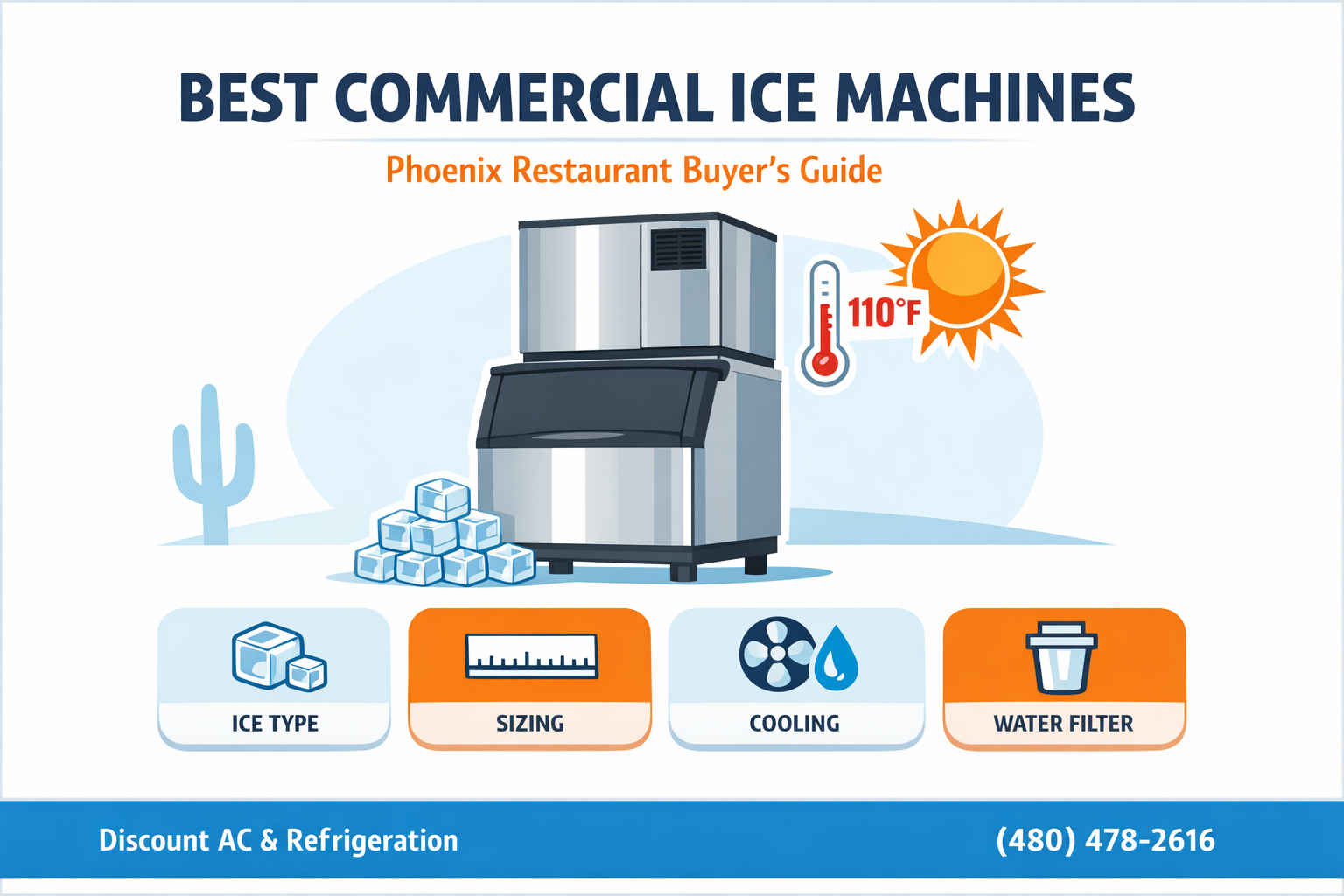
The best commercial ice machine Phoenix restaurants can buy is the one sized for desert heat, matched to the ice your menu needs, and protected against hard-water scale. For most local kitchens that means a properly derated cuber or nugget machine, the right cooling setup for 110°F summers, and a filtration plan. Below, our team breaks down ice types, capacity, cooling, brands, and water quality so you choose once and chill for years.
We have spent more than 20 years installing and servicing ice machines, walk-ins, and refrigeration across the Valley, so we built this guide for owners, chefs, and facility managers who need ice to keep flowing during a 118°F July rush. Buying the wrong unit is expensive in two ways: the purchase itself, and the lost sales and food-safety risk when a machine quits mid-service. The good news is that choosing well is straightforward once you know which factors actually matter in Arizona. As the refrigeration partner many Phoenix restaurants and commercial kitchens rely on, we will walk you through every decision the way we would on a real site visit.
Start With the Right Type of Ice for Your Phoenix Restaurant
Before capacity or cooling, decide what kind of ice your concept actually serves. The shape of the cube changes drink quality, melt rate, throughput, and even how much your customers love refilling their cup. Picking the correct ice type first prevents the most common buyer’s mistake we see when we are called out for commercial refrigeration service: a great machine making the wrong ice.
Commercial Ice Types at a Glance — Matched to Phoenix Restaurant Use
| Ice Type | Best For | Texture & Melt | Phoenix Note |
|---|---|---|---|
| Full / Regular Cube | Bars, soda fountains, mixed drinks, to-go cups | Hard, slow-melting, slow dilution | Slow melt is a real advantage in 110°F dining rooms and patios |
| Half / Dice Cube | High-volume beverage stations, fast casual | Packs densely, fast cooling per ounce | Great throughput when summer traffic spikes |
| Nugget (Chewable) | Healthcare, smoothies, soft drinks, sonic-style fans | Soft, chewable, absorbs flavor | Customer favorite; melts faster, so size up for heat |
| Flake | Seafood displays, salad bars, produce, meat cases | Snow-like, molds around product | Essential for food displays in a hot, dry climate |
| Gourmet / Top Hat | Upscale bars, craft cocktails, hospitality | Clear, slow-melting, premium look | Low dilution keeps signature drinks consistent |
| Crescent | Restaurants, dispensers, all-purpose service | Hard, displaces liquid for fuller-looking cups | Durable and efficient; common on Hoshizaki units |
Cube and Crescent Ice: The Restaurant Workhorses
Cube and crescent ice melt slowly and dilute drinks gently, which is exactly what you want when a guest is nursing an iced tea on a 105°F patio. For most full-service restaurants and bars, a cuber is the safe, versatile choice. We install these every week for dining rooms that need dependable, all-day ice without babysitting the machine.
Nugget Ice: The Crowd-Pleaser That Needs Extra Capacity
Nugget ice has a loyal following, and it can genuinely set a beverage program apart. The trade-off is melt rate. Because nugget melts faster, Phoenix kitchens should size up so the bin does not run dry during a summer rush. If your current nugget machine struggles to keep ahead of demand, that is often a sizing or scale problem rather than a dead machine, and a quick diagnosis usually tells the story.
Flake Ice: Built for Displays in a Dry Climate
If you run a seafood case, raw bar, or produce display, flake ice is non-negotiable. In Arizona’s dry heat, flake holds product temperature and presentation better than cubes. Many of our restaurant clients pair a flaker for displays with a cuber for beverages, and we help map that out during planning.
Sizing the Best Commercial Ice Machine for Phoenix Demand
Sizing is where Arizona buyers get burned most often, because the production number printed on the box assumes mild conditions. A unit rated for 500 pounds per day in a temperate climate can drop to 250–300 pounds in peak Phoenix heat. That is not a defect; it is physics. When ambient air and incoming water are both hot, the machine works harder for less ice. We always plan around real Valley summer conditions, not the spec-sheet ideal.
The Quick Capacity Formula
A reliable starting point is roughly 1.5 to 2 pounds of ice per customer for a restaurant, and more for bars or high-beverage concepts. Add bagged ice, to-go drinks, and catering if those apply. Then, and this is the Arizona-specific step, build in a 20–30% cushion for summer derating so you are not caught short in July. We would rather see a kitchen with comfortable headroom than one chasing ice during its busiest week.
Don’t Forget the Bin
Production and storage are two different numbers. A machine can make plenty of ice over 24 hours yet still run out at 7 p.m. if the bin is too small to bank ice for the dinner rush. We size the head unit and bin together so supply matches your real service curve. The same planning logic we apply to walk-in coolers and freezers applies here: capacity has to match peak demand, not daily averages.
Air-Cooled, Water-Cooled, or Remote Condenser for Arizona Heat
How a machine sheds heat is arguably the most important Phoenix-specific decision, and it is where generic buyer’s guides fall short. Each cooling style behaves differently once the mercury climbs, so let us translate the options into local terms.
Air-cooled units are the most common and affordable, and they work well in a climate-controlled kitchen. The catch is that they dump heat into the surrounding air, so a hot back-of-house or an outdoor enclosure during a Phoenix summer can choke production. If you go air-cooled, give the unit generous clearance and keep ambient temperatures in check. We see avoidable production loss every summer from air-cooled machines crammed into hot corners, the same way we see condenser strain on neglected commercial HVAC systems.
Water-cooled machines hold output far better in high heat because they use a water loop instead of hot air to reject heat. The trade-off is water use, often 100–200 gallons a day, which matters for both your utility bill and Arizona’s water priorities. In some buildings it is the right call; in others the water cost outweighs the benefit. We help you run that math honestly.
Remote condenser setups place the condenser on the roof or outside the kitchen, pulling heat away from the cooking line entirely. For hot kitchens and high-volume operations, this is frequently the best long-term answer in the Valley. It costs more up front and requires professional installation, but it protects production through the worst of summer. When you are ready to compare configurations for your space, our commercial services team can spec the option that fits your building and budget.
The Brands We Install and Service Across the Valley
We stay brand-flexible because the right machine depends on your menu and space, not on a logo. That said, four manufacturers earn their reputation in Phoenix kitchens, and our technicians are trained on all of them.
Hoshizaki
Known for stainless-steel durability and reliable crescent ice, Hoshizaki units tend to age gracefully in demanding environments. They are a strong pick when uptime is everything.
Manitowoc Ice
The Indigo NXT line brings genuinely useful onboard diagnostics and easy-to-clean components, which shortens service calls and helps with the frequent cleanings Arizona water demands.
Scotsman
Scotsman’s Prodigy Plus machines emphasize efficiency and sanitation, and the brand is a go-to for nugget ice if that is your customer draw.
Ice-O-Matic
A dependable value choice that delivers solid production without a premium price, which makes it popular with independent restaurants watching startup costs. Whichever brand you choose, professional setup matters as much as the badge, and when a unit does act up our Phoenix ice machine repair team handles scale, compressor, and production faults on every major make.
Water Quality, Filtration, and the 90-Day Maintenance Reality
Here is the truth that separates machines that last a decade from machines that fail in three years: Phoenix water is hard, and hard water is the enemy of ice. Our municipal supply carries high mineral content, and that scale builds on the evaporator plate and water inlet valve. A valve partly clogged with scale restricts flow, which produces small, hollow, or malformed cubes and eventually no ice at all. We diagnose this exact issue constantly, and we have written more about it in our guide on why commercial ice machines stop making ice in Phoenix.
Two habits protect your investment. First, install proper water filtration sized for your machine, which cuts scale at the source and improves ice clarity and taste. Second, commit to a real maintenance cadence. In cooler climates an annual cleaning is fine; in Arizona, high heat and hard water mean a full preventive service roughly every 90 days. That is the single most cost-effective thing you can do, and it is why we encourage restaurants to fold ice machines into a preventive maintenance program alongside their other equipment. Should a unit fail during service, our emergency commercial refrigeration repair keeps downtime short, and for broader kitchen coolers we also offer same-day walk-in cooler repair across Phoenix.
Restaurants are not our only ice customers, either. Breweries, bars, healthcare facilities, and grocery operations across the Valley rely on us to keep mission-critical ice and restaurant refrigeration running, and when minutes matter our emergency refrigeration service is on call. That volume of real-world service is what informs the advice in this guide. You can see where we are based and read directions on our Google Maps business listing if you want to reach us quickly.
Licensing, Safety Standards, and Professional Installation
A commercial ice machine is a food-contact appliance and a refrigeration system, so installation is not a do-it-yourself project. Cube quality, drainage, refrigerant handling, and sanitation all depend on correct setup, and getting them wrong creates food-safety and reliability problems that surface during your busiest weeks.
Our work is performed by licensed, insured technicians under Arizona license ROC 361623, and we hold to recognized industry standards. We look for equipment certified to NSF/ANSI 12 for food-zone sanitation, follow EPA refrigerant-handling rules on every job, and favor efficient designs in line with ENERGY STAR commercial ice machine guidance to keep operating costs down. These are not marketing badges; they are the standards that protect your guests and your bottom line.
Transparency is part of how we earn long-term clients. We explain what a machine needs, give honest repair-versus-replace guidance, and never pressure a sale. That approach is reflected in our reputation and reviews on Google, and in the fact that so many Valley businesses call us back year after year. As a family-owned Phoenix HVAC and refrigeration company, we treat every install like it has our name on it. If you want to talk through a purchase, you can always contact our team or learn more about Discount AC & Refrigeration.
Phoenix Commercial Ice Machine FAQs
How much ice does a Phoenix restaurant really need?
Why does my ice machine make less ice in summer?
Air-cooled or water-cooled for an Arizona kitchen?
How often should a commercial ice machine be serviced in Phoenix?
Do I need a water filter on my ice machine?
What if my ice machine fails during service?
Keeping Your Phoenix Kitchen Iced, Efficient, and Ready for Summer
Choosing the best commercial ice machine Phoenix restaurants can rely on really comes down to four decisions made in the right order: the ice type your menu needs, capacity sized with a summer cushion, a cooling style that survives 110°F heat, and a filtration plus maintenance plan that beats hard-water scale. Get those right and your machine becomes the quiet, dependable backbone of every shift instead of a recurring headache.
We would be glad to help you make that call with real Valley experience behind it. Our licensed technicians install and service every major brand, we are available from 6 a.m. to midnight every day of the week, and we are happy to give honest repair-versus-replace guidance before you spend a dollar. If you are also weighing the broader picture of cooling costs and equipment lifespan, our breakdown of replacement cost estimates is a useful companion read, and existing customers can earn rewards through our refer and earn program. You can find our location and hours anytime on our Google Maps listing, and explore everything we cover across the Valley on our service areas page — from Phoenix and Mesa to Gilbert and the wider East Valley.
Ready to choose the right ice machine for your Phoenix restaurant?
Our licensed Discount AC & Refrigeration technicians will help you size, select, and install the right unit — available 6 a.m. to midnight, 7 days a week. Visit our Google Maps listing or call now.