Root cause: Most “AC services near me” calls in Phoenix come down to three stress points: restricted airflow, poor heat transfer (dirty coils), or electrical components that can’t handle long summer runtimes. The right service starts by measuring Delta T, static pressure, and system pressures so we fix the cause—not just the symptom.
Phoenix heat doesn’t give you time to “wait and see.” When the system runs long and still feels weak, it’s already telling you something.
If you’re trying to route service quickly, start with the Phoenix hub: AC repair near me in Phoenix. For statewide coverage, use our service areas. If you want to see who you’re working with, start at Discount AC & Refrigeration and our About Us page.
Directions and reviews: Google Maps
Updates and tips on our social channels: https://www.facebook.com/DiscountACR/
Here’s the simple truth. “AC services” isn’t one thing. It’s a decision tree. In Phoenix, the correct branch depends on what your numbers look like—not what a unit “seems” like it’s doing.
What “AC services” means in Phoenix
In the field, AC service usually falls into four buckets:
- Diagnostics (measure and isolate the cause)
- Maintenance (reduce stress points before failure)
- Repair (replace failed parts and verify stable performance)
- Installation or replacement (design a system that can hold up under load)
If you’re a homeowner, this starts under Residential Services. If you operate a facility, restaurant, or manage multiple locations, you’ll spend more time under Commercial Services.
When the system can’t keep up, the fastest way to stop wasting money is to start with AC repair diagnostics. We measure first. Then we recommend the correct path.
If the unit is down right now and the house is heating up fast, use 24/7 emergency AC repair and then follow up with full diagnostics once the emergency is stabilized.
The Phoenix measurements that decide what service you actually need
People ask, “Is it repair or maintenance?”
In Phoenix, that question has a numbers-based answer.
Delta T
Delta T is the temperature difference between return air and supply air under stable conditions.
When Delta T drops, you’ll notice it immediately:
- Longer runtimes
- Warm rooms that never catch up
- The thermostat calling nonstop
Low Delta T can mean high airflow with low capacity, low refrigerant charge, coil performance loss, or metering behavior (TXV). High Delta T can mean restricted airflow or coil starvation. The measurement is only useful when airflow is understood.
Static pressure and airflow
Airflow is half the system. If airflow is wrong, the best equipment in the world will still disappoint you.
High static pressure often comes from:
- Undersized returns
- Restrictive filters
- Dirty evaporator coils
- Crushed or kinked duct runs
If airflow drops far enough, coils freeze. Compressors overheat. Capacitors fail. Repairs repeat.
When airflow is part of the problem, we connect the fix to ductwork services and, when appropriate, comfort and filtration upgrades through indoor air quality.
Head pressure and system pressures
Phoenix heat pushes condensing temperatures high. A dirty condenser coil pushes them higher. Head pressure climbs and everything downstream suffers.
High head pressure stresses:
- Compressors
- Condenser fan motors
- Capacitors
- Contactors
This is why Phoenix burns through electrical parts faster than cooler climates.
Electrical health
Electrical problems don’t always look dramatic. They look “intermittent.” The system works… until it doesn’t.
We commonly see:
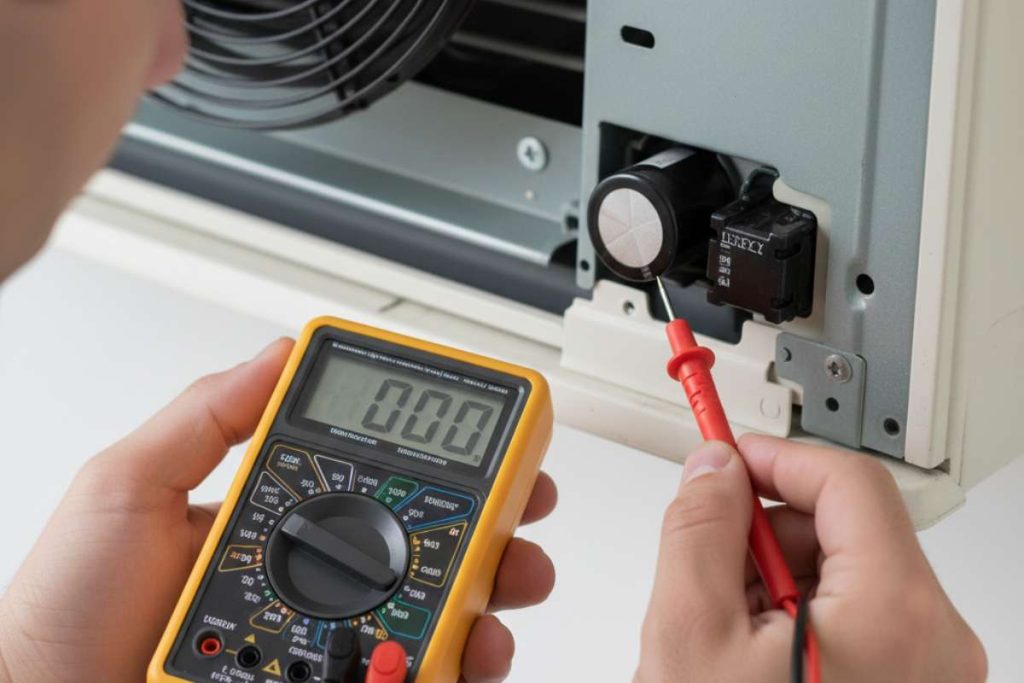
- Weak capacitors that cause hard starts
- Contactors that pit and create random shutdowns
- Loose connections that arc under load
When someone says, “It works at night but not in the afternoon,” we often find electrical and coil stress showing up under peak ambient conditions.
What a real diagnostic visit includes
A proper diagnostic prevents wasted repairs. It saves money because it stops guessing.
When you book AC repair diagnostics, we focus on:
- Delta T performance under realistic load
- Airflow indicators and static pressure
- Coil condition and heat transfer capability
- Electrical components (capacitor, contactor, motor draw patterns)
- Refrigerant circuit behavior (pressures, metering stability)
If the system is repairable, we’ll tell you. If it’s time to plan replacement, we’ll show you why.
If you need to schedule quickly, here’s the direct path: Contact Us.
What Phoenix AC maintenance should cover before summer
Maintenance isn’t a quick look-over. Not here.
A Phoenix tune-up is about stopping predictable failures before they strand you mid-heat wave. Our homeowners usually get best results by scheduling through maintenance programs so visits are consistent, not “whenever we remember.”
A thorough maintenance visit typically targets:
- Indoor and outdoor coil condition
- Airflow restrictions and filter strategy
- Electrical wear items (capacitors, contactors, wiring integrity)
- Drain and condensate management (monsoon season matters)
- Thermostat accuracy and cycling behavior
It’s cheaper to replace a weak capacitor in spring than replace a compressor in July.
What Phoenix AC repair usually looks like in real life
Repairs in Phoenix fall into patterns.
Capacitors and contactors
These are some of the most common failure points in extreme heat. A weak capacitor can mimic a bigger failure. A burned contactor can create “it works sometimes” behavior.
Fan motor and airflow failures
A failing condenser fan motor can push head pressure up quickly. A blower-side airflow restriction can collapse capacity and cause freeze-ups.
Coil and refrigerant-side issues
Dirty coils reduce heat transfer. Refrigerant leaks show up as low capacity and long runtimes. A leak is not a “top-off” situation. It’s a fix-the-cause situation.
If your equipment is older and repairs repeat, we’ll talk about replacement instead of running you in circles.
When installation or replacement becomes the smarter move
If the system can’t hold performance under load, you’ll spend the whole summer chasing problems.
Replacement usually makes sense when:
- Major repairs repeat each season
- Comfort never stabilizes even after repairs
- Efficiency is gone and runtimes are extreme
- The system is aging and parts failures stack up
When replacement is on the table, the right starting point is AC installation and replacement. Proper sizing and airflow planning matter more than “brand preference.”
If you have a hard-to-cool addition, bonus room, or a layout that doesn’t play nicely with central air, ductless can be a smart solution: ductless mini-split systems.
Restaurant and commercial AC services (where downtime costs real money)
Restaurants don’t get second chances in July. When an RTU drops during lunch rush, you lose revenue fast.
For commercial work, we often route service through:
Many restaurants also have refrigeration risk tied to HVAC. If you’re dealing with both, start here:
Service decision table
| What you’re seeing | What it often means | What we check | Best next step |
|---|---|---|---|
| Runs nonstop, still warm | Capacity loss or airflow restriction | Delta T, static pressure, coil condition | Diagnostics first |
| Works at night, fails mid-day | Load exposes coil/electrical weakness | Head pressure behavior, capacitor/contactor health | Diagnostics + repair plan |
| Weak airflow at vents | Duct restriction or blower strain | Static pressure, return sizing | Ductwork evaluation |
| Frequent shutdowns | Electrical wear or high-pressure cutout | Electrical checks, condenser airflow | Repair + verification |
| Repairs keep repeating | System is near end-of-life | Repair history + performance data | Replacement evaluation |
Quick Diagnosis
Symptom → likely cause → what a pro checks (no guessing)
- Weak cooling + long runtime → coil fouling or airflow restriction → Delta T, static pressure, coil inspection
- Short cycling → electrical stress or controls issue → capacitor/contactor, sensor placement, amp draw patterns
- Ice on indoor coil → low airflow or charge problem → airflow checks, coil condition, refrigerant behavior
- Breaker trips on hot days → high head pressure or motor strain → condenser airflow, head pressure behavior, wiring integrity
- Water near air handler → drain restriction → drain line and safety switch function
External references (authoritative)
- Home AC maintenance guidance: ENERGY STAR — Maintenance Checklist
- Diagnostics + maintenance best practices: NREL — Air Conditioner Diagnostics, Maintenance, and Replacement
- Temperature split screening method: Proctor Engineering — Temperature Split Airflow Check
FAQs
What does “AC services near me” include in Phoenix?
It typically includes diagnostics, maintenance, repair, or a replacement evaluation depending on what your system is doing. Phoenix heat makes small restrictions show up as big comfort issues, so measurement-based diagnostics matter.
How often should Phoenix systems get maintenance?
Most systems do best with at least two checkups per year in Arizona. Older equipment or heavy-use properties may need more. Our maintenance programs keep it consistent.
Why does my AC cool at night but struggle in the afternoon?
Afternoon ambient temperature raises head pressure and exposes airflow and coil weaknesses. A system can look “fine” at night and struggle hard under peak load.
Is it normal for my AC to run all day in Phoenix?
Long runtimes are common during extreme heat, but “all day with poor comfort” usually signals a performance problem. Diagnostics clarifies whether it’s airflow, coils, charge, or capacity.
When should I stop repairing and replace?
When performance stays poor under load, repairs repeat, or major components fail on aging equipment. Start with AC repair diagnostics and then review AC installation and replacement if the data supports it.
Do you handle commercial rooftop units?
Yes. Commercial work runs through Commercial HVAC and we stabilize uptime with commercial preventive maintenance.
Do you offer emergency service?
Yes. Use 24/7 emergency AC repair when the unit is down in extreme heat.
Final Take: What to Do Next in Phoenix
Phoenix forces fast decisions. The smartest move is still the same: measure first, fix right.
Start with diagnostics when performance drops. Use maintenance to prevent predictable failures. Choose repair when the system is healthy and a component failed. Choose replacement when the data says the system can’t hold up anymore.
Discount AC & Refrigeration is family-owned, serves Arizona with 20+ years of field experience, and is licensed ROC #361623. We operate 6:00 a.m. to Midnight. We also train our techs through our training program, and we reward referrals through Refer & Earn.
HVAC systems involve high voltage and pressurized refrigerant circuits. Leave it to pros. Call (480) 478-2616 or reach out through Contact Us. For more resources, visit our blog and our Commercial Services pages.
Heating and Air Conditioning Repair Near Me
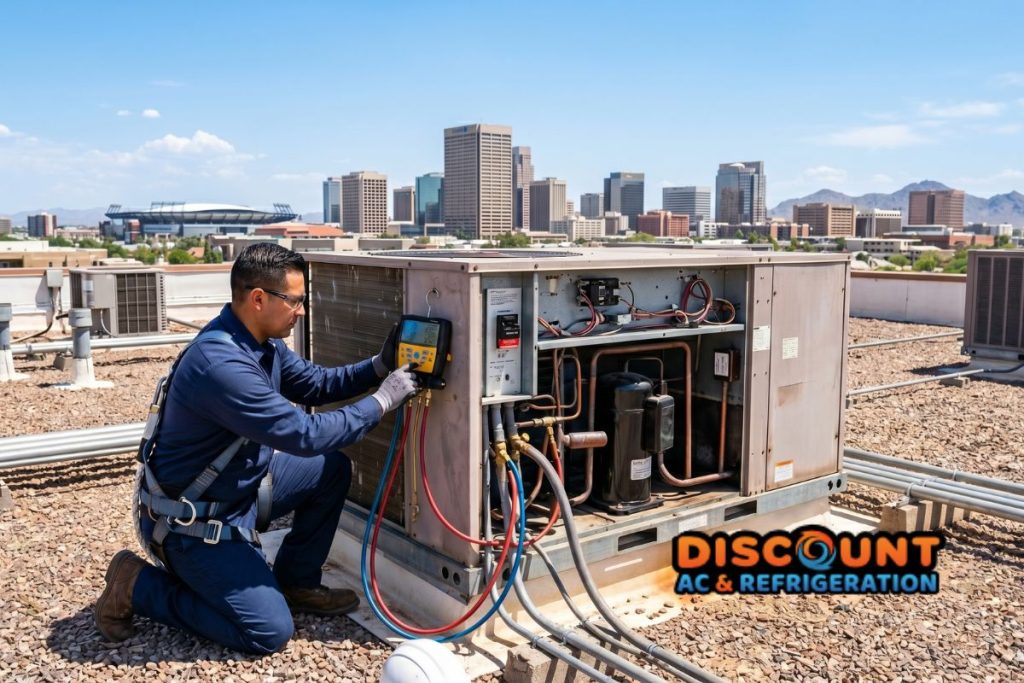
When your HVAC system fails in Arizona, the root cause is frequently a failed dual run capacitor or a dirty condenser coil causing high head pressure. These components take a beating during our 110°F+ summers. If your unit is humming but the fan isn’t spinning, or if it’s blowing warm air, you likely have an electrical failure or a refrigerant leak. Stop searching and get a licensed technician to test your amperage and pressures immediately.
Why “Near Me” Matters for Arizona HVAC
In my 20+ years working on roofs from Tucson to Phoenix, I’ve seen exactly why local expertise wins over national chains. Arizona isn’t like other states. Our equipment has to handle extreme ambient temperatures that would melt units elsewhere. When you search for heating and air conditioning repair near me, you need a technician who understands how monsoon dust clogs coils and how heat load calculations differ in the desert.
At Discount AC & Refrigeration, we don’t just guess. We troubleshoot. As a family-owned business operating under ROC 361623, we treat every service call like we’re visiting a neighbor. Whether it’s a blown fuse or a seized compressor, we identify the failure point and fix it right.
Residential Cooling: More Than Just Freon
Homeowners often ask me to “just add some Freon.” But a system doesn’t “use up” refrigerant; it leaks it. If I just add gas without fixing the leak, you’re throwing money away.
Critical Component Failures
During a typical July week in Phoenix, my truck is stocked with capacitors and hard start kits. These are the first line of defense for your compressor. When they get weak, your compressor draws high amps and eventually overheats.
If your unit is older, we might look at AC installation and replacement. Newer high-efficiency units (with higher SEER ratings) handle the heat load much better than the builders-grade units installed 15 years ago.
The Ductwork Factor
You can have the best condenser in the world, but if your return air ducts are undersized or leaking, you will never be comfortable. We inspect static pressure to verify airflow. Poor airflow freezes coils. If you are noticing dust buildup around vents or sneezing more often, let us check your indoor air quality.
Ductless Options for Hot Rooms
Have a garage or a master bedroom that never stays cool? We install ductless mini-split systems that bypass central ductwork entirely. They are efficient and perfect for zoning specific areas of your home.
| Problem / Symptom | Likely Cause | Recommended Solution |
|---|---|---|
| Unit hums but fan won’t spin | Failed dual run capacitor | Replace Capacitor |
| Blowing warm air | Refrigerant leak or dirty coil | Test Pressure & Leak Search |
| Ice machine cubes are thin | Scale buildup on evaporator | Descale & Sanitize |
| Warm rooms / Poor airflow | Undersized or leaking return ducts | Inspect Static Pressure |
Commercial HVAC: Keeping Business Running
I know that if the AC dies in a restaurant or server room, you are losing money every minute. Commercial systems—like Rooftop Units (RTUs)—face different stresses than residential ones. Belt tension, economizer linkages, and three-phase power monitors need regular eyes on them.
We handle commercial HVAC repairs across the valley. From a simple belt replacement to a full compressor change-out, we keep your doors open.
Refrigeration and Cold Storage
For our restaurant clients, a warm walk-in is a disaster. We specialize in commercial refrigeration, including troubleshooting TXV valves and defrost timers on walk-in coolers and freezers.
We also service ice machines. Scale buildup is the enemy here. If your cubes are coming out thin or the machine is locked out on a safety code, our ice machine service technicians can descale and sanitize the evaporator plate to restore production.
Preventive Maintenance
The best repair is the one you don’t have to make. Our preventive maintenance plans are designed to catch that fraying belt or bulging capacitor before it snaps on a Friday night.
Serving the Entire Valley
We don’t limit ourselves to one zip code. Our technicians are staged across the state to ensure rapid response times.
- East Valley: We have trucks ready for AC repair in Gilbert and Mesa.
- West Valley: From commercial AC repair in Surprise to residential calls in Avondale.
- Central: We cover Scottsdale and the heart of Phoenix.
- Southern AZ: We even extend our AC repair services to Tucson.
Frequently Asked Questions
Why is my AC blowing warm air?
This is often due to a refrigerant leak or a dirty condenser coil. Do not just add Freon without fixing the leak. Contact us for Emergency AC Repair to diagnose the root cause.
How do I know if I need a new AC?
If your unit is over 15 years old and repairs are becoming frequent, replacement is often more cost-effective. Modern units handle Arizona heat better. Learn more about AC Installation & Replacement.
Do you fix commercial refrigeration units?
Yes, we service walk-in coolers, freezers, and ice machines for restaurants and businesses. Visit our Commercial Refrigeration page for details on ice machine descaling and repairs.
What prevents AC breakdowns in summer?
Regular inspections are key. We check belt tension, capacitors, and pressures to catch issues early. Check out our Preventive Maintenance plans.
What areas do you serve in Arizona?
We are based in Queen Creek but serve the entire valley, including Mesa, Phoenix, Scottsdale, and even Tucson. You can find more details on our Contact Us page.
Are you available on weekends?
Yes! We operate from 6:00 a.m. to Midnight, 7 days a week, to ensure you aren’t left in the heat. Visit our Home Page to see our full service commitment.
Is Discount AC & Refrigeration licensed?
Yes, we are a family-owned business operating under license ROC 361623. We pride ourselves on transparency and expertise. Read more about our history at About Us.
Can I earn money by referring a friend?
Absolutely. If you know someone struggling with their AC, we pay cash for successful referrals. Check out the details of our Refer & Earn Program.
When to Call a Professional
HVAC systems involve high voltage electricity (240V+), flammable gases, and high pressures (400+ PSI). This is not a DIY environment. One wrong move with a multimeter can cause serious injury or destroy the equipment.
Trust the team that Arizona residents have relied on for decades. We are transparent with our pricing and clear with our diagnostics.
Need help now?
- Check our 24/7 emergency AC repair options.
- Visit our Contact Us page to schedule a tech.
- Learn more About Us and our family history.
Bonus for Locals: Do you know someone else struggling with their AC? We pay cash for referrals. Check out our Refer & Earn program. It’s our way of saying thanks to the community that supports us.
Discount AC & Refrigeration 17426 E Hunt HWY, Queen Creek, AZ 85142 (480) 478-2616