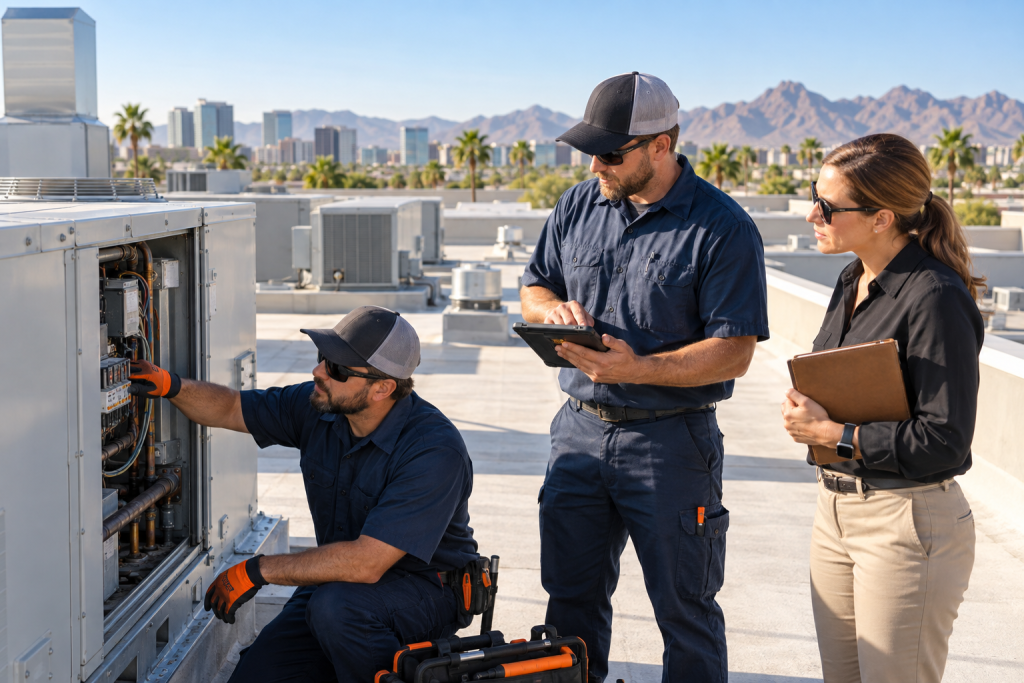
Multi-family property managers in Phoenix need HVAC contractors who handle 50-500+ unit complexes with scheduled maintenance, emergency response under 4 hours, and transparent per-unit pricing that simplifies budgeting. The right contractor reduces tenant complaints, prevents costly emergency calls during 115°F summers, and extends equipment lifespan across your entire portfolio.
Why Multi-Family HVAC in Phoenix Demands a Specialized Contractor
Managing HVAC across apartment complexes, condominiums, and townhome communities is fundamentally different from single-building commercial service. Property managers juggle tenant comfort expectations, maintenance budgets, unit turnover schedules, and regulatory compliance—all while Phoenix’s desert heat pushes systems to their limits 6-7 months per year.
A single-family HVAC company sends one technician to one home. A commercial contractor handles one large system in one building. Neither model fits multi-family operations where you need coordinated service across dozens or hundreds of individual units, each with its own equipment, tenant schedule, and maintenance history.
The right commercial HVAC contractor for property management understands volume logistics: scheduling maintenance across occupied units without disrupting tenants, maintaining parts inventory for common equipment models across the property, tracking service history per unit for capital planning, and responding to emergency calls within hours—not days—because a broken AC in Phoenix summer is a habitability issue, not an inconvenience.
Discount AC & Refrigeration has served multi-family properties across the Phoenix metro area for over 20 years, from 30-unit apartment buildings to 400+ unit complexes in Mesa, Tempe, Chandler, and Scottsdale.
The Multi-Family HVAC Challenge in Phoenix’s Climate
Phoenix’s extreme heat creates HVAC demands that amplify across multi-family portfolios. Understanding these challenges helps property managers plan maintenance budgets and set realistic expectations for equipment lifespan.
Heat Load Multiplication
A single apartment unit with a 3-ton AC system in Phoenix runs 10-14 hours daily during peak summer. Multiply that by 200 units in a complex, and you have 200 compressors running simultaneously, drawing massive electrical load, and generating maintenance needs at a predictable rate. Statistically, in a 200-unit complex, 8-12 AC systems will require repair during any given summer month. Without a maintenance contract, each repair becomes a separate emergency call at premium pricing.
Equipment Standardization vs. Reality
Newer complexes may have standardized equipment—same brand, model, and tonnage across all units. Older properties typically have a mix of brands, ages, and refrigerant types (R-22, R-410A, R-32) accumulated through years of individual unit replacements. A contractor experienced in multi-family service maintains familiarity with all common equipment and stocks parts accordingly.
Tenant Coordination
Every HVAC service call in an occupied unit requires tenant coordination—scheduling access, ensuring pets are secured, communicating repair timelines, and following up on completion. A contractor without multi-family experience treats each call as isolated; a specialized contractor batches service calls, coordinates with your property management office, and provides documentation for your maintenance records.
Common Area Systems
Beyond individual units, multi-family properties have common area HVAC: lobbies, fitness centers, clubhouses, laundry rooms, and hallways. These systems are larger tonnage, run on different maintenance cycles, and serve the entire community. A contractor handling your property should service both individual units and common area equipment under one contract.
What a Multi-Family HVAC Maintenance Contract Should Include
Not all maintenance contracts are equal. Property managers should evaluate contracts based on coverage scope, response time guarantees, pricing structure, and reporting capabilities.
Scheduled Preventive Maintenance
Each unit should receive a minimum of two maintenance visits per year—one pre-summer (April-May) and one pre-winter (October-November). During each visit, the technician inspects the condensing unit, checks refrigerant charge, cleans or replaces the air filter, tests electrical connections, verifies thermostat calibration, and documents findings.
For Phoenix properties, pre-summer maintenance is critical. Catching a weak capacitor, low refrigerant charge, or dirty condenser coil in April prevents an emergency failure in July when repair demand peaks and response times lengthen industry-wide.
Emergency Response Guarantee
The contract should specify maximum response time for emergency calls—ideally under 4 hours during summer months. In Phoenix, a non-functioning AC unit in an occupied apartment during summer creates a habitability issue that can trigger tenant complaints, lease violations, and potential legal liability. Your contractor must have the dispatch capacity to respond quickly across your portfolio.
Per-Unit Pricing Transparency
Multi-family contracts typically price on a per-unit-per-month basis, covering scheduled maintenance and sometimes including a set number of emergency calls. This structure converts unpredictable repair expenses into a fixed monthly cost that simplifies budgeting. Ask for clear breakdowns: what’s included in the base rate, what triggers additional charges, and what the labor/parts markup is for non-covered repairs.
Unit-Level Service Tracking
Your contractor should provide documentation for every service call—unit number, date, technician, findings, parts used, and recommendations. This data feeds into your capital expenditure planning: when you can see that Building C has 15 units with compressors over 12 years old, you can budget for phased replacement rather than reacting to failures.
Common Area Coverage
Ensure the contract covers common area systems at specified maintenance intervals. Lobby and clubhouse systems run different hours than residential units and may require commercial-grade maintenance including duct cleaning, coil treatment, and control calibration.
Cost Comparison: Contract Maintenance vs. On-Demand Service
Property managers often debate whether maintenance contracts are worth the investment compared to calling for repairs as needed. The data consistently favors contracts for multi-family properties.
On-Demand (No Contract) Costs
Without a contract, each service call is billed at standard rates: $85-$150 for the diagnostic visit, plus parts and labor at retail pricing. During peak summer months (June-September), emergency rates can increase 25-50% due to demand. A 100-unit property averaging 8-10 emergency calls per summer month spends $8,000-$15,000+ in reactive repairs annually—with no preventive work reducing future failures.
Contract Maintenance Costs
A typical multi-family maintenance contract runs $8-$20 per unit per month depending on equipment age, complexity, and included services. For a 100-unit property, that’s $9,600-$24,000 annually—but includes two scheduled maintenance visits per unit, priority emergency response, reduced labor rates on repairs, and documented service history.
The ROI Difference
Properties on maintenance contracts see 30-40% fewer emergency calls because preventive maintenance catches failing components before they break. Equipment lifespan extends 3-5 years on average. Energy efficiency improves 10-15% when systems are clean and properly charged. Tenant satisfaction increases because fewer units experience mid-summer failures.
Over a 5-year period, a 100-unit property on a maintenance contract typically saves $25,000-$50,000 compared to reactive-only service when factoring in reduced emergency calls, extended equipment life, and lower energy costs.
Capital Planning: When to Replace vs. Repair Across Your Portfolio
Multi-family property managers face ongoing decisions about unit-level HVAC replacement. A strategic approach saves money and reduces disruption.
The 12-Year Rule
In Phoenix’s climate, residential-grade HVAC equipment in multi-family units averages 10-14 years of useful life. Systems approaching 12 years old in a desert environment have consumed most of their reliable service life. Rather than waiting for failures, proactive managers budget for phased replacement—replacing the oldest 10-15% of units each year, spreading capital expenditure over time instead of facing a wave of simultaneous failures.
Refrigerant Transition Planning
Properties with R-22 (Freon) equipment face escalating refrigerant costs as R-22 production ended in 2020. Each repair requiring R-22 recharge costs significantly more than R-410A equivalent. If more than 30% of your units still run R-22 equipment, developing a replacement timeline is a financial priority.
Energy Efficiency Upgrades
Newer HVAC equipment (16+ SEER) reduces per-unit energy consumption by 25-40% compared to older 10-13 SEER units. For properties where the landlord pays utilities, this directly reduces operating costs. For tenant-paid utilities, energy-efficient equipment becomes a leasing advantage—tenants prefer lower utility bills, especially in Phoenix where summer electric bills can exceed $200/month.
Unit Turnover Replacement Strategy
The most cost-effective time to replace aging HVAC equipment is during tenant turnover. The unit is empty, access is unrestricted, and the new system is ready for the incoming tenant. Coordinate with your property management team to flag units with equipment over 12 years old for replacement during the next vacancy.
Compliance and Liability Considerations
Multi-family HVAC maintenance intersects with legal and regulatory requirements that property managers must address.
Habitability Standards
Arizona’s residential landlord-tenant act requires landlords to maintain heating and cooling systems in working condition. During Phoenix summers, a non-functioning AC system can render a unit uninhabitable, potentially triggering rent abatement, lease termination rights, or code enforcement action. Rapid HVAC response isn’t optional—it’s a legal obligation.
EPA Refrigerant Regulations
All refrigerant handling must be performed by EPA-certified technicians. Improper refrigerant recovery, venting, or disposal creates regulatory liability for the property owner. Your HVAC contractor must provide proof of EPA certification and follow proper recovery procedures.
Air Quality and Mold Prevention
HVAC systems that aren’t properly maintained can contribute to indoor air quality issues, including mold growth in ductwork and drain pans. In Arizona’s monsoon humidity spikes (July-September), condensate management becomes critical. Clogged drain lines cause water damage and mold, creating liability exposure and costly remediation.
Documentation for Asset Management
Comprehensive HVAC service records demonstrate proper maintenance to potential buyers, lenders, and investors during property transactions. Well-documented maintenance history supports higher property valuations and smoother due diligence processes.
Your Next Step for Reliable Multi-Family HVAC Service in Phoenix
Managing HVAC across a multi-family portfolio requires a contractor who understands volume, tenant coordination, budget constraints, and Phoenix’s extreme climate demands. Reactive service costs more, disrupts tenants, and shortens equipment life. Proactive maintenance contracts deliver predictable costs, fewer emergencies, and longer-lasting systems.
Discount AC & Refrigeration provides multi-family HVAC maintenance contracts across Phoenix, Mesa, Tempe, Chandler, Scottsdale, and the East and West Valley. Our licensed, EPA-certified technicians service individual units and common area systems under one contract with per-unit pricing, priority emergency response, and detailed service documentation for your property management records.
Call: (480) 478-2616
Available 6 AM–Midnight, 7 days/week. Licensed • Insured • EPA-Certified.
Request a Multi-Family HVAC Quote | Commercial HVAC Services | About Discount AC & Refrigeration
Contract Maintenance vs. On-Demand Service: Cost Comparison (100-Unit Property)
| Factor | On-Demand (No Contract) | Maintenance Contract |
|---|---|---|
| Annual cost (100 units) | $12,000 – $20,000+ (unpredictable) | $9,600 – $18,000 (fixed monthly) |
| Preventive maintenance | None included | 2 visits/unit/year included |
| Emergency response time | 8-24 hours (peak summer) | Under 4 hours (priority) |
| Summer emergency calls | 8-12 per month (reactive) | 4-7 per month (30-40% fewer) |
| Diagnostic fee | $85-$150 per call | Often waived or reduced |
| Parts/labor rates | Retail pricing | 10-20% discount |
| Equipment lifespan | 8-10 years (Phoenix avg) | 12-14 years (with maintenance) |
| Energy efficiency | Degrades 5-10% yearly | Maintained at 90-95% of rated |
| Service documentation | Invoice only | Full unit-level history + reports |
| 5-year total cost estimate | $80,000 – $120,000 | $55,000 – $85,000 |
Multi-Family HVAC Maintenance Visit Checklist
| Component | What We Check | Why It Matters in Phoenix |
|---|---|---|
| Air filter | Inspect, replace if needed | Desert dust clogs filters 2x faster; restricted airflow causes freezing |
| Condenser coil | Clean fins, check for damage | Dirty coils reduce efficiency 15-25% in 110°F+ heat |
| Refrigerant charge | Pressure test, check for leaks | Low charge forces compressor to overwork; accelerates failure |
| Electrical connections | Tighten, test voltage, check capacitor | Heat degrades capacitors and contactors; causes short cycling |
| Thermostat | Calibrate, test accuracy | Miscalibrated thermostats waste energy and trigger tenant complaints |
| Condensate drain | Clear line, treat with algaecide | Monsoon humidity clogs drains; causes water damage and mold |
| Blower motor | Test amperage, lubricate bearings | Overworked motors in desert heat fail prematurely |
| Ductwork | Visual inspection for leaks/damage | Leaky ducts waste 20-30% of cooled air in attic spaces |
| Safety controls | Test high/low pressure switches | Faulty switches cause false shutdowns or fail to protect compressor |
| Overall system | Record age, model, performance data | Tracks equipment lifecycle for capital planning decisions |
FAQ: Multi-Family HVAC Property Management
How many units do you service under one maintenance contract?
We service multi-family properties ranging from 20-unit apartment buildings to 500+ unit complexes across the Phoenix metro area. Our dispatch and scheduling systems are designed for volume—we coordinate maintenance visits across occupied units, batch service calls by building, and maintain parts inventory for common equipment models found across your property. Contract pricing scales with unit count, so larger properties receive better per-unit rates.
What is your emergency response time for multi-family properties?
Contract clients receive priority dispatch with a target response time under 4 hours during peak summer months. For non-contract emergency calls, response depends on current demand—during July and August, industry-wide response times stretch significantly. This is one of the primary advantages of a maintenance contract: guaranteed priority when your tenants need it most.
How do you handle tenant access and scheduling?
We coordinate directly with your property management office or on-site maintenance team. For scheduled maintenance, we provide 48-72 hours advance notice so your team can notify tenants. We work within your preferred access protocols—whether that’s tenant-present visits, maintenance staff escort, or lockbox access. Each visit is documented with unit number, findings, and any follow-up recommendations sent to your designated contact.
What does a typical multi-family maintenance visit include?
Each maintenance visit covers thermostat calibration, air filter inspection and replacement, condensing unit inspection and cleaning, refrigerant charge check, electrical connection testing, condensate drain line clearing, and a visual ductwork inspection. For common area systems, we add coil cleaning, belt inspection, and control system verification. The technician documents all findings and flags any units needing repair or approaching end-of-life.
How much does a multi-family HVAC maintenance contract cost?
Pricing depends on unit count, equipment age, included services, and emergency call coverage. Typical contracts range from $8-$20 per unit per month. A 100-unit property might pay $12,000-$18,000 annually for comprehensive coverage including two scheduled visits per unit, priority emergency response, and reduced repair rates. We provide customized quotes based on a property walkthrough and equipment assessment. Contact us for a no-obligation quote.
Can you help with capital planning for HVAC replacement across my portfolio?
Yes. Our service documentation tracks equipment age, repair frequency, and efficiency data for every unit. We provide annual capital planning reports that identify which units are approaching end-of-life, recommend phased replacement schedules, and estimate costs for budgeting. This data helps property managers and owners plan capital expenditures 2-3 years ahead rather than reacting to failures.
Do you service both individual units and common area HVAC?
Yes. Our contracts cover individual apartment/condo units and all common area systems—lobbies, clubhouses, fitness centers, laundry rooms, and hallways—under one agreement. Common area systems typically operate on commercial maintenance schedules with quarterly or monthly visits depending on usage and equipment type.
What if a tenant damages their HVAC unit?
We document all service calls with photos and technical findings. If damage is consistent with tenant misuse (e.g., blocked vents, removed filters, thermostat set to extreme temperatures), our report provides the documentation your property management team needs for tenant billing or deposit deductions. We differentiate between normal wear-and-tear and tenant-caused damage in every service report.
Do you handle R-22 (Freon) equipment still in older units?
Yes. Many older multi-family properties still have R-22 systems. We service and repair these units and can source R-22 refrigerant, though costs have increased significantly since production ended in 2020. For properties with substantial R-22 inventory, we recommend a phased replacement plan to transition to R-410A or R-32 equipment, prioritizing units with the highest repair frequency or lowest efficiency.
What areas in Phoenix do you cover for multi-family HVAC?
We service multi-family properties throughout the Phoenix metro area including Phoenix, Mesa, Tempe, Chandler, Gilbert, Scottsdale, Glendale, Peoria, Surprise, Goodyear, Avondale, Buckeye, Queen Creek, and Maricopa. We also serve properties in Tucson. Our mobile dispatch covers the entire Maricopa County service area with technicians positioned across the valley for rapid response.