Industrial and commercial process cooling—cooling for manufacturing, data centers, medical facilities, and food processing—demands precision, reliability, and scalability that standard commercial HVAC cannot provide. When your facility’s core operation depends on maintaining exact water or fluid temperature within 0.5°F tolerance, you need industrial process cooling equipment engineered for 24/7 duty cycles and extreme loads.
Phoenix’s desert heat and hard water create unique challenges for process cooling systems. Manufacturing plants generate 500,000+ BTU/h of waste heat from machinery. Data centers draw 50-200 kW of server heat per cabinet. Pharmaceutical production requires temperature-humidity control tighter than ±2°C. Without properly designed cooling systems, precision processes fail, product quality degrades, and downtime costs spiral into thousands per hour.
Understanding Industrial Process Cooling Technologies
Process cooling differs fundamentally from comfort cooling (HVAC). While residential air conditioning cools air to 70-75°F, process cooling circulates chilled water or glycol solution to cool machinery, process tanks, or server racks to precise setpoints—often 45-55°F for water-cooled servers, or 32-45°F for food processing.
Chiller Systems: The Heart of Industrial Cooling
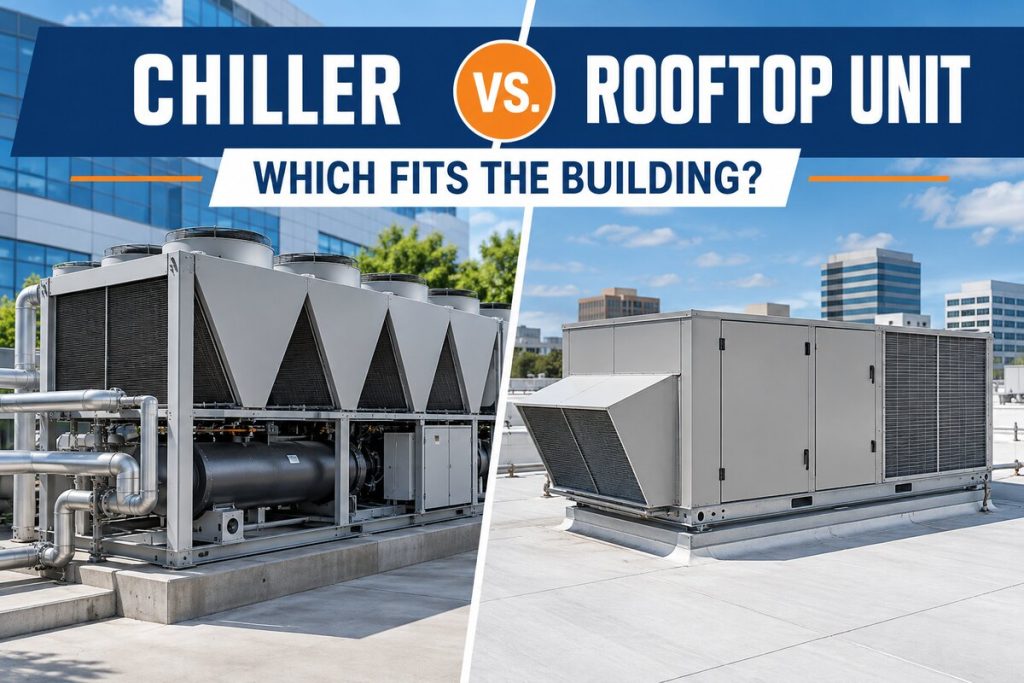
A chiller is a refrigeration machine that cools water or glycol from 70-80°F inlet temperature down to 40-50°F outlet temperature. The chiller operates continuously, month after month, year after year. Unlike residential air conditioners designed for 15-20 year lifespans, industrial chillers run 8,000-8,760 hours annually (continuous) and must operate reliably for 25-30 years.
Water-Cooled Chillers:
- Refrigeration circuit cools water inside an evaporator
- Waste heat is rejected to a cooling tower (see below) or condenser unit
- Efficiency: 0.5-0.7 kW per ton of cooling (typical 15-20 EER)
- Best for: Large loads (>30 tons), continuous duty, indoor installation
- Cost: $15,000-$50,000+ depending on capacity and compressor type
Air-Cooled Chillers:
- Refrigeration circuit cools water, waste heat rejects directly to outdoor air
- No cooling tower required; self-contained outdoor unit
- Efficiency: 0.8-1.0 kW per ton (lower than water-cooled, but acceptable for smaller loads)
- Best for: Smaller loads (<30 tons), outdoor installation, areas with water scarcity
- Cost: $12,000-$35,000+
Cooling Towers: Rejecting Waste Heat Efficiently
A cooling tower uses evaporative cooling (water evaporation) to dissipate heat to the atmosphere. Hot water from the chiller condenser (typically 95-105°F in Phoenix) enters the tower. Air flows upward through the tower’s fill material while water cascades downward, transferring heat through evaporation.
The cooled water (typically 80-85°F) returns to the chiller condenser, completing the loop. A cooling tower can reject heat at approximately one-third the energy cost of an air-cooled condenser, making water-cooled chiller systems much more efficient than air-cooled systems for large loads.
Types of Cooling Towers:
- Crossflow: Air flows horizontally through the fill; compact, quiet, commonly used in Phoenix
- Counterflow: Air flows upward opposite to water flow; slightly more efficient, but taller profile
- Closed-loop (plate-frame): Water never contacts air; eliminates algae/mineral buildup; essential for glycol systems and sensitive processes
Capacity Range: 10 tons to 500+ tons of heat rejection
Cost: $3,000-$30,000+ depending on capacity and materials (galvanized steel vs. fiberglass)
Glycol Chilling Systems: Freeze Protection for Cold Process Cooling
Some processes require cooling below water’s freezing point (32°F). Antifreeze glycol solutions (typically 30-50% propylene or ethylene glycol in water) allow safe chilling to -10°F while maintaining fluidity and heat transfer properties.
Glycol systems require:
- Closed-loop circulation (no open cooling towers)
- Specialized plate-frame heat exchangers
- Regular glycol testing and replacement (typically every 5-10 years)
- Larger pump capacity (glycol is more viscous than water)
Applications: Pharmaceutical storage (-5 to 5°C), cryogenic applications, ice skating rinks
Cost Premium: Glycol systems cost 20-30% more than equivalent water systems due to fluid costs and closed-loop components.
Phoenix-Specific Challenges for Process Cooling
Extreme Heat Impact on Cooling Efficiency
Phoenix’s summer temperatures (110-118°F) push cooling tower performance to its limits. A cooling tower’s efficiency depends on the temperature difference between the ambient dry-bulb temperature and wet-bulb temperature (humidity). On a 115°F day with low humidity (20%), the wet-bulb temperature might be only 70°F, giving a 45°F approach. But on rare high-humidity days (40%), wet-bulb climbs to 80°F, and the tower can only cool water to approximately 88-92°F—barely adequate for chiller inlet conditions.
When cooling towers can’t reject heat efficiently:
- Chiller inlet temperature rises (approaching 95-100°F in worst case)
- System pressure increases dangerously
- Refrigerant efficiency plummets
- Chiller compressor overloads and overheats
- Risk of compressor failure and downtime
Solution: Oversizing the cooling tower (20-30% larger than minimum design) ensures adequate cooling even on extreme high-humidity days.
Hard Water Scale and Condenser Fouling
Phoenix’s hard water (calcium and magnesium content 250-350 ppm) deposits mineral scale on cooling tower fill and chiller condensers. Scale insulation reduces heat transfer efficiency by 10-30% per year of operation without treatment.
Prevention strategies:
- Water softening/filtration: Reduce incoming water hardness by 80% before entering cooling tower
- Chemical treatment: Corrosion inhibitors, scale inhibitors, and biocides maintain condenser efficiency
- Quarterly condenser cleaning: Professional tube cleaning removes scale buildup
- Annual cooling tower inspection and cleaning: High-pressure cleaning restores fill efficiency
Cost: $500-$2,000/year for comprehensive water treatment and maintenance (cheap insurance against $8,000-$15,000 chiller failure)
Dust and Particulate Fouling
Phoenix’s desert environment deposits dust, pollen, and particulates on cooling tower fill and chiller air-cooled condensers. Clogged fill reduces air flow and cooling capacity by 15-25% within months of operation.
Monthly cooling tower fill washing and fan blade cleaning prevent efficiency loss.
Industrial Process Cooling System Design
Proper design requires:
- Load Calculation: Total heat to be removed (measured in BTU/h or tons of refrigeration)
- Equipment heat generation (from data sheets)
- Process fluid temperature rise
- Safety factor for peak loads
- Example: 100 servers × 500W per server = 50 kW (172,000 BTU/h ≈ 14 tons of cooling needed)
- Chiller Selection: Size and type based on load and application
- Oversizing by 10-20% ensures capacity margin on peak hot days
- Cooling Tower or Condenser Sizing: Heat rejection must exceed chiller load by 5-10% (accounts for compressor inefficiency)
- Piping Design: Flow rates, pipe sizing, pressure drop analysis
- Typical flow rates: 2-3 GPM per ton of cooling
- Pressure drop: 2-5 psi maximum across entire loop
- Example: 14-ton system = 28-42 GPM, ~300 GPM equivalent cooling tower size
- Redundancy and Control: Critical systems require backup
- Dual chillers on standby, or
- Partial system operation if primary fails
- Automated switchover controls
Industrial Process Cooling Applications in Phoenix
Data Center Cooling
Data centers in Phoenix generate massive heat loads: a 1 MW facility (10,000 servers) generates 3.4 million BTU/h (283 tons) of cooling demand. Most modern data centers use:
- Chilled water distribution: Water at 50-55°F circulates to overhead in-row cooling units or hot aisle containment
- Cooling tower or dry cooler: Rejects compressor waste heat (adds ~10-20% to load)
- Free cooling: Economizer mode: on cool nights/winter, use outside air or indirect heat exchange to cool water without running compressor
Energy efficiency matters: Reducing PUE (Power Usage Effectiveness) from 1.8 to 1.3 saves 30-40% on total facility power, equivalent to $100,000-$500,000/year for large data centers.
Manufacturing Plant Cooling
Industrial machinery generates concentrated heat: CNC machines, injection molding equipment, forges, and paint booths all require cooling to:
- Cool the machine itself (extend component life)
- Cool the product (metal dies, tooling)
- Maintain environmental conditions (mold release temperature, chemical reactivity)
Typical systems: 10-50 tons of process cooling circulated through dedicated loops to each machine or process station.
Pharmaceutical and Food Processing
Temperature and humidity control are critical:
- Pharmaceutical storage: 2-8°C (36-46°F) for drug stability
- Food processing: 32-40°F for meat processing, 38-42°F for ice cream production
- Controlled atmosphere: Temperature ±2°C, humidity ±5% RH
These applications require:
- Glycol-based chilling for sub-freezing temperatures
- Closed-loop systems to prevent contamination
- Redundant chillers for zero-downtime operation
- Monitoring and logging for regulatory compliance (FDA, cGMP)
Medical Facility Cooling
Hospitals and clinics require reliable cooling for:
- MRI magnets (require continuous 20°C cooling or magnet quenches)
- Operating rooms (precise humidity control for sterility)
- Lab equipment (critical temperature stability for accuracy)
- Server and imaging system cooling (PACS, radiology systems)
Downtime directly impacts patient care, making redundancy and 24/7 monitoring non-negotiable.
Industrial Process Cooling Installation & Service
Installation is complex and requires specialized contractors:
- Engineering Design Phase: 4-8 weeks
- Detailed load calculations
- Equipment selection and sizing
- P&ID (Process & Instrument Diagram) development
- Permit applications
- Equipment Procurement: 6-12 weeks
- Lead times for custom chillers and cooling towers
- Long-lead components (compressors, heat exchangers)
- Installation & Commissioning: 4-12 weeks
- Structural supports (cooling towers can weigh 5-50+ tons)
- Refrigerant charging and system evacuation (EPA-certified)
- Water system flushing and chemical treatment
- Startup, load testing, and performance verification
Total Project Timeline: 6-12 months from design to full operation
Cost Range:
- Small system (5-15 tons): $25,000-$60,000
- Medium system (15-50 tons): $60,000-$200,000
- Large system (50-150+ tons): $200,000-$800,000+
Why Discount AC & Refrigeration for Industrial Process Cooling
Discount AC & Refrigeration brings 20+ years of experience in Phoenix’s demanding climate:
- EPA-certified technicians: All refrigerant and process cooling work meets federal certifications
- Design expertise: Custom load calculations and system design for your specific application
- Installation capability: From small-load packaged units to large multi-ton chiller and cooling tower systems
- Maintenance contracts: Quarterly service, chemical treatment, and emergency support
- 24/7 emergency service: Process cooling downtime costs thousands per hour; we prioritize emergency calls
- Arizona climate expertise: We understand hard water, extreme heat, and dust challenges unique to Phoenix
Contact us at (480) 478-2616 for a process cooling consultation, system design, or emergency service.
Water-Cooled vs. Air-Cooled Chiller Comparison
| Feature | Water-Cooled Chiller | Air-Cooled Chiller |
|---|---|---|
| Cooling Efficiency | 0.5-0.7 kW/ton (15-20 EER); very efficient | 0.8-1.0 kW/ton (10-15 EER); moderate efficiency |
| Ideal Load Range | >15 tons; scales to 100+ tons | <10 tons; limited scaling |
| Installation Space | Indoor unit (compact); separate cooling tower outdoors | Single outdoor unit; needs clear space for airflow |
| Initial Cost (10-ton) | $25,000-$40,000 (chiller + tower) | $18,000-$28,000 |
| Operating Cost (annual) | $4,000-$6,000 (10-ton load, Phoenix) | $6,000-$9,000 |
| Cooling Tower Required | Yes; essential for heat rejection | No; self-contained |
| Performance in Heat | Excellent; cooling tower improves efficiency as ambient temp rises | Degrades in Phoenix heat (115°F+) |
| Noise Level | Low (indoor compressor, outdoor tower noise) | High (all components outdoor, louder) |
| Water Treatment Needed | Yes; cooling tower scale prevention critical in Phoenix | No; simpler maintenance |
| Lifespan | 25-30 years with maintenance | 15-20 years |
| Best Use Case | Data centers, manufacturing (25+ tons), continuous operation | Small labs, offices (<10 tons), intermittent use |
Industrial Process Cooling Applications
| Application | Typical Load | Required Temperatures | System Type |
|---|---|---|---|
| Data Center Cooling | 50-500 tons | 50-55°F chilled water; precise ±2°C | Water-cooled chiller with cooling tower; free cooling economizer |
| Manufacturing Equipment | 5-100 tons | 40-55°F for machine cooling, process-specific | Water-cooled chiller or packaged air-cooled for smaller loads |
| Food Processing | 10-50 tons | 32-40°F for freezing/refrigeration | Glycol-based chiller with closed-loop circulation |
| Pharmaceutical Storage | 3-30 tons | 2-8°C (36-46°F); ±2°C tolerance | Glycol chiller with redundant compressors; monitoring/logging |
| Medical Facility (MRI, PACS) | 5-20 tons | 20°C continuous for MRI; variable for servers | Water-cooled chiller with backup unit for zero downtime |
| Cryogenic Applications | 2-30 tons | -10 to -40°F | Glycol cascade or multi-stage chiller with closed-loop |
| CNC/Injection Molding | 2-50 tons | 45-65°F; machine-specific setpoints | Dedicated water chiller with precision controls |
| Research Lab Cooling | 1-15 tons | 4-25°C; application-specific | Compact water or glycol chiller; benchtop or wall-mounted |
FAQ: Industrial Process Cooling in Phoenix
What size process cooling system do I need?
System size depends on your facility’s heat generation. Conduct a load calculation: identify all heat-generating equipment, sum their outputs in BTU/h, and add 15-25% safety factor. Example: 10 kW computer equipment = 34,120 BTU/h ≈ 3-ton chiller needed. For complex facilities, we provide free load assessments.
Should I choose a chiller or a packaged air-cooled unit?
Chillers (water-cooled with cooling tower) are more efficient for loads >15 tons and continuous operation. Packaged air-cooled units are simpler for <10 tons but less efficient and louder in Phoenix’s heat. We recommend chillers for most industrial applications in Arizona.
How often should process cooling systems be serviced?
At minimum, twice yearly (spring and fall). Most facilities with critical processes contract quarterly or monthly service including: condenser cleaning, water treatment chemical checking, filter replacement, and refrigerant level verification.
What’s the lifespan of an industrial chiller?
A well-maintained water-cooled chiller lasts 25-30 years. Air-cooled units typically last 15-20 years. Regular maintenance (especially water treatment and condenser cleaning) extends lifespan significantly.
Can I retrofit an old cooling system to modern efficiency standards?
Partial retrofits are possible: replacing the compressor, upgrading controls, or installing a more efficient cooling tower. Full replacement is more cost-effective if the current system is >20 years old. We assess retrofit vs. replacement on a case-by-case basis.
How much does industrial process cooling cost?
Small systems (5-15 tons): $25,000-$60,000. Medium systems (15-50 tons): $60,000-$200,000. Large systems (50+ tons): $200,000-$800,000+. Cost includes chiller, cooling tower or condenser, piping, controls, and installation labor.
What’s the difference between glycol and water-cooled systems?
Water systems circulate chilled water and work for temperatures above 40°F. Glycol systems use antifreeze solutions (typically 30-50% propylene glycol) and allow safe cooling to -10°F or colder. Glycol systems cost 20-30% more but are essential for pharmaceutical, cryogenic, and similar applications requiring sub-freezing temperatures.
How does Phoenix’s heat affect cooling tower performance?
Cooling towers rely on evaporative cooling, which depends on the difference between dry-bulb and wet-bulb temperature. On Phoenix’s hot, dry days, cooling is very efficient. But on rare humid days, wet-bulb temperature rises (reducing cooling capacity). We recommend oversizing cooling towers by 20-30% to handle worst-case humidity scenarios.
What maintenance prevents cooling tower failure in Phoenix?
Three critical maintenance tasks: (1) Water softening/filtration to prevent mineral scale buildup. (2) Chemical treatment (corrosion inhibitors, biocides) to control algae and rust. (3) Quarterly fill washing and annual condenser cleaning. Budget $500-$2,000/year for maintenance to prevent $8,000-$15,000 chiller failures.
How long does process cooling system installation take?
Total project timeline is typically 6-12 months: design/engineering (4-8 weeks), equipment procurement (6-12 weeks), and installation/commissioning (4-12 weeks). Smaller systems can be faster; complex multi-ton systems with structural support requirements take longer.
What emergency support is available for process cooling downtime?
We offer 24/7 emergency service for process cooling failures. Process cooling downtime costs thousands per hour, so we prioritize emergency calls and maintain parts inventory for rapid repair or temporary cooling solutions until permanent repairs are complete.