Commercial Ice Equipment Installation Requirements for High-Volume Businesses
Root cause: Commercial ice equipment installation requirements vary significantly by application — and the gap between what a spec sheet lists and what a high-volume operation actually needs in Arizona’s extreme climate is where most installations fail.
You ordered the unit, it arrived on schedule, and the installer had it running by afternoon. Three weeks into summer service, you’re producing 40% less ice than the manufacturer promised, your drain line is backing up, and your circuit breaker is tripping every time the compressor starts. You’re losing revenue — and you haven’t even hit peak demand yet.
This is not an equipment problem. It’s an installation requirements problem. And it’s one of the most preventable failure modes we see at restaurants, hotels, sports facilities, and food service operations across the Phoenix East Valley.
This guide covers every category of commercial ice equipment installation requirements your operation needs to get right before the equipment arrives on your loading dock — electrical, plumbing, ventilation, space clearance, water quality, and commissioning. Read it front to back before you sign an equipment contract. It will save you time, money, and an operational crisis during your busiest season.
The licensed refrigeration team at Discount AC & Refrigeration has over 20 years of experience installing and servicing commercial ice equipment for high-volume businesses across Arizona — from full-service restaurants and hotel banquet kitchens to breweries, healthcare facilities, and large convenience operations throughout Gilbert, Mesa, Chandler, Tempe, and the surrounding East Valley.
Why High-Volume Operations Have Different Installation Standards
A residential or light-commercial installation guide doesn’t apply to a restaurant doing 400 covers a night or a hotel serving a banquet hall. The equipment class is different, the infrastructure demands are different, and the consequences of getting it wrong are different.
High-volume commercial ice equipment — typically modular or stackable units producing 500 to 3,000+ lbs of ice per day — requires:
- Dedicated electrical circuits with appropriate amperage and voltage, not shared circuits with other high-draw equipment
- Water supply lines sized to the unit’s demand, with filtration matched to local water chemistry
- Gravity-fed drain systems with correct slope, air gaps, and capacity for the machine’s purge and harvest cycles
- Ventilation or condenser configurations that keep operating temperatures within manufacturer specs
- Adequate floor clearance for service access, ice bin pull-out, and airflow
In Arizona’s climate — where ambient temperatures routinely reach 110–115°F from June through September — each of these requirements carries additional weight. A unit rated for 1,000 lbs/day at 70°F ambient will produce 700–800 lbs/day at 95°F ambient inside an equipment room. Getting the infrastructure right from day one is what keeps your production numbers where your business needs them.
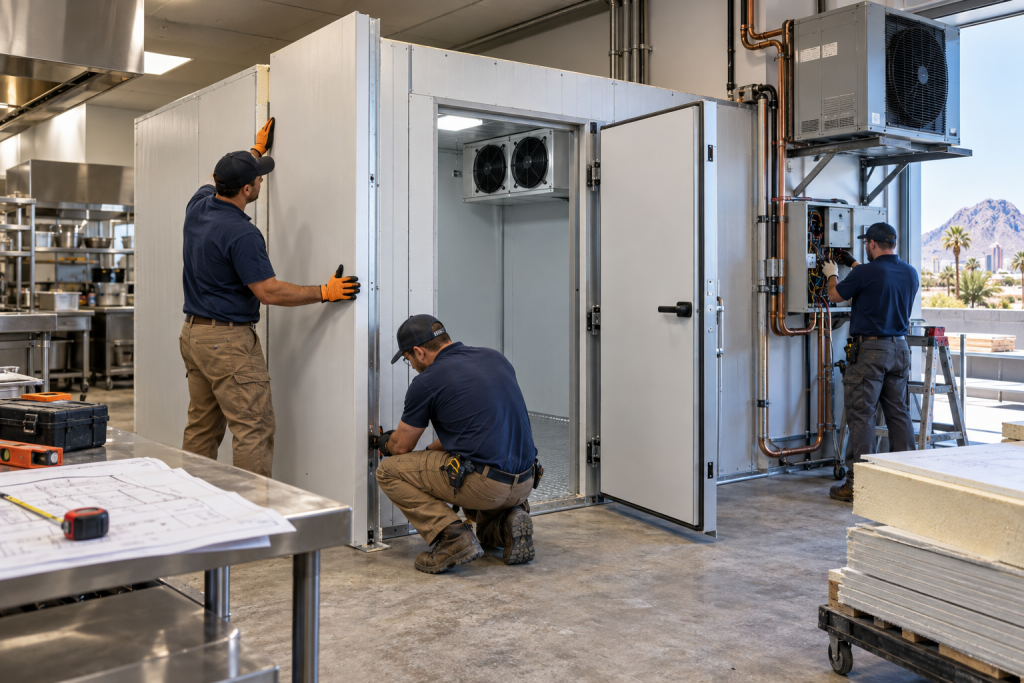
Our commercial refrigeration team performs full site assessments before any equipment is ordered — because the most expensive part of a bad installation isn’t the equipment, it’s the rework.
Electrical Requirements
Most commercial ice machine failures in the first 60 days trace back to the electrical setup. Here are the hard numbers:
- Voltage: Most modular ice machines in the 500–2,000 lb/day class operate on 208–230V single-phase. Higher-output stackable configurations may require three-phase power.
- Dedicated circuit: Required for all commercial ice equipment — no exceptions. Sharing a circuit with walk-in coolers, fryers, or any other high-draw load causes voltage sag and compressor start failures.
- Breaker sizing: Typically 20–30A per circuit, but always verify against the nameplate on the specific unit. Undersized breakers cause nuisance tripping; oversized breakers are a code violation.
- Ground fault protection (GFCI): Required in commercial kitchen environments in most jurisdictions. Confirm with your local building department and your licensed contractor.
- Wiring run distance: Voltage drop over long runs affects compressor start performance. Runs exceeding 50 feet in a typical commercial setting should be evaluated for wire gauge upgrades.
All electrical work for commercial ice equipment must be permitted and inspected in Arizona. Any contractor who skips permits on commercial electrical work is exposing your business to liability during a health department inspection or insurance claim. Our team holds Arizona ROC License 361623 and pulls all required permits as part of every job we perform.
Plumbing, Water Quality, and Drain Requirements
Water quality and drain performance are the two most underestimated variables in commercial ice equipment installation.
Water Supply
- Inlet pressure: 20–80 PSI is the standard acceptable range for most ice machines. Pressure above 80 PSI requires a pressure-reducing valve (PRV) installed upstream. Pressure below 20 PSI causes incomplete water fill cycles and thin or malformed ice.
- Supply line sizing: Minimum 3/8″ line for smaller units; 1/2″ strongly recommended for machines producing 800 lbs/day or more.
- Shutoff valve: An accessible shutoff valve must be installed within reach of the unit — required for service access and emergency shutoff.
Water Filtration
NSF/ANSI 12 — the governing standard for commercial ice equipment — requires that water used in ice production be potable and free of harmful contaminants. For high-volume operations in the Phoenix metro area, where municipal water TDS commonly runs 400–700 mg/L, this means:
- A carbon block filter with scale inhibitor, rated for the machine’s flow rate
- Filter change intervals matched to your local water quality — in Arizona’s hard-water environment, quarterly changes are often necessary at high-output locations
- Manufacturer-specified filtration installed as a condition of warranty — most manufacturers void coverage on ice-side damage caused by scale if no filtration system is present
Drain Requirements
- Slope: Minimum 1/4 inch per foot of horizontal drain run — no flat runs, no uphill sections
- Line diameter: 1″ IPS minimum for single machines; 1.5″ or larger for multi-machine installations or long runs
- Air gap: Required at the drain connection point — prevents backflow contamination and is mandated under the FDA Food Code for food service environments
- Drain pan and line cleaning: High-volume machines purge the water sump regularly; if the drain can’t handle the purge volume without backing up, you’ll have standing water under the machine within weeks
Ventilation and Condenser Configuration
Ventilation is where Arizona-specific planning matters most. An air-cooled ice machine that’s perfectly sited in a climate-controlled equipment room in Chicago will be significantly underperforming in a Phoenix back-of-house mechanical room that peaks at 105°F in August.
For air-cooled units:
- Equipment room temperature must remain below the manufacturer’s maximum ambient rating — typically 100–110°F depending on the model
- Minimum 500 CFM of fresh air exchange per large modular unit
- Exhaust air cannot recirculate back to the intake — hot exhaust into the intake side of a condenser instantly destroys efficiency and accelerates compressor wear
- Minimum side and rear clearances: typically 6″ on sides, 12″ at the rear; consult the installation manual for your specific unit
Condenser alternatives for challenging environments:
- Remote condensers — Refrigerant-cooled condenser mounted outside the building. Removes heat rejection from the equipment room entirely. Best solution when the equipment space can’t be adequately ventilated. Requires refrigerant line sets and a qualified refrigeration technician for installation.
- Water-cooled condensers — Use building water supply for heat rejection; highly efficient and not affected by ambient air temperature. Increases water consumption, which is a meaningful consideration in Arizona’s water-scarce environment.
Our commercial HVAC team evaluates condenser configuration as part of every pre-installation site assessment. The right configuration for your site depends on your equipment room layout, ambient temperature data, and water cost tradeoffs.
Commercial Ice Equipment Installation Requirements at a Glance
| Requirement | Standard Spec | Arizona High-Volume Note |
|---|---|---|
| Voltage | 208–230V single-phase or 3-phase | Verify panel capacity before equipment order |
| Dedicated Circuit | 20–30A per nameplate; no shared circuits | No sharing with walk-ins or cooking equipment |
| Water Inlet Pressure | 20–80 PSI required | Install PRV if supply exceeds 80 PSI; test before commissioning |
| Water Filtration | Carbon block + scale inhibitor (NSF/ANSI 12) | Quarterly cartridge changes typical in AZ hard-water zones |
| Drain Slope | Min 1/4″ per foot of run; air gap required | Verify slope before delivery — no corrections after install |
| Ambient Temperature | Max 100–110°F (air-cooled models) | Remote or water-cooled condenser often required in AZ |
| Service Clearance | 6″ sides, 12″ rear minimum | 24″ front clearance preferred for bin access |
| Permits | Electrical + plumbing permits required | ROC-licensed contractor must pull permits in Arizona |
Pre-Commissioning and First-Run Verification
A completed installation isn’t a finished installation until the unit has been commissioned under operating conditions and the output has been verified. At minimum, commissioning should confirm:
- Inlet water pressure at the machine (not just at the supply line)
- Drainage function under a full purge cycle — no backups, no slow drain
- Refrigerant operating pressures within manufacturer spec
- Harvest cycle timing and ice weight/dimensions — compare against published spec at the measured ambient temperature
- Control board error logs — clear of pre-existing fault codes
Document the commissioning data. If a warranty claim arises in year one, having a commissioning record with pressure readings, ambient temperatures, and water test results protects your investment.
For ongoing reliability, preventive maintenance contracts are available for high-volume operators who want scheduled service — full cleaning, filter replacement, condenser inspection, and operational diagnostics — without tracking the intervals themselves. Our clients across Arizona, including restaurants, breweries, and healthcare facilities, rely on Discount AC & Refrigeration to keep commercial refrigeration equipment running at production targets year-round.
Get Commercial Ice Equipment Installed Right in Gilbert and the Phoenix East Valley
Meeting every commercial ice equipment installation requirement from day one is the difference between equipment that performs to spec through Arizona summers and equipment that underwhelms from the first week. There’s no patch for a bad site preparation — only rework, downtime, and lost revenue.
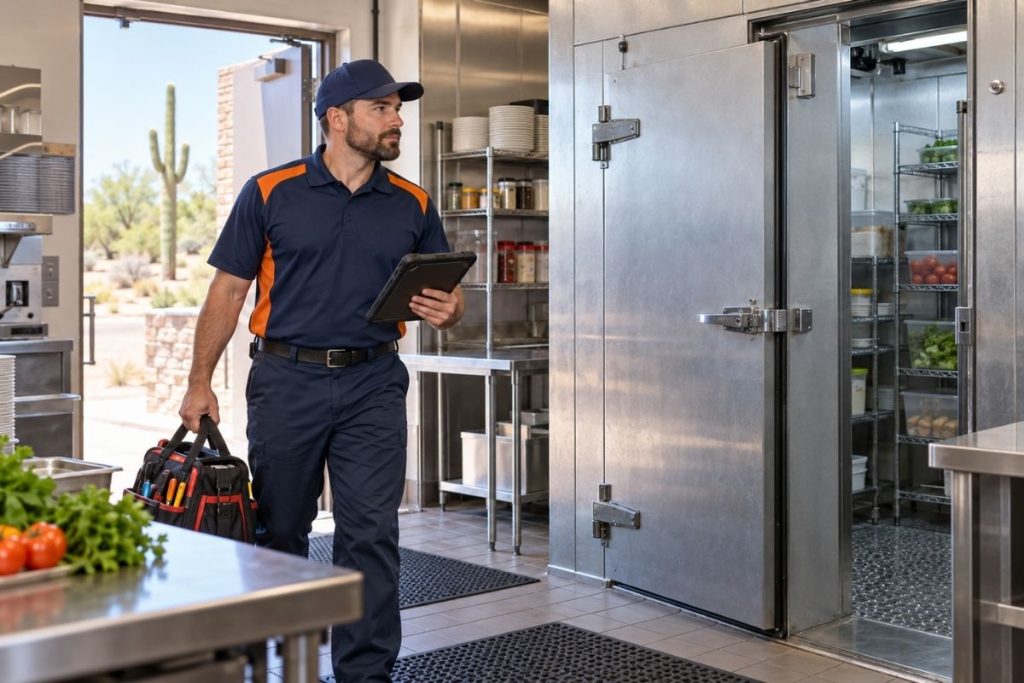
Our licensed technicians at Discount AC & Refrigeration hold Arizona ROC License 361623 and are available 6 AM to midnight, 7 days a week, across Gilbert, Mesa, Chandler, Tempe, Scottsdale, Queen Creek, Apache Junction, and the broader Phoenix metro area. We perform full site assessments, pull all required permits, and commission every installation before we sign off.
See why Arizona businesses trust our team on Google — then call (480) 478-2616 to schedule your pre-installation site walk. Or reach us through our contact page and we’ll respond the same day.
Frequently Asked Questions — Commercial Ice Equipment Installation Requirements
What are the basic electrical requirements for commercial ice equipment?
Most commercial ice machines in the 500–2,000 lb/day range require 208–230V power on a dedicated circuit — typically 20–30A depending on the unit’s nameplate rating. Sharing a circuit with other high-draw equipment causes voltage sag and compressor start failures. All electrical work must be permitted and inspected. Call our team at (480) 478-2616 to confirm what your site’s panel can support before you order equipment.
What water filtration does commercial ice equipment require?
NSF/ANSI 12 requires potable water free of harmful contaminants — in practical terms, a carbon block filter with a scale inhibitor. In Phoenix’s hard-water zones (TDS 400–700 mg/L), quarterly filter changes are common at high-production sites. Most manufacturers void ice-side warranty coverage without proper filtration. Our commercial refrigeration team installs manufacturer-specified filtration on every job.
Why is my ice machine producing less ice than rated?
The most common cause in Arizona is ambient temperature. A 1,000 lb/day unit rated at 70°F may only produce 700–750 lbs at 95°F in a poorly ventilated equipment room. Secondary causes include a saturated water filter, dirty condenser coil, or water inlet pressure out of the 20–80 PSI spec range. Call us at (480) 478-2616 — available 6 AM to midnight, 7 days a week.
Do I need a permit for commercial ice machine installation in Arizona?
Yes. New electrical circuits require an electrical permit; plumbing connections require a plumbing permit. A licensed contractor pulls these as part of the job. Skipping permits exposes your business to liability during health department inspections and insurance claims. Discount AC & Refrigeration holds Arizona ROC License 361623 and handles all required permitting.
Air-cooled vs. remote condenser — which is better for a hot Arizona equipment room?
If your equipment room regularly exceeds 95–100°F, a remote condenser is almost always the better long-term choice — it removes heat rejection from the space entirely and extends compressor life significantly. Our commercial HVAC team evaluates condenser configuration during every pre-installation site walk.
What drain requirements apply to commercial ice equipment?
Gravity-fed drain with minimum 1/4″ per foot slope, 1″ IPS line (1.5″ for multi-machine setups), and a proper air gap at the drain connection — mandated under the FDA Food Code for food service environments. Flat runs and missing air gaps are the two most common plumbing deficiencies we find on inspection. Contact our team to verify drain specs during a pre-installation assessment.
How often should commercial ice equipment be serviced?
Every 6 months at minimum per NSF/ANSI 12. High-production Arizona locations with hard water often benefit from quarterly filter replacements and condenser cleaning. An annual full inspection covers refrigerant pressures, harvest timing, and electrical draw. Our preventive maintenance contracts handle all scheduling automatically.
How do I size commercial ice equipment for my high-volume operation?
Start with peak-hour demand across every use point, then add a 25–35% margin for Arizona’s ambient temperature impact. A 1,500 lb/day unit typically delivers 1,050–1,100 lbs on a 110°F day. Getting undersized equipment is far more expensive than paying for the right unit upfront. Call (480) 478-2616 and we’ll run a full load calculation for your operation before you commit to equipment.
Need Commercial Ice Equipment Installed Right the First Time?
Our licensed refrigeration technicians (ROC 361623) serve Gilbert, Mesa, Chandler, Tempe, and the greater Phoenix metro — 6 AM to Midnight, 7 days a week. We assess your site before you order equipment, pull all required permits, and commission every installation to spec.