Root cause: Commercial ice machine installation Goodyear AZ for a high-traffic gas station fails most often not because of the machine itself — but because the site was never properly evaluated for electrical load, water supply quality, drainage, and ventilation before the unit arrived.
You’ve already priced the ice machine. Maybe you’ve even picked a model. But three weeks after your installer leaves, the unit is cycling short, the ice output is half what the spec sheet promised, and it’s tripping your electrical panel during the evening rush. This is the most common scenario we walk into at high-volume gas stations across the Phoenix metro area — and almost all of it was preventable.
If you operate a large-format gas station or travel plaza in Goodyear or the West Valley, this guide covers what you actually need to know before, during, and after a commercial ice machine installation. Read through it before you sign any equipment contract or pull a permit — it can save you thousands of dollars in rework and lost revenue.
The licensed refrigeration team at Discount AC & Refrigeration has over 20 years of experience installing and servicing commercial refrigeration equipment — from walk-in coolers and reach-in units to high-output ice machines — for businesses across the greater Phoenix area, including convenience stores, restaurants, breweries, and gas stations that run 24 hours a day in 110°F+ Arizona heat.
Why Scale Matters: Ice Demands for High-Traffic Gas Stations
Most residential and light-commercial ice machine calculators don’t apply to a large-format gas station. A high-traffic location in Goodyear — serving 800 to 1,500+ customers daily, with a fountain drink station, bagged ice sales, and a coffee program — has an ice demand profile that looks more like a fast-casual restaurant chain than a typical c-store.
Here’s how to think about your actual daily demand:
- Fountain drinks: A standard fountain station with 6–8 dispensers can consume 150–300 lbs of ice per day in summer, depending on cup size mix and traffic volume.
- Bagged ice retail: If you sell 5, 7, or 10 lb bags to customers, a busy summer weekend day can move 40–80 bags, translating to 200–800 additional lbs of production demand.
- Cold brew / blended drinks: Any specialty beverage program adds another layer. A blended frozen drink station can use 50–100 lbs per day on its own.
Arizona’s climate compounds demand. At ambient temperatures of 110–115°F — common in Goodyear from June through September — ice machines lose a significant portion of their rated production capacity. An air-cooled 1,000 lb/day unit rated at 70°F ambient may only produce 700–800 lbs/day at 95°F ambient inside a non-air-conditioned equipment room. Proper commercial refrigeration system sizing for Arizona means building in a 25–35% margin above your calculated peak demand.
Getting this wrong means you run out of ice on your busiest summer days — exactly when your fountain drink sales are highest.
Key Steps in the Commercial Ice Maker Installation Process
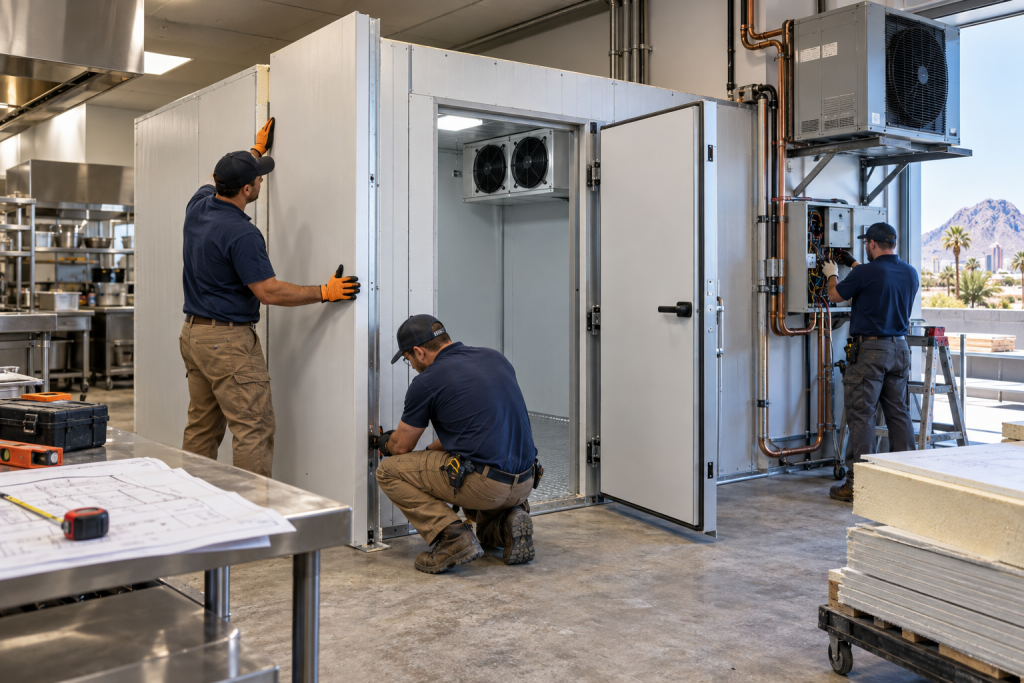
A proper commercial ice machine installation in Goodyear AZ is a multi-trade project. Rushing any phase creates problems that surface weeks or months later under operational load.
Phase 1: Site Assessment and Load Calculation
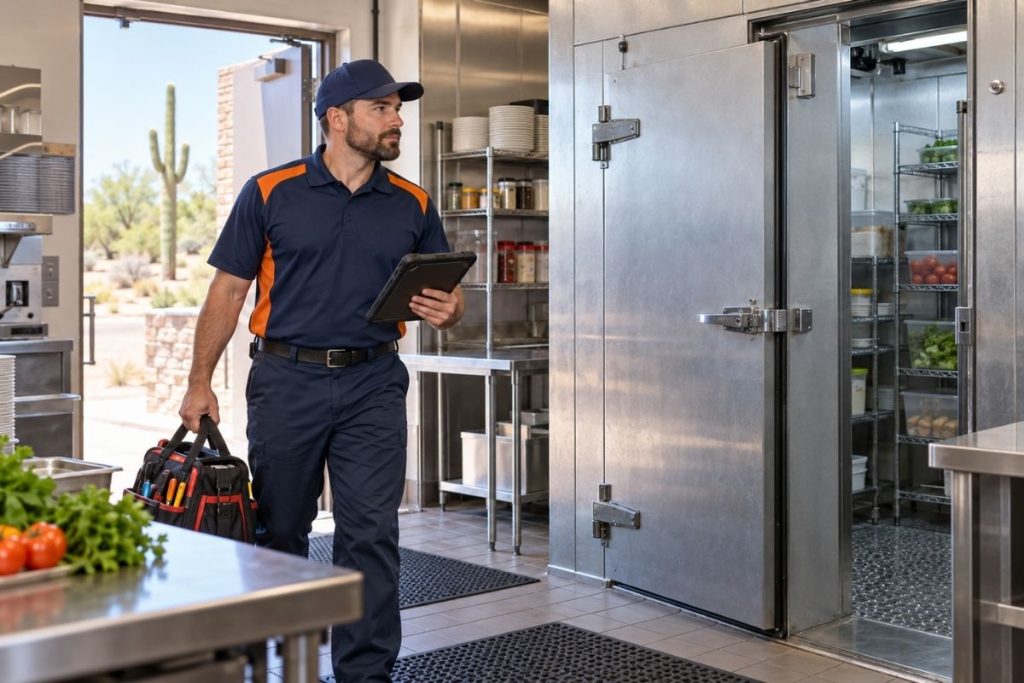
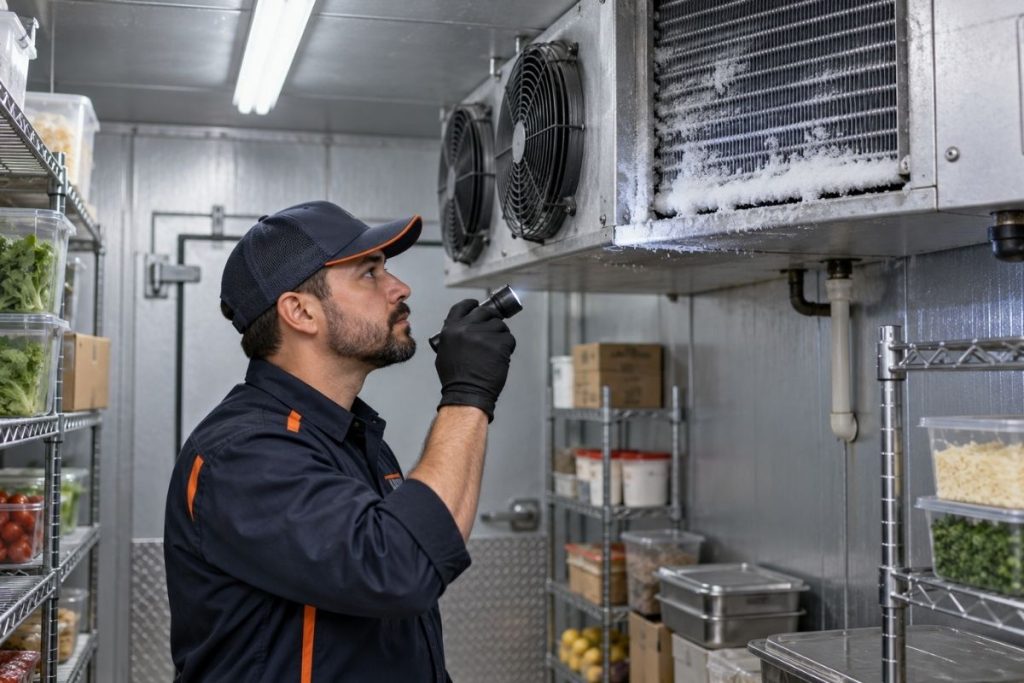
Before the equipment is ordered, a qualified refrigeration technician should walk the location and document:
- Available electrical capacity at the service panel (voltage, amperage, circuit availability)
- Incoming water pressure and TDS (total dissolved solids — critical in the Phoenix metro where municipal water can run 400–700 mg/L)
- Drain slope and drain line routing from proposed equipment location
- Ambient temperature in the equipment space at peak outdoor conditions
- Ventilation options (ducted vs. remote condenser vs. water-cooled configuration)
This assessment determines machine type, condenser configuration, filtration requirements, and whether any infrastructure upgrades are needed before the unit ships.
Phase 2: Infrastructure Prep
Most sites require at least some pre-work:
- Dedicated electrical circuit run and inspected per NEC and local code
- Water line sized and routed with a shutoff valve within reach of the unit
- Filtration system installed upstream of the ice machine (required by NSF/ANSI 12 for commercial equipment)
- Drain line with proper air gap and slope (minimum 1/4 inch per foot of run)
- Ventilation or duct work if the unit will be in an enclosed equipment space
Phase 3: Installation and Commissioning
- Position the unit per manufacturer clearance specs (typically 6 inches minimum on sides and rear for air-cooled models)
- Connect water supply, drain, and electrical
- Level the unit precisely — ice machines are extremely sensitive to being off-level
- Start the first freeze cycle and verify inlet water pressure (typically 20–80 PSI required), drainage function, and refrigerant operating pressures
- Check ice harvest cycle timing and cube weight/dimensions against spec
- Log commissioning data and provide to the site operator for warranty documentation
Electrical, Plumbing, and Ventilation Requirements
These three systems are where most installation problems originate. Here are the hard numbers:
Electrical:
- Most commercial modular ice machines (500–2,000 lb/day class) operate on 208–230V single-phase or three-phase power
- Dedicated circuit required — no sharing with other high-draw equipment
- Circuit breaker size: typically 20–30A per circuit (verify with equipment nameplate)
- Ground fault protection required by most local jurisdictions
Plumbing:
- Inlet water pressure: 20–80 PSI (80 PSI max — use a PRV if your supply exceeds this)
- Minimum 3/8″ water supply line (1/2″ recommended for larger machines)
- Drain line: 1″ IPS minimum, non-pressurized, gravity-fed
- Water filtration: carbon block filter with scale inhibitor — mandatory for Goodyear’s hard water supply
Ventilation (Air-Cooled Units):
- Room temperature must not exceed 110°F for most models
- Minimum 500 CFM of fresh air exchange recommended for a single 1,000 lb/day unit
- Exhaust air must not be recirculated — hot exhaust into the intake side destroys efficiency instantly
- If the equipment room can’t be adequately ventilated, consider a remote condenser or water-cooled condenser configuration
Water-cooled condensers eliminate the ventilation problem but require access to the building’s water loop and add to water consumption costs. Remote condensers push the heat rejection outside the building — often the best solution for a gas station equipment room that can’t be efficiently cooled. Our commercial HVAC team can evaluate which condenser configuration fits your site constraints.
Choosing the Right Spot: Traffic Flow vs. Technical Constraints
Where you put the ice machine inside a large gas station is a genuine tradeoff between customer convenience and technical feasibility.
From a customer-flow standpoint, the ice machine (or ice merchandiser) should be:
- Close to the fountain drink station to minimize customer travel distance
- Accessible without blocking checkout lines
- Visible from the entrance — impulse bagged ice sales increase dramatically with sightline placement
- Near an exterior wall if possible, to simplify bagged ice loading from a delivery truck
From a technical standpoint, the ideal location needs:
- Proximity to an existing or easily extended 208/230V electrical panel circuit
- Access to water supply and a drain — the farther you are from these, the more the infrastructure cost climbs
- Adequate ventilation or a path to route condenser exhaust outside
- Enough floor space for the unit plus required service clearances (minimum 24 inches of clear space in front for door access and ice bin pull-out)
In our experience, the most common mistake at gas stations is placing the ice machine where it looks best on a floor plan — then discovering after permitting that the electrical panel is 60 feet away and there’s no drain slope from that location. The rework cost to correct a poorly planned installation typically runs $3,000–$8,000 in additional plumbing, electrical, and construction work. A site walkthrough before finalizing the equipment location eliminates this entirely.
Installation Specs at a Glance: Common Machine Classes for Gas Stations
| Machine Class | Daily Output (AZ-Adjusted) | Power Requirement | Best For |
|---|---|---|---|
| Modular 500 lb/day | ~350–400 lbs at 110°F | 208–230V / 20A | Small c-store, low fountain volume |
| Modular 1,000 lb/day | ~700–750 lbs at 110°F | 208–230V / 30A | Mid-size gas station, active fountain |
| Modular 1,500 lb/day | ~1,050–1,100 lbs at 110°F | 208–230V or 3-phase / 30A | High-traffic, bagged ice sales |
| Stackable 2,000+ lb/day | ~1,400–1,600 lbs at 110°F | 3-phase / 40–60A | Travel plazas, 24/7 high-volume |
| Flake ice modular | Varies by model | 208–230V / 20A | Produce display, seafood, specialty |
*Output estimates adjusted for 110°F ambient air temperature per AHRI standard rating conditions. Actual output varies by model, water quality, and site conditions.
Schedule Preventive Maintenance from Day One
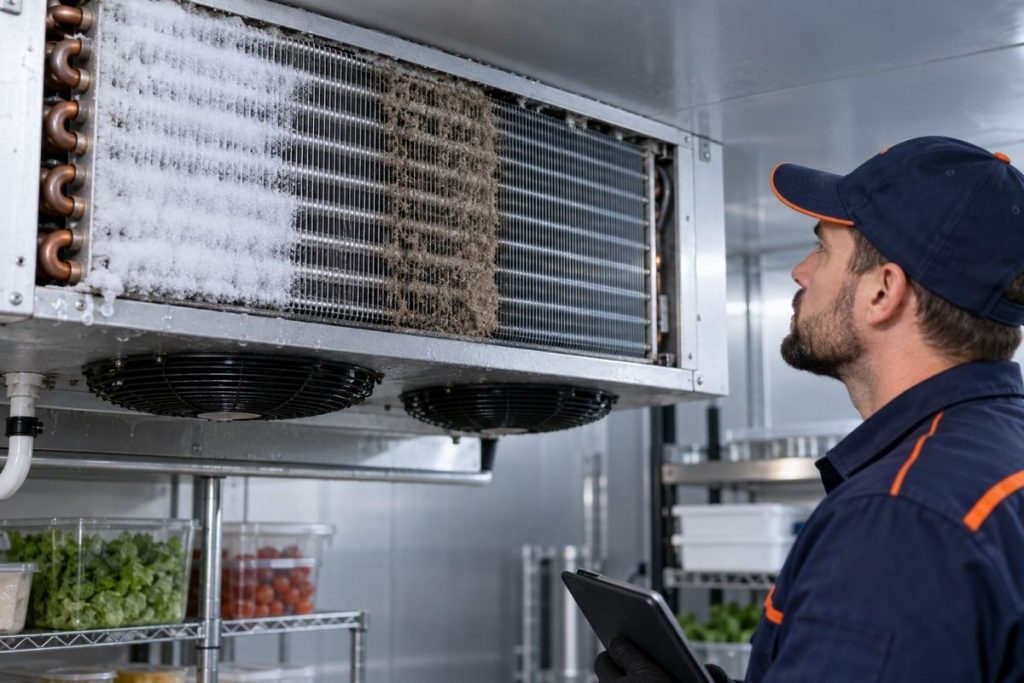
An ice machine that’s installed correctly but never maintained degrades quickly in Arizona’s hard-water environment. Scale buildup on evaporator plates reduces ice output, increases energy consumption, and eventually causes premature component failure.
At minimum, commercial ice machines serving high-traffic locations should receive:
- Every 6 months: Full cleaning and sanitizing cycle per NSF/ANSI 12 protocol, filter cartridge replacement, evaporator and condenser inspection
- Annually: Refrigerant pressure check, water distribution system descaling, full operational diagnostic
- Immediately after: Any output drop, ice quality change (cloudy, thin, or small cubes), unusual noise, or error codes on the control board
Preventive maintenance contracts are available for gas station operators who want scheduled service without the administrative overhead of tracking it themselves. Our clients across Arizona — including convenience stores, restaurants, and high-volume food service operations — rely on Discount AC & Refrigeration to keep commercial refrigeration equipment running reliably year-round.
Get Your Ice Machine Installation Done Right in Goodyear AZ
A commercial ice machine installation in Goodyear AZ isn’t a one-day job you can hand off to a generalist contractor. It requires refrigeration expertise, knowledge of local code requirements, and real-world experience sizing equipment for Arizona’s extreme climate conditions.
Our licensed technicians at Discount AC & Refrigeration hold Arizona ROC License 361623 and are available 6 AM to midnight, 7 days a week, across the greater Phoenix metro area — including Goodyear, Avondale, Buckeye, Surprise, and the East Valley. Whether you’re installing a new unit, replacing an undersized machine, or troubleshooting a system that isn’t meeting your production targets, we provide honest diagnostics without pressure.
Check out our reputation as Discount AC & Refrigeration on Google and see why Arizona businesses trust our team. Call (480) 478-2616 to schedule a site assessment — or reach out through our contact page and we’ll get back to you the same day.
Troubleshooting Guide: Common Ice Machine Installation Problems
| Problem | Likely Cause | Recommended Action |
|---|---|---|
| Low ice output after installation | Ambient temp too high; ventilation inadequate; undersized unit | Inspect equipment room airflow; recalculate demand with AZ ambient correction; add remote condenser if needed |
| Tripping circuit breaker | Shared circuit; undersized breaker; compressor start surge | Install dedicated circuit per NEC; verify breaker rating matches equipment nameplate |
| Cloudy or thin ice cubes | High TDS / hard water; clogged filter; water inlet pressure out of spec | Replace water filter; check inlet pressure (20–80 PSI); test source water TDS |
| Water not draining / pooling | Insufficient drain slope; line blockage; missing air gap | Verify minimum 1/4″/ft slope; inspect for blockages; confirm air gap at drain connection |
| Unit short-cycling (frequent on/off) | Condenser overheating; refrigerant issue; dirty condenser coil | Clean condenser coil; verify clearances; check refrigerant charge; inspect head pressure control |
Frequently Asked Questions: Commercial Ice Machine Installation in Goodyear AZ
How much does commercial ice machine installation cost in Goodyear AZ?
Installation costs vary widely based on machine size, condenser type, and site readiness. Equipment-only installations on a prepped site typically run $800–$2,500 in labor. Sites requiring new electrical circuits, drain runs, or ventilation work can add $1,500–$5,000. Call us at (480) 478-2616 — we’ll do a site walk before quoting.
What size ice machine does a large gas station need?
Most high-traffic gas stations in the Phoenix metro need at least 1,000–1,500 lbs/day of rated capacity — but Arizona ambient temperatures reduce actual output by 25–35%. Our commercial refrigeration team can run the full load calculation for your site.
Do I need a permit for commercial ice machine installation in Goodyear?
Yes, in most cases. New electrical circuits require a permit from the City of Goodyear. Plumbing connections typically require a plumbing permit as well. Our team holds Arizona ROC License 361623 and handles all required permitting for jobs we perform.
Air-cooled vs. water-cooled ice machine — which is better for Arizona?
If your equipment room regularly exceeds 95–100°F, a water-cooled or remote condenser is worth the additional cost. Remote condensers are often the best compromise for gas stations with tight equipment rooms. Call (480) 478-2616 and we’ll walk through the tradeoffs for your specific site.
How often should a gas station ice machine be serviced?
At a minimum, every 6 months per NSF/ANSI 12 standards. In Arizona’s hard-water environment, some high-production locations benefit from quarterly filter changes. Our preventive maintenance plans handle scheduling automatically.
What water filtration is required for a commercial ice machine?
NSF/ANSI 12 requires potable water free of harmful contaminants. For Goodyear’s hard water supply, a carbon block filter with a scale inhibitor is the minimum requirement. Most manufacturers void warranties if the specified filtration system is not installed and maintained.
How long does a commercial ice machine installation take?
A prepped site typically takes 4–8 hours for a single modular unit. Sites requiring new electrical runs, drain work, or equipment room modifications can add 1–3 days. Contact our team to schedule a pre-installation site assessment.
My ice machine suddenly dropped output. What happened?
In Arizona summer, sudden drops are almost always a clogged water filter, dirty condenser coil, or refrigerant issue. Monsoon dust clogs condenser coils fast. Call us at (480) 478-2616 — we’re available 6 AM to midnight, 7 days a week.
Ready to Install a Commercial Ice Machine at Your Goodyear Gas Station?
Our licensed refrigeration technicians (ROC 361623) serve the greater Phoenix metro area — including Goodyear, Avondale, Buckeye, and the West Valley — 6 AM to Midnight, 7 days a week. Get a site assessment before you order equipment.