Airflow in Walk-in Coolers: The Physics Behind Proper Stacking
Poor airflow in walk-in coolers is the single most preventable cause of temperature failure, food loss, and compressor burnout in Arizona commercial kitchens — and in most cases, the culprit is how product is stacked, not a broken component.
Walk-in coolers are engineered around a specific airflow pattern: the evaporator unit pulls warm room air through its coils, removes heat from that air, and discharges cold air back into the cooler. That continuous circulation loop keeps every corner of the space within the safe temperature range required by the FDA Food Code — 41°F or below for cold-hold storage. When product stacking disrupts that loop, the system doesn’t fail all at once. It fails slowly, through rising utility costs, inconsistent temperatures, and a compressor running 20% over its design load until it burns out.
For restaurants, breweries, and food service operations across the Phoenix East Valley, this problem is amplified by summer ambient temperatures that push condensing units past their rated performance limits before the kitchen even opens. Our licensed technicians at Discount AC & Refrigeration have spent over 20 years diagnosing walk-in cooler failures across Gilbert, Mesa, Chandler, Queen Creek, and Tempe — and stacking-driven airflow obstruction consistently ranks among the top three root causes we find on service calls. Check our Google reviews to see what local operators say about our diagnostic accuracy and response times.
If your walk-in is struggling to hold temperature or your utility bills are climbing, this guide explains exactly what’s happening inside your cooler — and what to do before the next breakdown. You’ll also find a Quick Diagnosis table mapping specific stacking behaviors to symptoms so you can act today. Our team providing commercial refrigeration service in Gilbert and across the East Valley is available 6:00 AM to Midnight, 7 days a week.
How Airflow in Walk-in Coolers Actually Works
To understand why stacking matters, you first need to understand what the refrigeration circuit is doing inside your cooler.
A standard walk-in uses a vapor compression refrigeration cycle — compressor, condenser, expansion valve, evaporator — to move heat from inside the cooler to the outdoors. The evaporator coil, mounted inside the cooler (typically high on a wall or ceiling), is the heat-absorbing end of the system. A fan forces room air across the evaporator coil, the refrigerant absorbs heat from that air, and the now-cooled air is discharged back into the space.
That discharge creates a directional airflow pattern. Cold air — which is denser — falls and flows along the floor toward the far end of the cooler. Warmer air near the floor gets pushed toward the walls, rises toward the evaporator intake, and the loop continues. The system is designed to sweep every cubic foot of the cooler continuously through this cycle.
This loop runs at a design airflow rate, specified in CFM by the evaporator manufacturer for the cooler’s volume. The commercial refrigeration specialists on our team verify this pattern on every walk-in inspection, because any disruption — from product placement, shelving density, or a single solid-sided pallet in the wrong spot — can raise effective temperatures in “dead zone” areas by 5–10°F above what the thermostat reads.
That’s the deceptive part: your temperature controller reads air at the sensor location, typically positioned near the evaporator return. A back corner blocked by a fully loaded sheet pan rack can be running 10°F warmer than the sensor indicates — and the compressor has no way of knowing. Our commercial HVAC and refrigeration service team uses thermal imaging during cooler assessments to map actual temperature distribution across the entire volume, not just at the sensor.
Why Stacking Height and Density Directly Control Temperature
Three stacking behaviors create the most significant airflow disruptions in walk-in coolers, and all three are common in commercial kitchens across the East Valley.
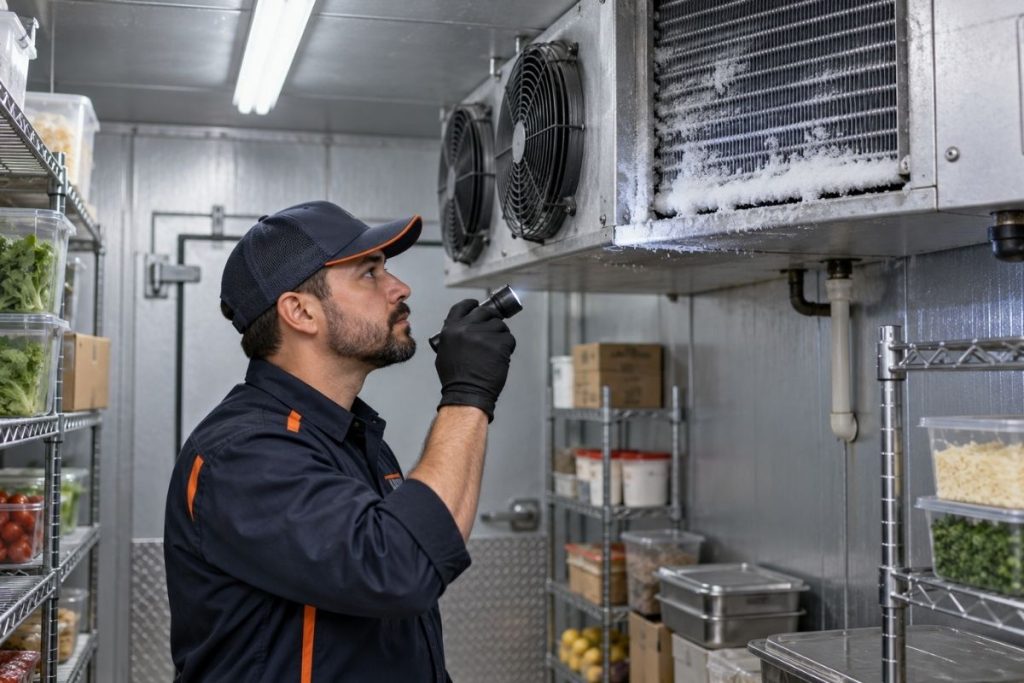
Blocking the evaporator discharge zone. The evaporator fan needs open clearance — typically 18 to 24 inches minimum in front of the discharge outlet — to develop proper air velocity and throw distance. When stacked boxes or shelving fill this zone, the cold air stream never reaches the far end of the cooler. The evaporator overworks, the compressor runs extended cycles, and temperature at the far wall climbs while the sensor near the coil reads normal.
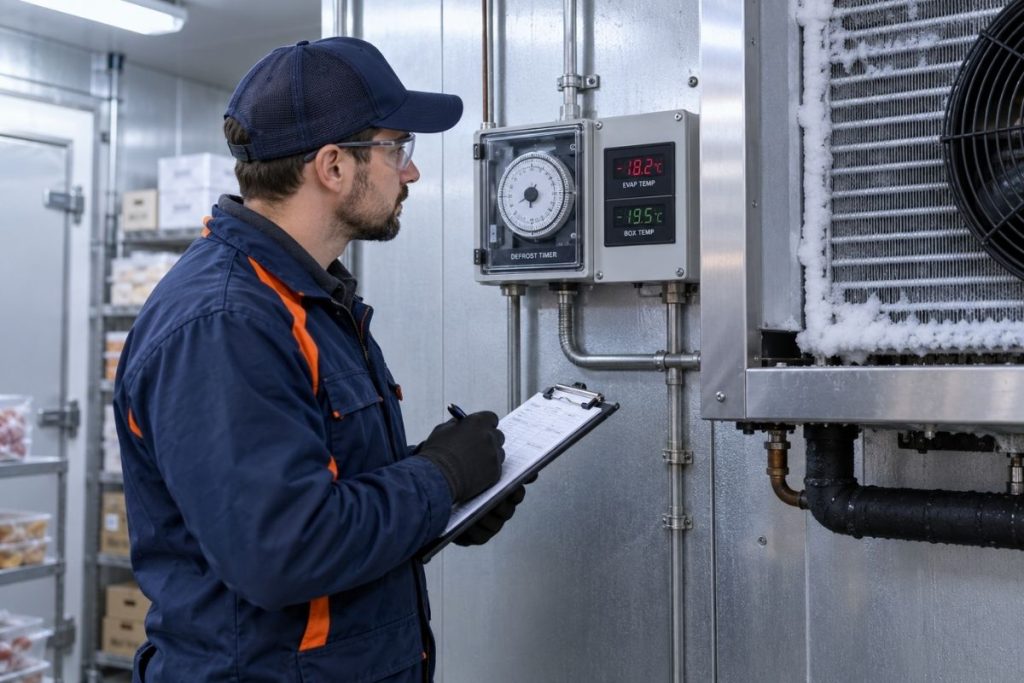
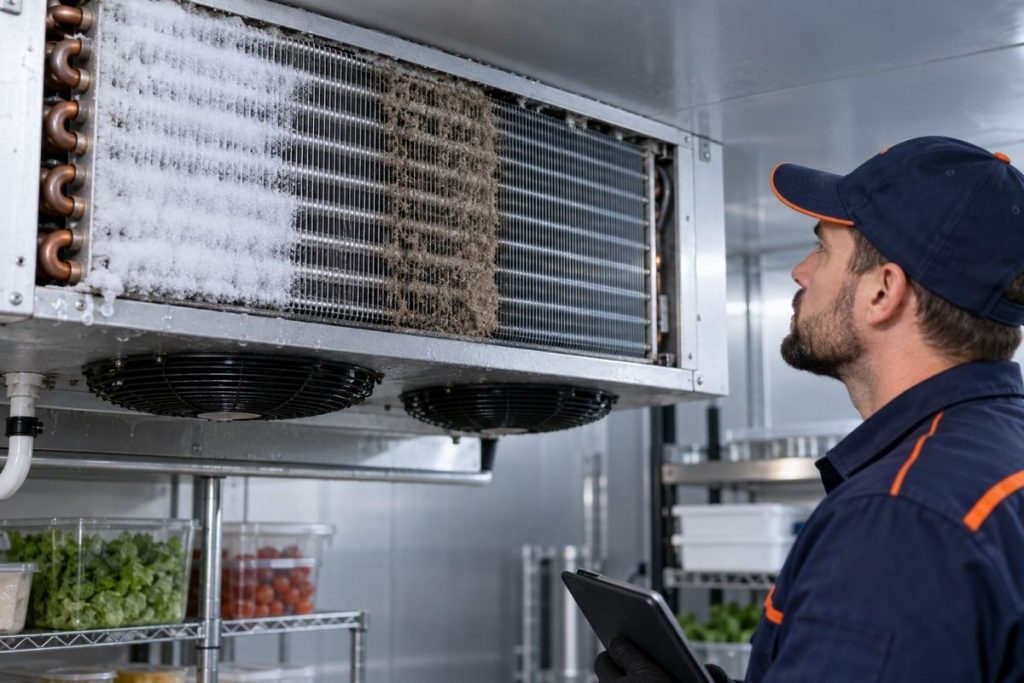
Floor-to-ceiling stacking along side walls. In a top-discharge evaporator layout, warm return air needs a clear path back up to the coil intake. When walls are stacked floor-to-ceiling with product, that return path is blocked. The evaporator starts recirculating the same pocket of cold air near the coil rather than pulling warm air from the rest of the room. Result: ice builds up on the coil, defrost cycles become less effective, and cooling capacity drops across the entire cooler — often by 15 to 25%.
Dense product directly on the floor. Cold air sweeps the floor and picks up residual heat from the space before rising back toward the evaporator. Solid-sided cases placed directly on the floor create a physical barrier that breaks this sweep. Product stored in sealed floor-level cases can run 8–12°F warmer than the thermostat indicates, putting items like raw proteins and dairy directly at risk.
Our commercial refrigeration preventive maintenance program includes a stacking and shelving configuration audit as part of every walk-in inspection — because a rearrangement that costs nothing often eliminates the root cause of a costly service call.
Quick Diagnosis: Stacking Behaviors and Their Airflow Impact
| Stacking Behavior | Airflow Impact | Temp Effect | Fix |
|---|---|---|---|
| Product within 18" of evaporator discharge | Fan throw blocked; dead zones at far end | +5–10°F in far corners | Clear 24" min. in front of evaporator |
| Floor-to-ceiling stacking on side walls | Return air path blocked; coil recirculates same air | Ice on coil; 15–25% capacity loss | Keep top 12" of wall free for return air |
| Solid-sided cases on the floor | Cold air sweep interrupted along floor | Floor product +8–12°F above sensor | Wire shelving; elevate product min. 6" |
| Overstuffed shelves, no gap between items | Natural convection between product blocked | Warm pockets throughout shelf level | Leave 2–3" between all items |
| Product blocking thermostat sensor | Sensor reads product temp, not ambient air | False low reading; room runs warm undetected | Keep 12" clearance around sensor |
| Hot product loaded directly into walk-in | Heat load spike; compressor short-cycles | Rapid 5–8°F ambient rise | Pre-cool below 70°F before walk-in entry |
| Pallet blocking center floor aisle | End-to-end sweep obstructed | Stratified temps; back wall warmest | Keep center aisle clear at all times |
| Cardboard boxes left on wire shelving | Cardboard insulates; blocks inter-shelf airflow | Inconsistent temps between shelf levels | Remove product from cardboard before shelving |
If your walk-in shows any of these symptoms, contact our commercial refrigeration team before assuming it’s a mechanical failure. In our experience, a significant share of “broken cooler” calls across the East Valley are resolved through airflow corrections with no parts replacement.
How Arizona Heat Multiplies Walk-in Airflow Problems
Phoenix-area kitchens face a compounding effect that makes stacking-related airflow disruption significantly more costly than it would be in a cooler climate.
When outdoor temperatures reach 110–115°F, the condensing unit — typically located on your roof or outside the building — is rejecting heat into air that’s already at or beyond its design temperature limit. This drives condensing pressure up and reduces available refrigerating capacity. Your walk-in is now fighting a larger internal heat load with reduced mechanical capacity — before you factor in any stacking problems.
Kitchen ambient temperatures compound this further. Every time an employee opens the walk-in door in a 90–100°F kitchen, hot air floods in. That’s a significant heat load event, and it happens dozens of times per shift. When the airflow pattern inside the cooler is already compromised by product placement, the system has no margin left to absorb these door-opening loads.
A cooler that holds a reliable 38°F in March with borderline stacking may fail to hold 42°F in August under identical conditions — putting you in violation of food safety requirements and creating grounds for a failed health inspection.
For walk-in cooler inspections and refrigeration service across the East Valley, our team evaluates system performance against local climate conditions, not just the manufacturer’s spec sheet. If your compressor is already running hot trying to compensate for airflow inefficiencies and age, it may also be worth reviewing commercial refrigeration replacement cost estimates before committing to another repair cycle on aging equipment.
Walk-in Cooler Airflow and Food Safety Compliance
The Arizona Department of Health Services follows the FDA Food Code, which requires cold-hold food items to be maintained at 41°F or below. Compliance means maintaining that temperature throughout the storage volume — not only at the thermostat sensor near the evaporator.
If a health inspector probes product temperature and finds items at 44–48°F in a section of your walk-in that your controller shows as 37°F, that’s a temperature violation — and the most likely cause is an airflow dead zone created by improper stacking, not a failed refrigeration component. The equipment may be running perfectly; the problem is that conditioned air never reaches the product.
Structured commercial refrigeration preventive maintenance includes periodic multi-point temperature mapping across the full cooler volume, not just at the sensor. This produces documentation you can present to health inspectors showing that your system maintains uniform temperatures — a useful record if you’re ever cited for a temperature variance you weren’t tracking.
Our commercial refrigeration technicians hold EPA Section 608 certification (Type I, II, and III) for refrigerant handling and operate under Arizona ROC License 361623. Every inspection is documented for your records.
Don’t Let a Stacking Problem Become a Compressor Failure
Improper stacking in walk-in coolers is cheap to fix — but only when you catch it before it translates into mechanical damage. A compressor running over load because it’s compensating for airflow-driven temperature drift doesn’t announce itself. It runs hotter, degrades faster, and fails mid-service on a Friday in August when the dining room is full and your walk-in holds $8,000 in inventory.
The right fix starts with a professional assessment. Our licensed technicians map actual airflow patterns with thermal imaging, identify dead zones, evaluate shelving and stacking configurations, and check refrigeration system performance metrics — all in one visit.
Discount AC & Refrigeration is available 6:00 AM to Midnight, 7 days a week for scheduled walk-in cooler assessments and 24/7 emergency refrigeration repair when a temperature failure can’t wait until morning. Call (480) 478-2616 or contact us online to schedule — honest diagnosis, no upsells, backed by Arizona ROC License 361623. Ask about our Refer & Earn program when you refer a fellow business owner to our team.
Frequently Asked Questions — Airflow in Walk-in Coolers
Most evaporator manufacturers specify a minimum 18-inch clearance directly in front of the discharge grille, but 24 inches is the practical standard for reliable performance. This clearance allows the fan to develop full air velocity and throw distance — without it, cooled air short-circuits back to the evaporator instead of reaching the far end of the cooler.
In high-volume commercial kitchens, shelving is often installed too close to the evaporator as the walk-in fills up. This is one of the first things our commercial refrigeration technicians check on every walk-in inspection.
Your thermostat sensor is positioned near the evaporator, which is typically the coldest spot in the cooler. If product stacking has created airflow dead zones, product in those zones can run 8–12°F warmer than the sensor reads without triggering any alarm.
The fix starts with a temperature mapping inspection, not a refrigeration repair. Our team uses thermal imaging to identify exactly where dead zones exist. Contact us to schedule an assessment.
Yes — indirectly, but reliably. When airflow dead zones cause temperatures in parts of the cooler to exceed the setpoint, the thermostat calls for more cooling. The compressor runs longer duty cycles trying to compensate for a problem it can’t actually solve. Extended duty cycles raise discharge temperatures, accelerate lubricant breakdown, and shorten the compressor’s operational life.
In Arizona summers, where your condensing unit is already operating near its capacity limits, this additional load can lead to premature failure. Our preventive maintenance program catches this pattern before it becomes an emergency.
We recommend a full walk-in cooler inspection at least twice a year for commercial kitchens in the Phoenix East Valley: once before summer (April–May) to verify the system is ready for peak heat load, and once before the holiday season (October–November) when inventory levels and stacking density are highest.
For high-volume operations like breweries, hotel food service, and full-service restaurants, quarterly inspections are a better investment. Ask about our commercial refrigeration maintenance plans for scheduled coverage.
The Arizona Department of Health Services follows the FDA Food Code, which requires cold-hold food items to be maintained at 41°F (5°C) or below throughout the storage volume — not just at the thermostat sensor. Health inspectors may probe actual product temperatures, and a sensor reading of 37°F does not protect you if product in a dead zone is found at 45°F.
Multi-point temperature documentation as part of a preventive maintenance plan provides defensible records if temperature violations are ever disputed.
The most reliable method is thermal imaging. Without equipment, use a digital probe thermometer to take readings at multiple points: near the evaporator, in the center, at the back wall at mid-height, and at floor level in the back corners. If any point is more than 4°F above your setpoint, you have a dead zone. Common signs: frost buildup on the evaporator coil, product in back corners spoiling faster than expected, and the compressor running almost continuously.
Our commercial refrigeration team serving Gilbert and the East Valley can map your cooler’s full thermal profile in a single visit. Call (480) 478-2616 to schedule.