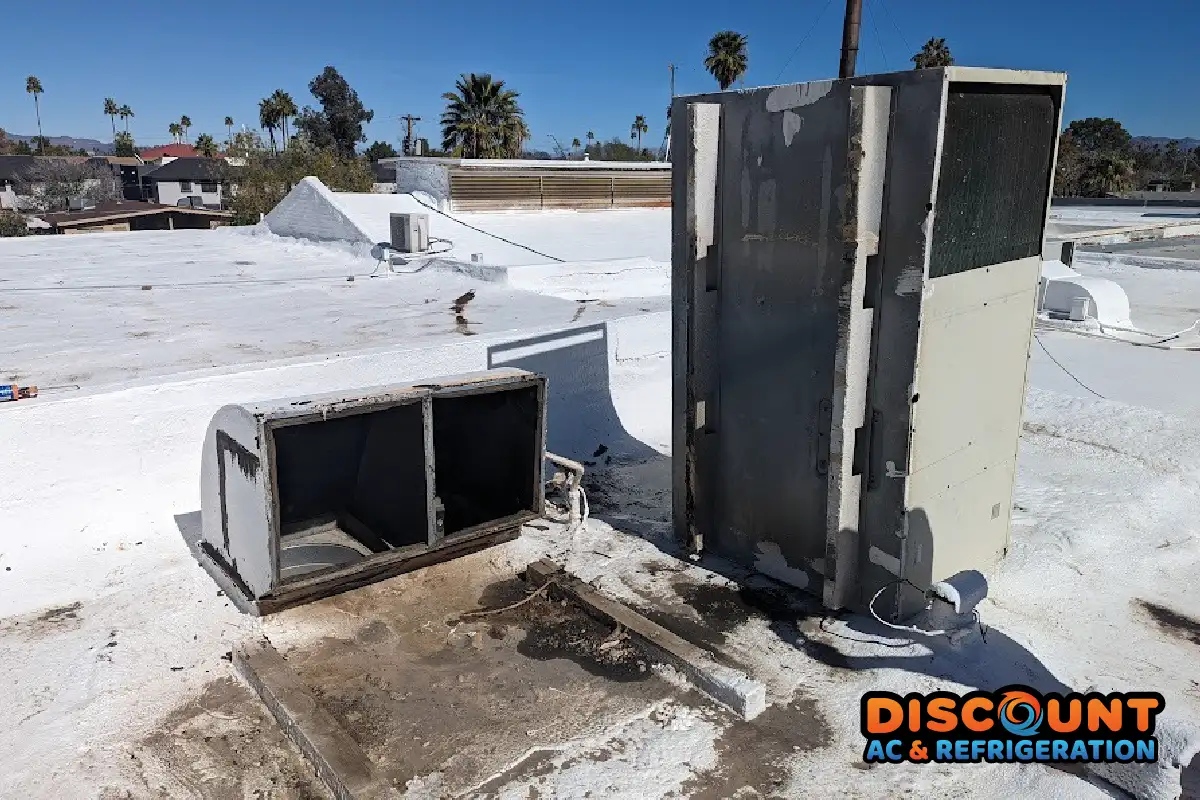
Rooftop unit replacement cost in Phoenix depends on capacity, equipment specifications and the work needed to connect the new RTU to the building. A published Phoenix contractor reference places replacements at roughly $6,500 to more than $16,000 per unit; larger or more complex projects can exceed that range. The examples below help frame a budget before a site-specific proposal.
Pricing disclaimer: These are third-party published planning references reviewed October 11, 2026, not Discount AC & Refrigeration prices, a local market average or a binding quote. Included work differs by source. Final pricing requires a site inspection and written scope; equipment availability, taxes, permits, crane access, electrical work, roof work and duct modifications can change the total.
Commercial Rooftop Unit Replacement Cost: Published Ranges
| Published example | Replacement range | How to use it |
|---|---|---|
| Phoenix RTU replacement, capacity not specified | About $6,500–$16,000+ | Local contractor reference; larger projects may be substantially higher. |
| 5-ton RTU, Southern California comparison | $9,500–$16,000 | Different market; publisher includes crane, curb adapter and electrical. |
| 10-ton RTU, Southern California comparison | $18,000–$32,000 | Shows why capacity and scope matter; not a Phoenix quote. |
| 20-ton RTU, Southern California comparison | $38,000–$65,000 | Larger-system reference from the same out-of-state publisher. |
Price sources: Phoenix Commercial HVAC installation and replacement; DC Air and Heating commercial rooftop units. These are examples of advertised ranges, not a survey of completed jobs.
For a Phoenix property, use these figures to start a budget conversation, then compare proposals for the same capacity, model and scope. Do not multiply a small-unit price by tonnage to estimate a larger installation. For projects beyond an RTU swap, see our Arizona commercial AC installation cost guide.
What Changes the Installed RTU Price?
- Equipment: specified capacity, heating type, efficiency, controls and accessories.
- Roof and curb: compatibility with the existing opening, curb adapter, flashing and any structural review or work.
- Crane and access: lifting location, reach, staging area, access restrictions and scheduling.
- Connections: duct transitions, electrical supply, controls, condensate drainage and other applicable services.
- Project scope: removal and disposal, permits, startup testing, documentation and warranty terms.
- Business disruption: sequencing, access windows and arrangements for occupied spaces during the shutdown.
Ask which items are included, which are allowances and which would require a change order. A low equipment-only figure is not comparable to a complete installed proposal.
Choose RTU Capacity From the Building Load
Replacement is a chance to check whether the old unit was correctly sized. Changes in occupancy, lighting, insulation or the use of the space can change the load. The U.S. Department of Energy recommends matching RTU capacity to building requirements rather than automatically replacing the old unit with the same tonnage.
Both an oversized and an undersized unit can create problems. Ask the designer or contractor to document the load basis, required airflow and compatibility with existing infrastructure. A square-feet-per-ton shortcut cannot establish the correct replacement by itself. See the DOE RTU sizing guidance.
Repair or Replace the Rooftop Unit?
A single failure does not automatically justify replacement. Request a diagnosis of the current fault and compare the repair scope with the condition of the rest of the system. Useful questions include:
- Is this an isolated component failure or one of several recurring problems?
- Does the equipment still meet the building’s cooling and ventilation needs?
- What warranty coverage remains, and are the required parts available?
- What is included in each repair and replacement proposal?
- How would either option affect planned operations and future maintenance?
A percentage rule or the equipment’s age alone should not decide the purchase. If you need diagnosis first, request rooftop unit service in Phoenix.
RTU Replacement Planning and Installation
- Site review: document the existing unit, building requirements, roof access and connections.
- Written proposal: identify the proposed equipment, included work, exclusions, warranties and schedule assumptions.
- Coordination: confirm delivery, lifting access, required approvals and the expected cooling outage before work begins.
- Installation: qualified trades remove and replace the equipment and complete the specified connections.
- Startup and handover: request operating checks, control settings, equipment records and maintenance instructions.
The shutdown window is not the same as the entire project lead time. Ask for both: when equipment and crews can be ready, and how long your space is expected to be without cooling. Equipment availability, site work and approvals affect scheduling.
Commissioning verifies that the installed system meets the design requirements. The DOE commissioning guidance highlights checking operation and controls rather than treating installation alone as completion.
Request a Rooftop Unit Replacement Quote in Phoenix
Discount AC & Refrigeration provides commercial AC installation and rooftop-unit service in the Phoenix metro. Call (480) 478-2616, 6 AM–midnight, seven days a week, to discuss the property and confirm assessment availability.
Have the property address, unit model and serial number if safely available, known symptoms, recent repair information and access restrictions ready. Do not climb onto the roof to collect information if safe access is unavailable.
Frequently Asked Questions
How much does it cost to replace a commercial rooftop unit?
The published references above range from several thousand dollars for some smaller projects to tens of thousands for larger systems. They are planning examples from identified markets, not Discount ACR quotes. A site-specific proposal is needed.
Can the existing ductwork be reused?
Ask the contractor to assess condition, airflow and connection compatibility before assuming reuse. The proposal should identify any required transitions or repairs.
Should I replace my RTU with the same tonnage?
Only after confirming that capacity fits the current building load. The old nameplate does not establish the correct size for a changed space.
What warranty should be included?
Request the exact manufacturer’s warranty and the contractor’s labor warranty in writing, including registration requirements and exclusions. Coverage varies by equipment and proposal.
How can I reduce disruption to the business?
Discuss access, tenant needs and shutdown timing during the site review. Confirm any temporary-cooling or phased-work arrangements and their cost in the written scope.