A commercial ice machine that stops producing ice isn’t a minor inconvenience — it’s a revenue problem that compounds by the hour. In Phoenix, where summer temperatures regularly exceed 110°F, the thermal stress on refrigeration equipment is unlike anywhere else in the continental United States. What causes an ice machine to slow down or stop entirely in mild climates can shut the system down completely under Arizona conditions.
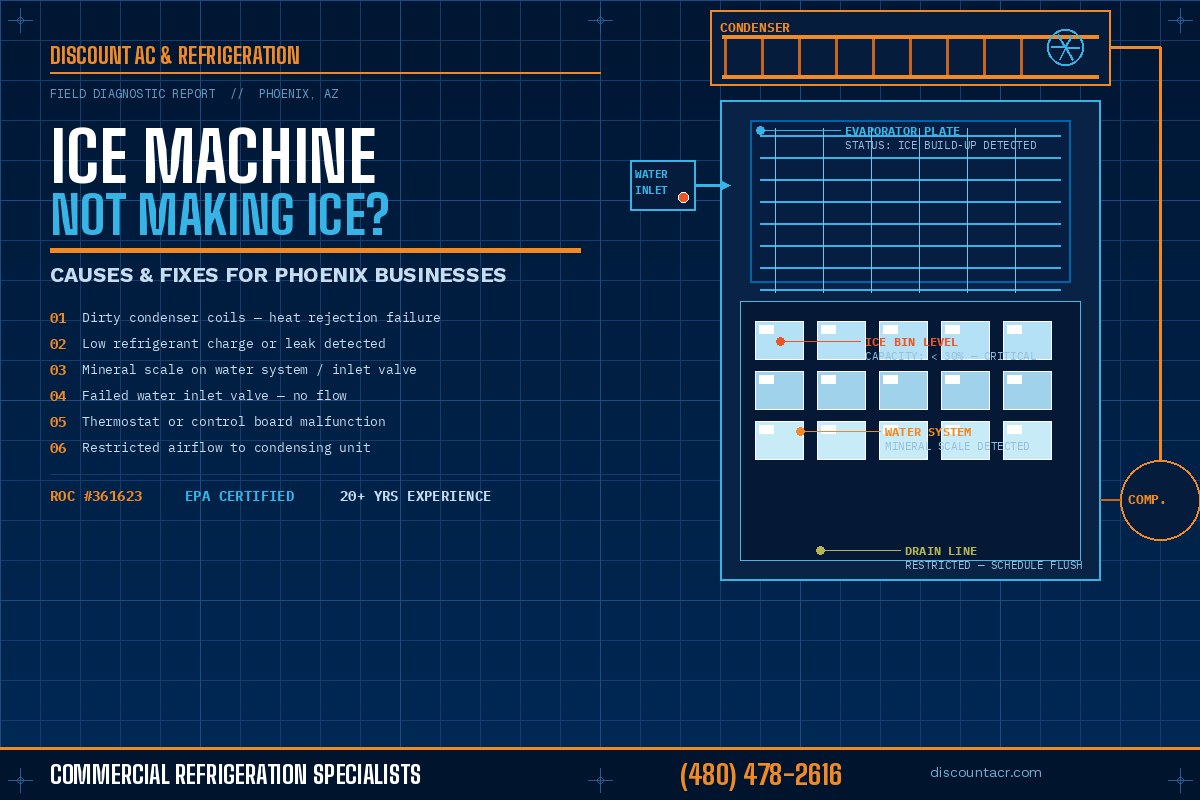
If your commercial ice machine is not making ice, the cause is almost always one of six things: a dirty condenser coil, a failing water inlet valve, a malfunctioning thermostat or sensor, a refrigerant issue, scale buildup on the evaporator plate, or a compressor under extreme thermal load. Understanding which one you’re dealing with — and how quickly it needs attention — is the difference between a $200 service call and a $3,000 compressor replacement.
This guide was written by Raúl GEO, EPA-certified refrigeration technician with over 20 years of field experience servicing commercial kitchens, bars, hotels, and food service operations across the Phoenix metro area.
Commercial Ice Machine: Quick Symptom Diagnosis Guide for Phoenix Operators
| Symptom | Most Likely Cause | Urgency in AZ | Recommended Action |
|---|---|---|---|
| Machine runs full cycle but bin stays empty | Harvest cycle failure — thermostat, sensor, or control board fault | Critical | Call for same-day diagnostic — note any fault codes displayed before calling |
| Ice production drops 40–60% over several weeks | Scale buildup on evaporator plate reducing heat transfer efficiency | High | Schedule descaling service; install water filter — Phoenix hard water accelerates buildup |
| Machine shuts down after short run then restarts | Dirty condenser coil causing high-pressure cutout in Arizona ambient heat | Critical | Turn off machine to protect compressor; call for emergency condenser cleaning |
| Ice cubes are cloudy, hollow, or misshaped | Water inlet valve partially clogged with mineral deposits or low water pressure | High | Inspect and replace water inlet valve; evaluate water filtration upstream |
| Machine runs but ice takes 2–3× longer to form | Low refrigerant charge — evaporator not reaching freeze temperature | Critical | EPA-certified refrigerant service — locate and repair leak, recharge to spec |
| Compressor housing extremely hot, unusual noise | Compressor overloading from high ambient heat and condenser restriction | Critical | Shut off immediately — continued operation risks permanent compressor failure |
| Water floods into bin or overflows reservoir | Float valve failure or water inlet valve stuck open | High | Shut off water supply; replace float valve and water inlet valve |
| Machine powers on but does not start ice cycle | Control board failure, tripped bin-full sensor, or electrical fault | Moderate | Check bin sensor and bin level first; if unresolved, schedule control board diagnostic |
Why Phoenix Ice Machines Fail More Often Than National Averages
Commercial ice machines are engineered to operate within specific ambient temperature ranges — typically 50°F to 100°F. Walk into the equipment room behind most Phoenix restaurants in July and you’ll find 105–115°F of ambient heat. That’s outside the operating envelope for most machines, and manufacturers know it. What they can’t engineer away is the physics: refrigeration is the process of moving heat from one place to another, and when the destination for that heat is already scorching, the system works exponentially harder.
The result is accelerated wear on every component. Condensers foul faster because the unit runs longer cycles. Compressor oil degrades sooner under continuous high-load operation. Water inlet valves see higher failure rates because hard Phoenix water leaves mineral deposits faster when the water-to-ice cycle repeats more frequently. Our commercial refrigeration service team responds to more ice machine calls per capita in the Phoenix metro than any other equipment category — because no other city stresses this equipment the same way.
The 6 Most Common Reasons Your Commercial Ice Machine Stops Making Ice in Arizona
1. Dirty or Blocked Condenser Coil
This is the single most common cause we see, and it’s preventable 100% of the time. The condenser coil is where the refrigeration cycle dumps heat into the ambient air. When it’s coated with grease, dust, and kitchen debris — which happens fast in a commercial kitchen environment — it can no longer shed heat efficiently. The system’s high-side pressure climbs. The ice-making cycle slows down, then stops entirely as the machine enters a self-protective fault state.
In Phoenix, condenser coils need cleaning every 30–60 days in high-grease environments, not the 90-day schedule most manufacturers assume for temperate climates. An air-cooled unit in a Phoenix kitchen runs hot enough on a clean coil — a fouled one is a guaranteed service call.
2. Failing Water Inlet Valve
The water inlet valve controls the flow of water into the ice machine’s reservoir. A valve that’s partially clogged with mineral scale restricts water flow, resulting in small, malformed, or hollow ice cubes — and eventually no ice at all. Phoenix tap water is among the hardest in the United States, with calcium carbonate content high enough to foul a water inlet valve in a fraction of the time it would take in Seattle or Chicago.
Signs of a failing inlet valve include: ice cubes that are cloudy, slushy, or smaller than normal; the sound of the water fill cycle running but the bin not filling; or ice production that drops off gradually over several weeks. A water filtration system upstream of the ice machine is the most effective long-term solution, and our commercial HVAC and refrigeration team can spec the right filter for your water quality and machine model.
3. Scale Buildup on the Evaporator Plate
The evaporator plate is the surface where water freezes into ice. In hard water environments, calcium and magnesium carbonate deposits accumulate on this surface over time, insulating it from the refrigerant and reducing heat transfer efficiency. The machine doesn’t fail immediately — instead, it produces progressively less ice over weeks or months until ice production drops below functional levels.
This is the root cause that operators most often miss because it happens gradually. Regular descaling with manufacturer-approved cleaning solution — at minimum every 6 months, quarterly in Phoenix — is the standard of care. If you’re seeing white, chalky deposits on or near your ice-making components, the machine is overdue for a descaling service.
4. Low Refrigerant Charge
A refrigerant leak causes the evaporator plate to lose the ability to reach adequate freezing temperatures. Unlike condenser or water issues, refrigerant problems typically manifest as the machine running through its cycle but producing little or no ice — sometimes along with ice that is soft or takes significantly longer than normal to form.
Refrigerant leaks in commercial ice machines are most commonly found at fitting connections, the evaporator plate seams, or brazed joints. Under Arizona thermal cycling — repeated expansion and contraction from extreme ambient temperature swings between day and night — fittings that were marginal in cooler climates can develop leaks faster. Refrigerant service is EPA-regulated work; our technicians hold current EPA 608 certification and carry the instrumentation to locate leaks, recover refrigerant properly, and recharge to manufacturer specifications.
5. Faulty Thermostat, Sensor, or Control Board
Modern commercial ice machines use thermistors, pressure sensors, and control boards to manage the ice-making cycle. A failed sensor can cause the machine to misread evaporator temperature, terminate the freeze cycle prematurely, or prevent the harvest cycle from initiating — any of which results in the bin not filling. A failed control board can cause erratic cycling, fault codes, or a machine that powers on but does nothing.
This is a diagnosis that genuinely requires a technician with manufacturer-specific knowledge. Sensor and board failures often don’t announce themselves with obvious symptoms — they present as “the machine ran fine yesterday and now it’s not making ice.” If your Manitowoc, Hoshizaki, Ice-O-Matic, or Scotsman unit is throwing fault codes, document the code sequence before calling us — it helps our technicians arrive prepared with the right parts.
6. Compressor Overheating or Failure Under Arizona Heat Load
The compressor is the heart of the refrigeration system. In Phoenix, compressors in commercial ice machines run at the top of their rated duty cycle for months at a time. A compressor that was installed years ago and has been running at high capacity through multiple Phoenix summers accumulates wear faster than equipment in cooler regions. An overheating compressor will typically trigger a high-pressure cutout and shut the machine down.
Before the compressor reaches failure, the signs are: the machine cycling off after short runs, the compressor housing being abnormally hot to the touch, or the machine running but not pulling the evaporator plate down to freezing temperature. If a compressor has failed, the repair cost math needs to be done honestly — for older machines, replacement is often more economical than a compressor swap. Our commercial refrigeration specialists will give you a straight answer on that equation.
Preventive Maintenance Schedule for Phoenix Commercial Ice Machines
The standard national maintenance schedule for commercial ice machines does not account for Arizona conditions. Here is the schedule our team recommends for operations in the Phoenix metro, Mesa, Scottsdale, Queen Creek, and surrounding areas.
Monthly: Clean condenser coil if the machine is in a high-grease or dusty environment. Inspect water filter and replace if flow is restricted. Check the bin for scale deposits and wipe down interior surfaces.
Every 90 Days: Full descaling of evaporator plate and water distribution components using manufacturer-approved descaling solution. Inspect door seals and hinges. Test the harvest cycle. Verify refrigerant pressures are within operating range.
Every 6 Months: Full preventive maintenance service — condenser cleaning, evaporator descaling, water inlet valve inspection, electrical connection check, refrigerant pressure verification, and a full cycle test. For high-volume operations, consider quarterly PM service instead.
Annually: Inspect all brazed refrigerant joints for signs of oil streaking. Check compressor amp draw against manufacturer spec. Review machine production capacity against original spec — a machine producing significantly less ice than rated capacity needs diagnostic attention even if it appears to be working.
A commercial preventive maintenance agreement from Discount AC & Refrigeration covers all scheduled service visits, priority response on emergency calls, and documented service records — which matter for health inspections and warranty claims.
Emergency Ice Machine Repair: When You Can’t Wait
Some ice machine failures can wait for a next-day appointment. Others can’t. If you operate a bar, hotel, healthcare facility, or high-volume restaurant in the Phoenix metro, a machine down during service hours is an emergency.
Call for same-day service when: the machine fails during a peak service period, ambient temperature in the equipment room exceeds 115°F and the machine is shutting down on thermal protection, or you observe any of the following — a burning smell from the machine, visible refrigerant oil around fittings, water flooding from the reservoir, or repeated fault codes that clear and return within hours.
Our emergency refrigeration response team covers the Phoenix metro area and operates from 6 AM to midnight, seven days a week. For operators in Mesa and Scottsdale, call to confirm the next available appointment. For Queen Creek and San Tan Valley operations, call to confirm coverage and current scheduling; same-day availability depends on location, workload and the reported fault.
What to Do Right Now While You Wait for a Technician
While you’re waiting for service, here are steps that won’t void your warranty and can help prevent secondary damage.
First, check the basics: Is the machine plugged in and the circuit breaker intact? Is the water supply valve open? Is the bin sensor or bin-full float tripped because the bin is actually full? These cause a significant percentage of calls and take 60 seconds to rule out.
If the machine is clearly running but not producing ice: turn it off to prevent the compressor from continuing to cycle under fault conditions. Note any error codes displayed. Check whether the condenser appears visibly fouled — if it’s coated in grease and debris, that’s almost certainly your problem.
Do not attempt to add refrigerant yourself. Refrigerant handling is federally regulated, and improper addition without a leak check can damage the compressor. Do not disassemble any refrigerant-circuit components. Beyond that, a clean hands-on inspection is safe while you wait for a certified technician.
Frequently Asked Questions — Commercial Ice Machine Repair in Phoenix
Why does my commercial ice machine stop making ice in summer in Phoenix? +
Phoenix summers push ambient temperatures to 110°F+, which is outside the operating range most commercial ice machines are designed for. When ambient heat is extreme, the condensing unit can’t shed heat fast enough — especially if the condenser coil is dirty. The system’s high-side pressure climbs until the machine enters a fault state and shuts down. The fix is regular condenser cleaning every 30–60 days in high-heat environments and ensuring the equipment room has adequate ventilation.
How often should a commercial ice machine be serviced in Arizona? +
In Arizona, commercial ice machines need a full preventive maintenance service every 90 days minimum — not the annual schedule that works in cooler climates. High heat accelerates condenser fouling, hard Phoenix water speeds up scale buildup on the evaporator plate and water inlet valve, and extended run cycles wear components faster. High-volume operations like bars, hotels, and healthcare facilities should consider bi-monthly condenser cleaning and quarterly full service.
What are the fault codes on my Manitowoc or Hoshizaki ice machine telling me? +
Fault codes vary significantly by brand and model. Manitowoc Indigo NXT machines display alphanumeric codes — E01 for water harvest issues, E02 for refrigeration cycle issues. Hoshizaki units typically use LED blink patterns rather than alphanumeric codes. Ice-O-Matic and Scotsman have their own proprietary systems. Write down or photograph the fault code sequence before calling a technician. When you call us at 480 478-2616, mention the brand, model, and exact code — it helps us arrive prepared with the right parts.
Does Phoenix hard water damage commercial ice machines? +
Yes — Phoenix tap water has very high mineral content (calcium and magnesium carbonate), significantly harder than the national average. This accelerates scale buildup on the evaporator plate, clogs water inlet valves and water distribution tubes faster, and reduces heat transfer efficiency over time. Left untreated, heavy scale buildup can permanently damage the evaporator plate. The solution is a commercial water filter on the supply line combined with descaling service every 90 days.
Can I add refrigerant to my commercial ice machine myself? +
No. Refrigerant handling on commercial equipment is regulated under EPA Section 608, and adding refrigerant without an EPA 608 certification is a federal violation. More practically: adding refrigerant without first locating and repairing the leak is a temporary fix that will fail again — and the additional charge can cause compressor damage if the system is already running high-pressure. Our EPA-certified technicians carry recovery equipment, leak detection tools, and the correct refrigerant types for your machine.
How long does a commercial ice machine compressor last in Arizona? +
In temperate climates, a well-maintained commercial ice machine compressor can last 10–15 years. In Phoenix, where compressors run at near-maximum capacity for 5–6 months per year, expect a realistic lifespan of 7–10 years for a well-maintained unit — and less with deferred maintenance. Signs the compressor is approaching end-of-life: higher amp draw than rated spec, abnormally hot compressor housing, repeated shutdowns on thermal protection, and refrigerant pressures outside spec.
What is the difference between an air-cooled and water-cooled ice machine in Phoenix? +
Air-cooled machines dump heat into the surrounding air — which is the problem in Phoenix summers when that air is already 110°F. Water-cooled machines use a water loop to remove heat, making them significantly more efficient in high-ambient-temperature environments. For Phoenix operations with high ice demand — hotels, banquet facilities, large bars — water-cooled machines are worth the higher water usage cost. Remote condenser configurations, where the heat-rejection coil is placed on the roof, are another strong option for extending equipment life.
Do you offer emergency ice machine repair in Scottsdale and Mesa? +
Yes. Our emergency refrigeration response team covers the entire Phoenix metro area including Scottsdale, Mesa, Tempe, Chandler, Gilbert, and Queen Creek. We operate from 6 AM to midnight, seven days a week. For confirmed emergency calls, our average response time in Scottsdale and Mesa is under two hours. Call 480 478-2616 and let our team know it’s an emergency refrigeration situation.
Should I repair or replace my commercial ice machine? +
If the repair cost exceeds 50% of the replacement cost for a machine over 7 years old, replacement is usually the better investment. In Phoenix, where equipment ages faster due to thermal stress, this calculation applies more aggressively. A compressor replacement on a 9-year-old machine with deferred maintenance is rarely the right call. A water inlet valve or control board failure on a 3-year-old machine from a quality manufacturer is absolutely worth repairing. Our technicians will give you a straight answer — not the one that generates the biggest invoice.
What brands of commercial ice machines does Discount AC & Refrigeration service? +
We service all major commercial ice machine brands in the Phoenix metro: Manitowoc (including Indigo NXT series), Hoshizaki (KM and FM series), Ice-O-Matic (ICEU series), Scotsman (C series and Prodigy Plus), Follett (nugget and flake machines common in healthcare and hospitality), and True Manufacturing ice and refrigeration combination units. We carry common replacement parts for these brands and can often complete repairs in a single visit. Call 480 478-2616 with your brand and model number for a pre-service parts check.
Ice Machine Brands We Service in Phoenix
Our commercial refrigeration technicians service all major commercial ice machine brands in the Phoenix metro area.
Manitowoc — including Indigo NXT series, cubers, nugget machines, and flake units. Manitowoc fault codes and control board diagnostics are a specialty.
Hoshizaki — including KM series cube machines and FM flake machines. Hoshizaki’s sealed system is robust but requires proper refrigerant handling.
Ice-O-Matic — including ICEU series undercounter and modular cube machines.
Scotsman — including C series cube machines and Prodigy Plus series.
Follett — including nugget and flake machines common in healthcare and hospitality operations.
True Manufacturing — ice and refrigeration combination units.
We carry common replacement parts for these brands and can often complete repairs in a single visit. For complex parts orders, we provide temporary ice solutions advice while waiting on parts delivery. Call 480 478-2616 to schedule service or request emergency response.