A commercial chiller maintenance checklist should tell facility personnel what to observe, what to document, and when to involve a qualified HVAC technician. In Phoenix, that separation matters because extreme heat, airborne dust, long cooling seasons, and rooftop or mechanical-room conditions can change how quickly small operating issues become larger comfort or process problems.
This guide gives facility teams a repeatable framework without asking staff to open electrical panels, handle refrigerant, bypass controls, or perform technician-only service. Use it alongside the equipment manufacturer’s instructions, the site safety program, and the building’s existing commercial HVAC preventive maintenance plan.
Why Phoenix Chiller Maintenance Needs a Defined Routine
Commercial chillers reject a significant amount of heat while supporting multiple zones, air handlers, process loads, or tenant spaces. Phoenix summer temperatures raise the heat-rejection burden, while dust can affect exposed surfaces and the condition of surrounding equipment areas. A checklist creates consistency between shifts and helps a technician see patterns instead of receiving a single unexplained complaint.
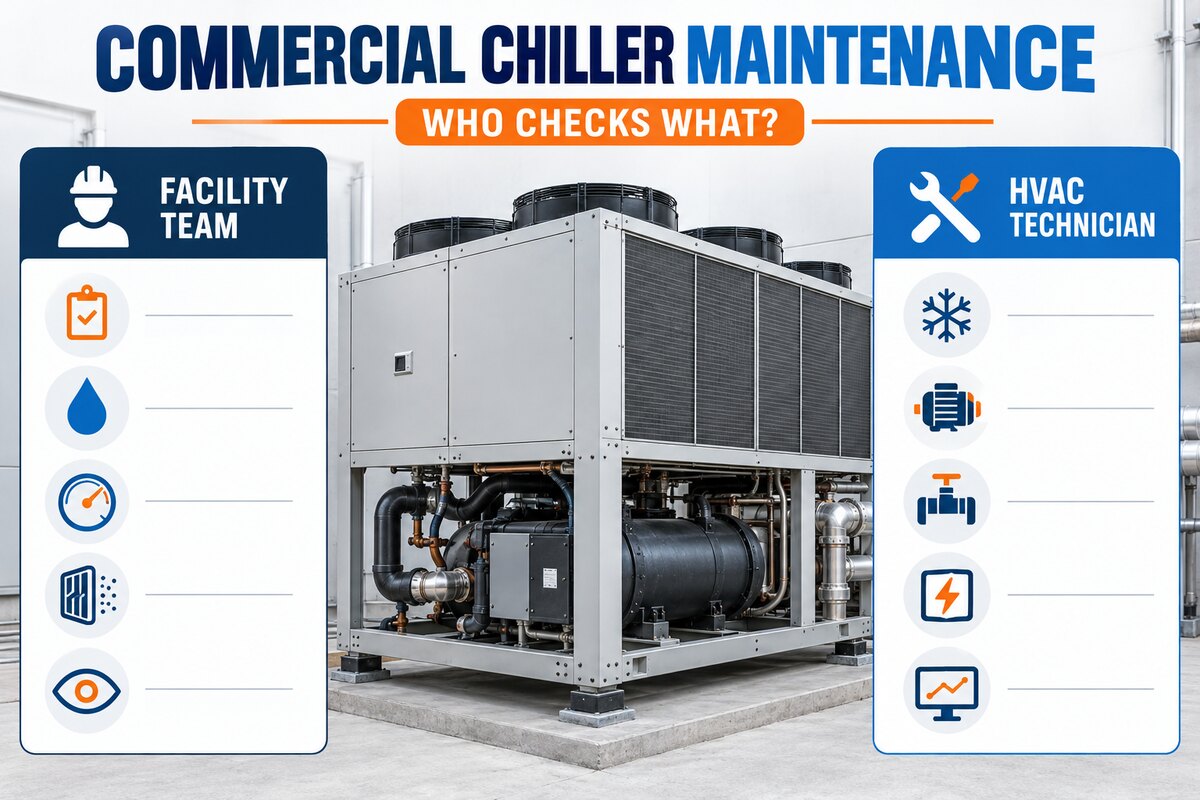
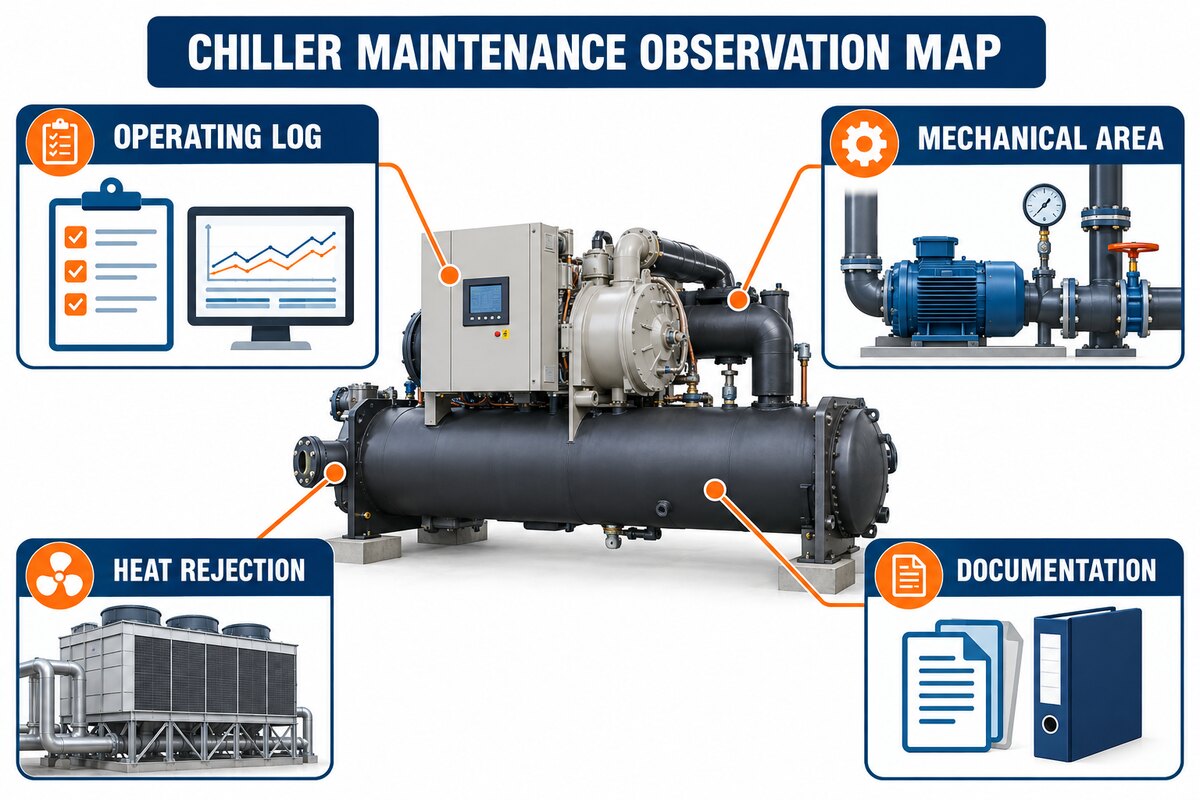
| Area | Facility observation | Professional scope |
|---|---|---|
| Operating log | Record leaving and entering water temperatures, displayed pressures or alarms, outdoor conditions, and occupied schedule without changing controls. | Verify sensors, safeties, control sequences, flow, electrical components, and refrigeration performance. |
| Mechanical area | Keep required access paths clear and note standing water, unusual odor, vibration, or visible leakage. | Inspect pumps, strainers, piping, insulation, heat exchangers, supports, and leak sources. |
| Heat rejection | Document condenser approach trends, fan or tower status visible from approved areas, and changes after dusty or windy conditions. | Clean and test condenser components, tower systems, fans, motors, water treatment interfaces, and controls. |
| Documentation | Use the same equipment ID, time, units, and escalation rules on every shift. | Compare logs with measured performance and update maintenance priorities. |
Daily and Weekly Facility Observations
Start with operating consistency. Record the equipment identification, date, time, outdoor conditions, occupied load, displayed temperatures, active alarms, and any tenant or process complaints. The goal is not to diagnose the chiller from one number. The goal is to create a reliable record that shows when performance changed and what else changed at the same time.
- Confirm that the expected chiller is enabled for the current schedule.
- Record visible controller values without changing setpoints.
- Note repeated starts, stops, alarms, or resets.
- Listen from an approved distance for new vibration, rattling, surging, or bearing noise.
- Look for water, damaged insulation, corrosion, or staining around accessible piping.
- Confirm that mechanical-room access and ventilation areas are unobstructed.
- Document which zones, tenants, or processes are affected.
If the building uses several chillers, identify the lead and lag equipment and note whether staging appears consistent with the normal schedule. A sudden change in staging may reflect load, control, flow, or equipment conditions that deserve professional review. Facility staff should not force a chiller online or defeat a safety to test a theory.
Monthly Documentation Review
At least monthly, organize the operating logs by asset. Look for rising approach temperatures, longer run hours, repeated alarms, unusual cycling, increasing complaints, or a growing difference between displayed values and independent building-management records. Review work orders to see whether the same symptom has been closed repeatedly without a verified cause.
Coordinate these findings with the contractor responsible for commercial chiller systems. The technician can determine which trends require testing and which are normal responses to load or weather. This review also helps management prioritize planned work before peak conditions instead of relying only on reactive calls.
Quarterly and Seasonal Professional Service
Professional maintenance may include electrical inspection, sensor verification, control-sequence review, refrigerant-side diagnostics, water-flow evaluation, heat-exchanger inspection, oil or lubricant checks where applicable, starter and motor testing, and analysis of recorded performance. The exact scope depends on chiller type, manufacturer requirements, run hours, water treatment, site conditions, and service history.
Before the highest-load months, combine the chiller review with the broader commercial HVAC system. Air handlers, pumps, controls, cooling towers, and distribution problems can resemble a chiller problem. Evaluating the system as a whole reduces the risk of replacing or adjusting a component that is responding to another condition.
What Facility Staff Should Not Do
Do not open energized panels, tighten electrical connections, bypass safeties, add refrigerant, vent refrigerant, force valves, change control programming, or repeatedly reset a chiller that trips. Burning odors, smoke, arcing sounds, major water release, rapidly worsening vibration, or repeated protective shutdowns require escalation under the site’s safety plan. Critical cooling loss may also require the building’s documented emergency process and emergency HVAC service.
Information to Prepare for a Service Request
- Asset number, manufacturer, model, and approximate age.
- Exact alarm wording and the time it appeared.
- Current and recent displayed temperatures.
- Areas or processes affected.
- Recent schedule, occupancy, weather, or control changes.
- Photos from safe accessible locations.
- Previous work orders for the same symptom.
- Any backup equipment that is currently operating.
A clear service request allows the technician to arrive with useful context and compare the complaint with the building’s normal operation. For help organizing a site-specific scope, use the contact page or review related commercial services.
Turn the Checklist Into a Repeatable Workflow
A checklist becomes valuable only when every shift uses the same asset names, units, measurement points, and escalation language. Assign responsibility for each observation, define where records are stored, and identify who reviews exceptions. Avoid vague entries such as “not cooling well.” Record the affected space, the displayed values, the alarm, the duration, and the operating context.
Use separate fields for normal observations, exceptions, actions taken, and follow-up. This prevents a corrective action from being mistaken for a diagnosis. It also gives management a clearer view of repeat issues, deferred work, and equipment that is consuming a disproportionate share of service attention.
Coordinate Chiller Records With the Rest of the Building
Chiller data is most useful when compared with air-handler operation, pump status, tenant complaints, outdoor conditions, and building automation trends. A warm zone does not automatically mean the chiller is underperforming. A control issue, closed valve, airflow problem, scheduling conflict, or distribution condition may affect only part of the building.
During review meetings, place the chiller log beside energy data, service reports, water-treatment reports when applicable, and open work orders. This gives the facility team and service contractor a common record for planning. Keep original readings intact rather than rewriting them after a technician identifies the cause.
Plan Maintenance Around Risk, Not Just the Calendar
Calendar intervals provide a baseline, but equipment condition and business risk should refine the plan. A chiller supporting critical processes, healthcare areas, dense occupancy, or limited redundancy may require closer trend review than a lightly loaded machine with available backup capacity. Run hours, age, service history, water quality, ambient exposure, and manufacturer guidance all influence the appropriate scope.
Related Commercial HVAC Resources
- Discount AC & Refrigeration
- Rooftop unit service
- Commercial AC installation
- Commercial refrigeration services
Frequently Asked Questions
How often should a commercial chiller be inspected?
Facility observations may be daily or weekly, while professional frequency depends on equipment type, run hours, manufacturer guidance, water treatment, and site conditions.
Can facility staff clean a chiller?
Staff can keep approved surrounding areas clear. Coil, tube, electrical, control, tower, refrigerant, and internal cleaning should follow manufacturer requirements and be handled by qualified personnel.
What should be included in a chiller log?
Include equipment ID, date and time, outdoor conditions, displayed temperatures, alarms, operating status, affected areas, observed changes, and the person recording the entry.
Why are temperature trends more useful than one reading?
A trend shows direction, duration, load context, and recurrence. One reading may reflect a temporary operating condition.
Should staff reset a chiller after every alarm?
No. Repeated resets can erase useful evidence and may allow a protective condition to recur. Follow the site escalation procedure and equipment guidance.
Does Phoenix dust affect chiller maintenance?
Dust can affect outdoor heat-rejection equipment and surrounding conditions. The actual impact depends on chiller design and location, so inspection findings should guide service.
Is water treatment part of chiller maintenance?
For water-cooled systems, water quality and treatment coordination can materially affect heat transfer and equipment condition.
When should a facility request professional service?
Request service for repeated alarms, changing temperature trends, short cycling, water leakage, unusual vibration, electrical odor, loss of capacity, or any condition outside normal operation.
Plan a Commercial Chiller Review
Discount AC & Refrigeration can review operating history, observed symptoms, and the professional maintenance scope for commercial chiller systems in the Phoenix area.