
A commercial HVAC preventative maintenance agreement should do more than schedule occasional filter changes. For Phoenix property managers, facility teams, restaurant operators, and multi-site owners, a useful contract defines the equipment covered, service frequency, inspection scope, documentation, communication process, and response terms.
Q4 is a practical time to compare agreements for the following year. Cooling demand begins to ease, teams can review the previous summer’s work orders, and decision-makers have time to correct gaps before the next high-load season.
Start With an Accurate Equipment Inventory
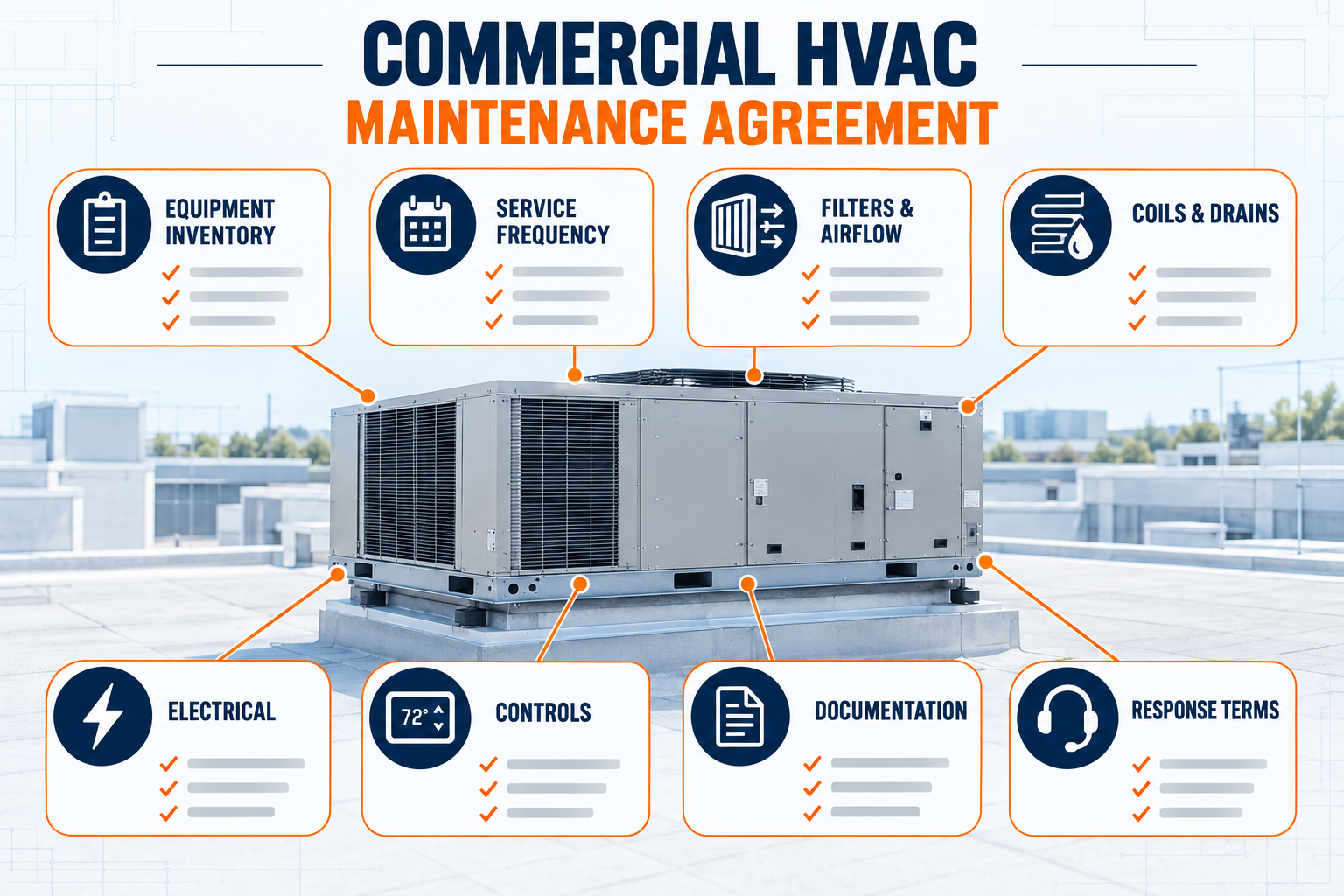
The contract should identify each covered asset by location, type, manufacturer, model, serial number, capacity, approximate age, filter requirements, and access conditions. Rooftop package units, split systems, heat pumps, exhaust equipment, controls, and commercial refrigeration should not be grouped under a vague equipment count if the service scope differs.
An inventory reduces confusion when staff changes or a service call occurs after hours. It also supports budget planning by showing which assets have repeated repairs, which require special filters or access, and which may need a separate replacement evaluation.
What Preventive Maintenance Should Cover
Filters and airflow
The agreement should state who supplies filters, which types and sizes are included, and how often they are checked or replaced. Technicians should also observe blower operation, belts where applicable, return and supply conditions, visible restrictions, and unusual temperature patterns.
Coils, condensers, and heat rejection
Phoenix dust and rooftop exposure can restrict outdoor coils. The contract should distinguish routine inspection from included cleaning and from restorative work that requires separate authorization. Access, water availability, chemicals, and environmental controls may affect the method.
Electrical and mechanical condition
Applicable connections, contactors, capacitors, motors, disconnects, belts, bearings, fans, and operating current should be evaluated according to the equipment and service scope. The report should identify abnormal readings and explain whether monitoring or corrective work is recommended.
Drains and moisture management
Condensate drains, pans, traps, and accessible lines need inspection because blockage can create water damage, biological growth concerns, or system shutdowns. The agreement should state which cleaning tasks are included.
Controls and operating sequence
Thermostats, schedules, sensors, economizers, building controls, and heating or cooling sequences should be reviewed to the extent defined in the contract. Control optimization and programming changes may require a separate scope.
How Often Should Commercial Equipment Be Serviced?
Frequency should reflect equipment type, operating hours, occupancy, dust exposure, criticality, manufacturer requirements, filter loading, and prior history. A lightly used office unit does not have the same risk profile as restaurant equipment, a server room system, or a retail site with long daily hours.
A good provider explains why it recommends monthly, quarterly, seasonal, or other intervals for each asset group. The schedule should also account for heating-mode testing and pre-summer preparation instead of concentrating every visit during peak demand.
Documentation Property Managers Should Expect
- Date, site, technician, and equipment identifier.
- Tasks completed and filters or consumables used.
- Measured readings relevant to the equipment.
- Photos when they clarify access, condition, or recommended work.
- Open recommendations separated by urgency and asset.
- Repair authorization history and completion status.
- Recurring issue summary for budgeting and capital planning.
Documentation should be consistent across sites. A stack of invoices without asset-level findings makes it difficult to identify repeated failures or confirm that the contracted work occurred.
Response Terms and Repair Authorization
Preventive maintenance does not eliminate every breakdown. The agreement should explain how service requests are submitted, which contacts can authorize work, how after-hours calls are handled, and whether preferred scheduling or other response terms apply. Avoid assuming that “priority” has the same meaning across providers. Ask for the exact process in writing.
The contract should also define what is excluded: replacement parts, refrigerant, major coil cleaning, crane service, roof access equipment, permits, controls programming, or corrective work may require separate approval.
Multi-Site Considerations
Multi-site operators benefit from standardized asset naming, a central contact list, consolidated reporting, consistent filter specifications, and site-specific access notes. Ask whether the provider can summarize open recommendations across properties without losing the detail needed by each manager.
A Contract Comparison Checklist
- Is every covered asset listed?
- Are visit frequencies tied to equipment use and risk?
- Are included inspections and cleaning tasks defined?
- Are filters, belts, and consumables addressed?
- Does the provider document readings and recommendations?
- Are exclusions and repair-authorization limits clear?
- Are response terms written in measurable language?
- Can reporting support multiple sites and capital planning?
Discount AC & Refrigeration supports Phoenix-area facilities with commercial HVAC service, preventive maintenance, repairs, and commercial refrigeration support. A site review can help define the equipment inventory and an appropriate service schedule.
Frequently Asked Questions
Does preventive maintenance include all repairs?
Usually not. The agreement should distinguish included maintenance tasks from parts, corrective work, and specialty services requiring authorization.
How many visits does a commercial HVAC system need?
Frequency depends on equipment type, operating hours, environment, criticality, and manufacturer guidance. The provider should explain the schedule for each asset group.
Should rooftop coil cleaning be included?
The contract should state whether routine cleaning is included, how often, and what conditions require a separate restorative cleaning scope.
What reporting should a property manager receive?
Expect asset-level tasks, readings, findings, photos when useful, open recommendations, and clear repair status.
Request a Commercial HVAC Maintenance Review
Call (480) 478-2616 or contact Discount AC & Refrigeration to discuss a Phoenix commercial property, equipment inventory, or multi-site maintenance requirement.