Root cause: the AC installation process Phoenix homeowners go through follows a predictable sequence — but how long each stage takes depends on permit turnaround, equipment availability, ductwork condition, and how booked installers are during peak summer demand.
If your air conditioner is on its last legs heading into another 115°F Phoenix summer, the question on your mind isn’t just “how much?” — it’s “how long until I have cold air again?” Most homeowners have never watched a system get replaced and have no idea whether they’re looking at a single afternoon or a week of waiting. The good news: a well-run installation is faster and far less disruptive than people expect, as long as you understand the steps and plan ahead of the heat.
This guide walks you through the entire AC installation process from the first phone call to the final city inspection, including realistic timeframes for each stage and the factors that speed it up or slow it down. Our licensed HVAC technicians at Discount AC & Refrigeration have installed and replaced systems across the Phoenix East Valley for over 20 years — including throughout Gilbert and the surrounding service areas of Mesa, Chandler, Tempe, Queen Creek, and Apache Junction. Homeowners can check our reputation as a local HVAC company on Google before they ever pick up the phone.
https://www.youtube.com/shorts/qXKZdnq4xpg
The AC Installation Process Phoenix Homeowners Should Expect
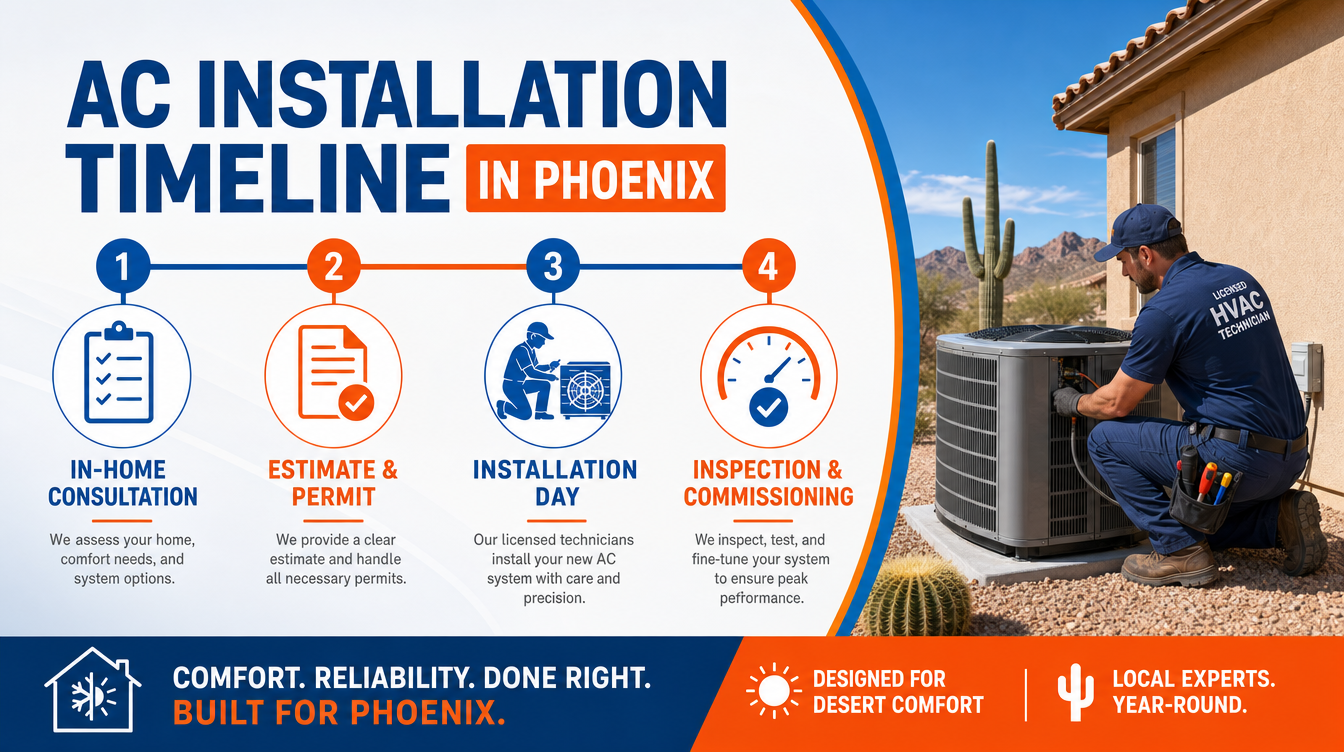
A complete residential replacement breaks down into four distinct stages. From your first call to a finished, inspected system, most Phoenix projects wrap up in 3 to 10 business days — and the physical installation itself is usually a single day.
Here’s the high-level timeline before we dig into each stage:
- Stage 1 — In-home consultation & load calculation: 1 visit, 45–90 minutes
- Stage 2 — Estimate, equipment selection & permitting: 1–5 business days
- Stage 3 — Installation day: 1 day, typically 6–10 hours
- Stage 4 — Commissioning, documentation & city inspection: same day + 1–10 days for inspection
The single biggest variable is timing. A replacement scheduled in March or October moves fast. The same job requested during a July heat wave — when every contractor in the valley is slammed — can add a week or more to your wait, which is exactly why we tell homeowners not to gamble on an aging system surviving one more summer.
| Stage | Typical Timeframe | What Happens |
|---|---|---|
| In-Home Consultation | 45–90 min (1 visit) | Measurements, duct & panel inspection, Manual J load calculation |
| Estimate & Permitting | 1–5 business days | Written quote, equipment & SEER2 selection, city permit pulled |
| Installation Day | 6–10 hours (1 day) | Old unit removed, new system set, ducts sealed, system commissioned |
| City Inspection | 1–10 days after install | Inspector confirms the installation meets Arizona code |
Stage 1: In-Home Consultation and Load Calculation
This is where a quality installation is won or lost, and it’s the stage low-bid contractors most often rush.
A technician visits your home to measure square footage, inspect your existing equipment, evaluate ductwork condition, check your electrical panel, and look at attic access and insulation. The purpose is to perform a proper Manual J load calculation — the industry-standard method for determining exactly how much cooling capacity your home needs.
Why this matters so much in Arizona:
- Undersizing is dangerous. A unit that’s too small runs nonstop without ever satisfying the thermostat, burning out the compressor years early in our 110°F-plus heat.
- Oversizing wastes money. An oversized system short-cycles, creating hot and cold spots, poor humidity control during monsoon season, and accelerated wear.
- Duct condition is critical. Leaky or undersized ducts can cut efficiency 20–30%, no matter how good the equipment is.
Expect this visit to take 45 to 90 minutes. If a salesperson quotes you a price by glancing at your old unit’s tonnage without measuring anything, that’s a red flag — and a common reason “matching” replacements underperform from day one. When you’re ready to book this assessment, our team handles scheduling through the contact our office line or directly at (480) 478-2616.
Stage 2: Estimate, Equipment Selection, and Permitting
After the assessment, you’ll receive a written estimate. A thorough quote should spell out the equipment make and model, SEER2 efficiency rating, refrigerant type, labor, permit fees, and warranty terms — not a single lump-sum number.
Choosing your system. Applicable Southwest efficiency requirements vary by equipment type and capacity; 15.2 SEER2 is not a universal legal minimum. Check the Department of Energy’s regional standards and our Arizona SEER2 guide. Compare the upgrade price with a realistic savings estimate. The federal 25C credit ended for improvements after 2025. For installed-cost factors, review our AC replacement pricing guide for Gilbert.
Refrigerant. Systems built after January 1, 2025 use R-454B in place of R-410A, which the EPA phased down under Section 608 of the Clean Air Act. If you’re replacing an older R-22 or R-410A unit, the newer refrigerant is already built into the price.
Permitting. Every Arizona city requires a permit for equipment replacement. Pulling the permit is the contractor’s job, and it’s what triggers the inspection that protects your homeowner’s insurance and resale value. Permit turnaround is usually 1–3 business days, though equipment lead time is the more common bottleneck — most standard systems are in stock, but premium or specialty units can take several days to source.
How long does this stage take? Anywhere from one to five business days, depending on how quickly you approve the quote and whether your chosen equipment is on the shelf.
Stage 3: Installation Day — Hour by Hour
This is the day you’ve been waiting for, and for a standard residential split system it runs 6 to 10 hours. Rooftop package units, common on older Phoenix ranch homes, often finish in 4–6 hours. Here’s the typical sequence:
- Refrigerant recovery & old system removal — Existing refrigerant is recovered per EPA regulations; nothing is vented to atmosphere.
- Condenser pad & disconnect prep — The outdoor pad is inspected or replaced, and electrical disconnect and breaker sizing are confirmed against the new equipment.
- Air handler / coil installation — Indoors, the evaporator coil or air handler is set, leveled, and secured; drain lines are cleared.
- Ductwork inspection & sealing — A quality crew checks static pressure and seals accessible duct leaks before connecting the new system. Low-bid installers routinely skip this.
- Line set evaluation — Copper refrigerant lines are checked for sizing and condition and replaced when capacity increases.
- Commissioning & testing — The system is charged using superheat and subcooling measurements (not just gauge pressure, which is unreliable in extreme heat) and supply/return temperatures are verified.
You don’t need to be home the entire time, but plan to be present at the start for a walkthrough and at the end for the handoff. Crews typically arrive between 6 and 8 AM to beat the worst attic heat — our licensed HVAC technicians work from 6 AM to midnight, seven days a week, which gives us more scheduling flexibility than the typical 8-to-5 shop.
Stage 4: Commissioning, Documentation, and City Inspection
Once the system is running, the job isn’t finished until the paperwork and inspection are squared away.
Before the crew leaves, you should receive equipment model and serial numbers, warranty registration details, and a startup sheet showing the system’s performance readings at commissioning. That sheet becomes your baseline for every future service visit, so keep it with your home records.
A few days to a week or two later, a city inspector verifies the installation meets code. A reputable contractor coordinates this for you and is present if the inspector has questions. Quality installations are also held to ACCA Quality Installation standards, which call for duct leakage testing and airflow verification — steps that separate a system that lasts 12 years from one that lasts 17.
After inspection passes, you’re done. To keep the new system healthy in desert conditions, ask about a preventive maintenance plan — and if you ever lose cooling unexpectedly, our 24/7 emergency AC repair team responds around the clock.
How Arizona’s Climate and Season Affect Your Installation Timeline
The same installation that takes three days in spring can take two weeks at the peak of summer. Three factors drive that swing:
- Demand. When the valley hits 115°F, every HVAC company is buried in emergency calls. Scheduling a planned replacement competes with no-cooling emergencies, stretching lead times by 2–4 weeks.
- Attic heat. Crews work slower and safer in 150–160°F attics, and many shops won’t send technicians into an attic past mid-morning in July. That’s why summer installs start at dawn.
- Equipment availability. Heat waves spike demand for popular models, occasionally creating short backorders on specific tonnages.
The takeaway for homeowners: if your system is more than 10–12 years old or still running on R-410A, plan the replacement in spring or fall. A planned installation is always faster, calmer, and less expensive than an emergency one during a heat event. For AC service in Gilbert and nearby East Valley areas, we offer same-week scheduling outside of peak demand.
Professional Standards, Licensing, and What to Ask Before You Sign
Arizona law requires HVAC contractors to hold a valid ROC (Registrar of Contractors) license. Our team operates under ROC 361623 — verifiable directly on the state portal. Before any crew touches your home, confirm:
- The ROC license number is real and active on the Arizona ROC website
- A permit will be pulled — unpermitted work can void insurance and create resale problems
- A Manual J load calculation is performed, not a tonnage-for-tonnage swap
- Refrigerant type is documented and recovery is done by EPA-certified technicians
- The warranty is in writing, covering both equipment and labor
Our clients across Arizona — from homeowners to restaurants, breweries, and retail centers that rely on our commercial HVAC services — choose Discount AC & Refrigeration for honest, no-pressure assessments and consistent results. Satisfied customers can even share the savings through our Refer & Earn program.
Frequently Asked Questions About the AC Installation Process in Phoenix
How long does the whole AC installation process take in Phoenix?
From your first call to a passed city inspection, most off-season projects finish in 3–10 business days. The physical install is usually a single 6–10 hour day. During peak summer, demand can stretch that to 2–4 weeks. Call (480) 478-2616 for a timeline specific to your home.
How long does installation day itself take?
A standard residential split system replacement runs 6–10 hours. Rooftop package units often finish in 4–6 hours. Attic air handler work in Arizona summer takes longer because crews work safely in 150°F-plus attic temperatures, which is why installs start at dawn.
Do I need a permit for a new AC installation in Arizona?
Yes. Arizona cities require a permit for equipment replacement, and pulling it is the contractor’s responsibility. The permit triggers the inspection that protects your insurance and resale value. Our ROC 361623 license covers permitted work across the Phoenix metro.
How much does a new AC installation cost in Phoenix?
Cost depends on system size, SEER2 rating, ductwork condition, and electrical work. Review our AC replacement near me in Gilbert cost breakdown for current pricing tiers and what a complete quote should include.
Do I have to be home during the installation?
Plan to be present at the start for a walkthrough and at the end for the handoff and startup-sheet review. You don’t need to stay the entire day. You will also need to provide access for the city inspector once the install is complete.
What refrigerant do new AC systems use in 2026?
Systems manufactured after January 2025 use R-454B, which replaced R-410A under the EPA phasedown. If your old unit uses R-22 or R-410A, your replacement automatically uses the newer refrigerant — already priced into the equipment. Questions? Call (480) 478-2616.
When is the best time of year to install a new AC in Phoenix?
Spring and fall. Off-season scheduling means faster turnaround, no emergency pricing, and cooler working conditions. For AC service in Gilbert and the East Valley, we offer same-week scheduling outside peak summer demand.
What happens after my new system is installed?
You’ll get a startup sheet and warranty registration, then a city inspector verifies code compliance within 1–10 days. To protect the system in desert heat, enroll in a preventive maintenance plan and keep our 24/7 emergency AC repair line handy.
Don’t Wait for the First Heat Wave: Plan Your Phoenix AC Installation Now
The AC installation process in Phoenix is straightforward when you start early — a consultation, a clear estimate, one focused install day, and a quick inspection. The homeowners who struggle are the ones who wait until their system dies in July, when timelines stretch and emergency pricing kicks in.
If your unit is over a decade old, running on phased-out refrigerant, or already straining during the first 100°F days of spring, now is the time to schedule an assessment. Our licensed technicians provide free in-home sizing consultations and document every installation with a startup sheet.
Call (480) 478-2616 today to book your assessment. Discount AC & Refrigeration — ROC 361623 — serves the Phoenix metro from 6 AM to midnight, every day of the year. And if your current system quits before your new one is installed, our emergency AC repair team is one call away at (480) 478-2616.
Ready to Start Your AC Installation Before the Heat Hits?
Our licensed HVAC technicians (ROC 361623) provide free in-home sizing assessments, clear written quotes, and professional installs across the Phoenix East Valley — available 6 AM to midnight, 7 days a week.