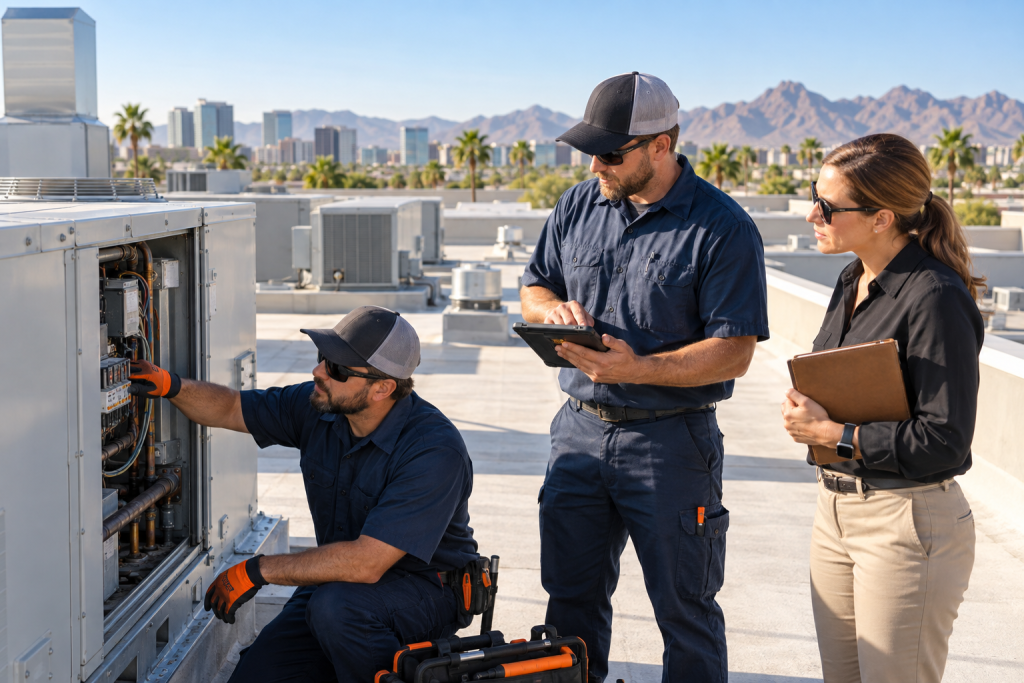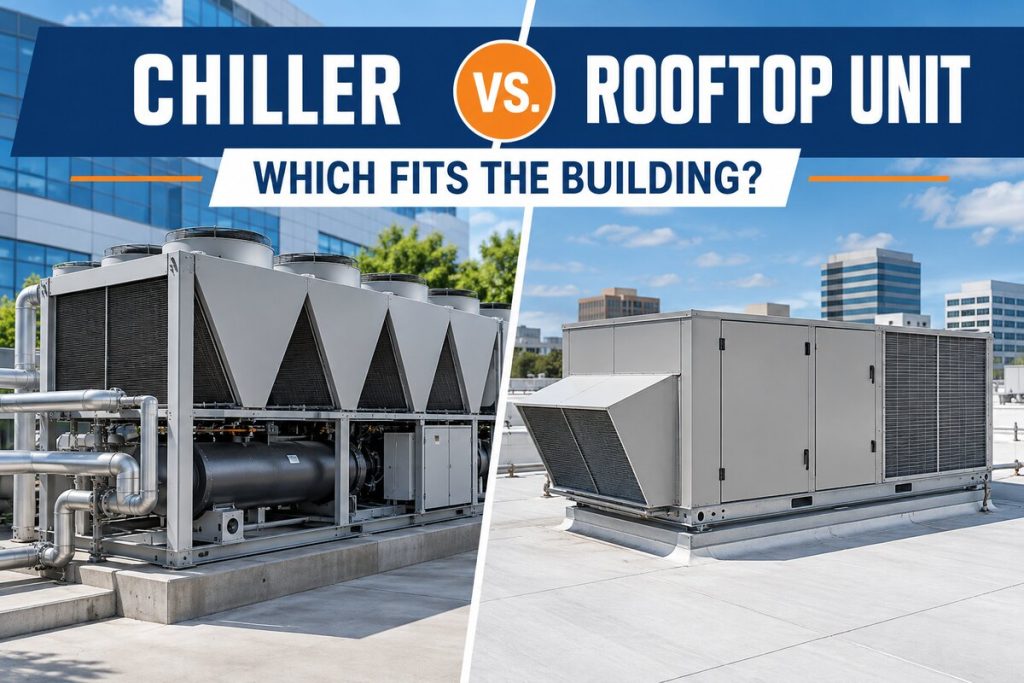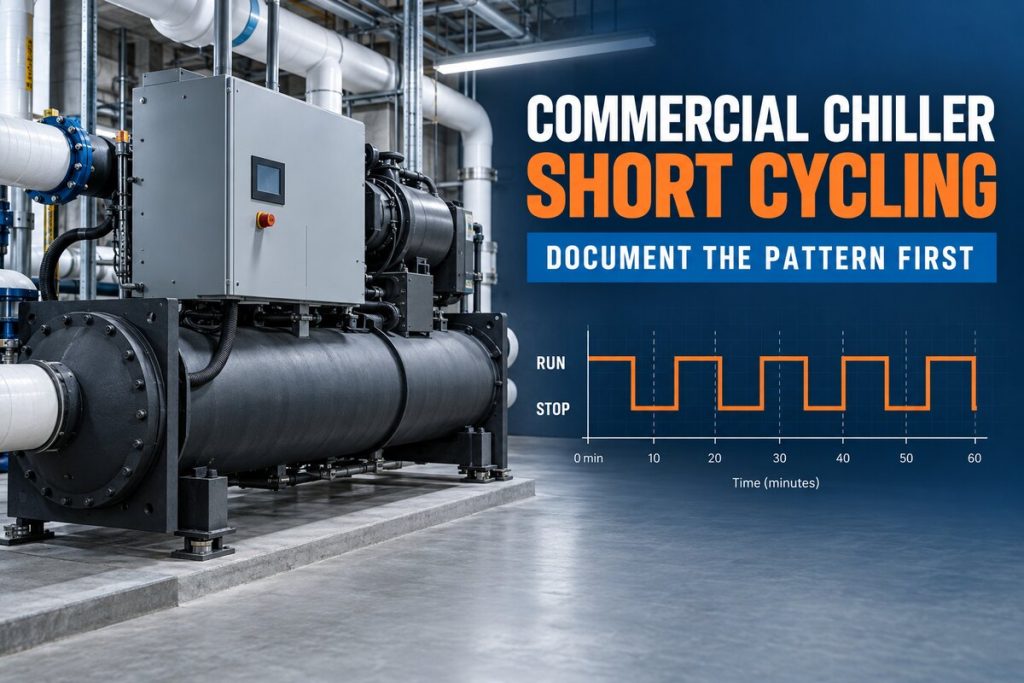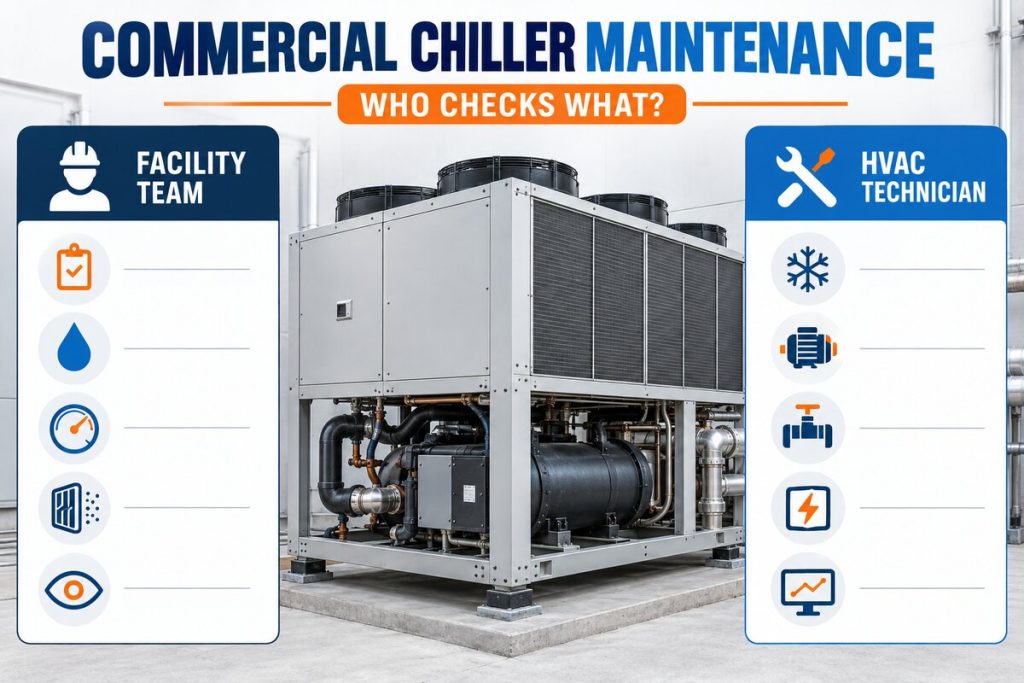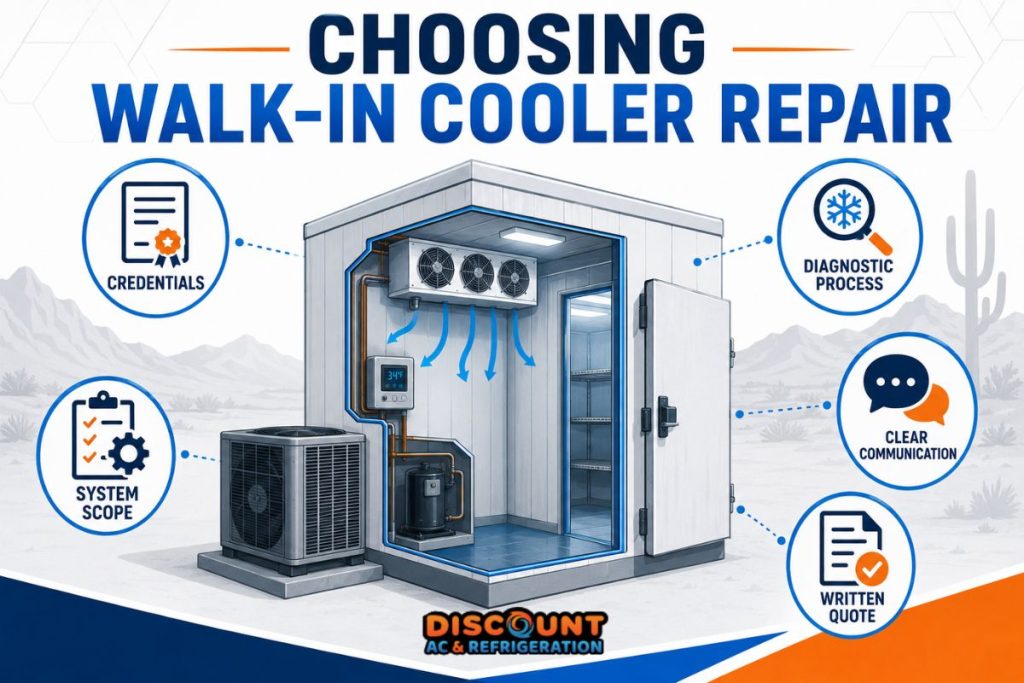
Walk in cooler repair should be scheduled when a commercial cooler can no longer maintain stable temperatures, begins cycling differently, develops unusual ice or moisture, or shows other signs that its refrigeration system is under stress. For restaurants, grocery stores, convenience stores, bars, florists, and other Arizona businesses, recognizing these symptoms early can help protect inventory and prevent a minor refrigeration problem from developing into a larger equipment failure.
That is especially important in Queen Creek, Phoenix, and the surrounding East Valley, where commercial refrigeration equipment can operate under demanding outdoor conditions for much of the year. A system that appears to be performing normally during cooler weather may have more difficulty rejecting heat when condenser conditions become more demanding.
This guide explains nine warning signs to watch for, what employees or business owners can safely observe without opening refrigeration components, when the equipment should no longer be relied upon for temperature-sensitive products, and what a commercial refrigeration technician may inspect during diagnosis.
Why Walk-In Cooler Problems Matter More in Arizona
A walk-in cooler does not create cold air in the same way people commonly imagine. Instead, the refrigeration circuit absorbs heat from inside the cooler and rejects it elsewhere through the condenser.
When outside conditions are demanding, the condenser still needs adequate airflow and properly functioning refrigeration components to remove that heat. Dirt accumulation, damaged electrical components, refrigerant problems, fan failures, control problems, or restricted airflow can reduce the system’s ability to maintain the required box temperature.
Commercial operators near Queen Creek and throughout metro Phoenix should therefore pay attention not only to complete refrigeration failure, but also to smaller changes in temperature, sound, ice formation, operating cycles, doors, and airflow.
If your business needs professional service, Discount AC & Refrigeration provides walk-in cooler and freezer service as part of its commercial refrigeration services in Arizona.
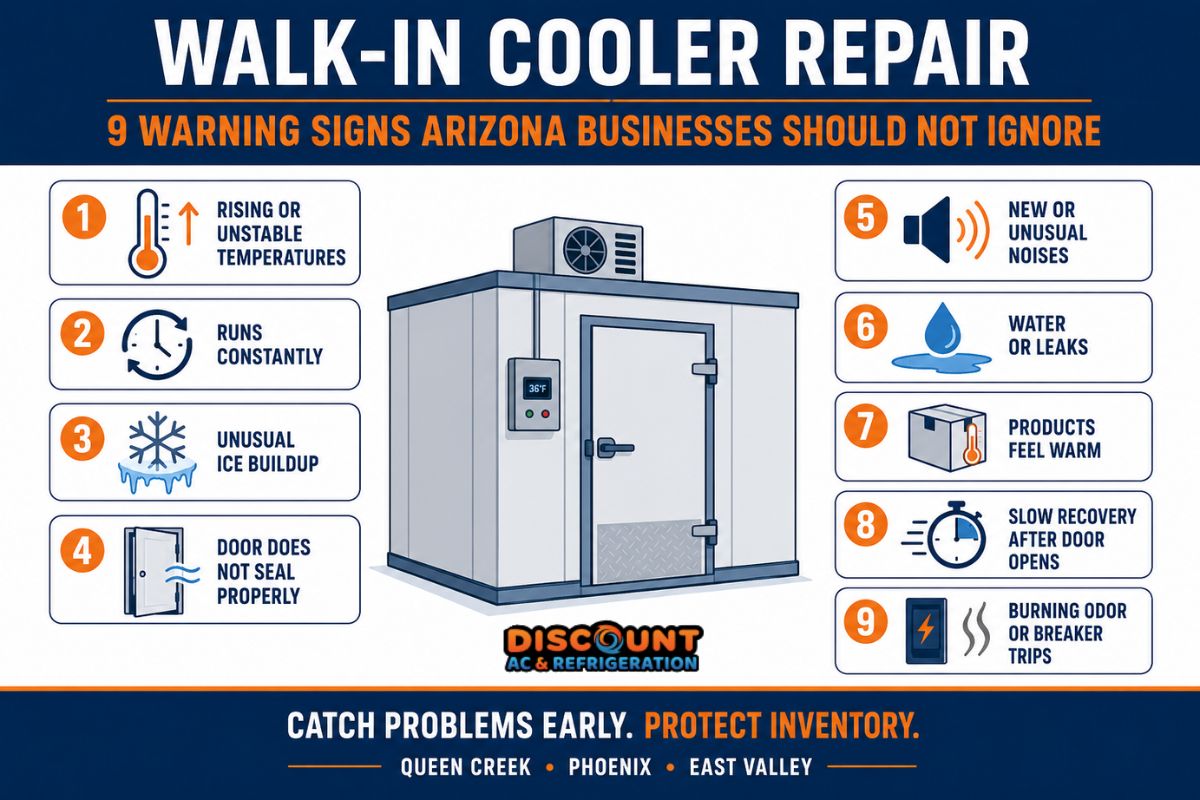
9 Signs You May Need Walk In Cooler Repair
1. The Cooler Is No Longer Maintaining a Stable Temperature
The most important warning sign is also one of the easiest to observe: the walk-in cooler is getting warmer or experiencing unusual temperature fluctuations.
A single temperature reading does not necessarily identify the cause. Door traffic, recently loaded products, defrost cycles, thermometer location, and other operating conditions can affect what you see. What matters is a repeated pattern in which the cooler is unable to recover and maintain its normal operating range.
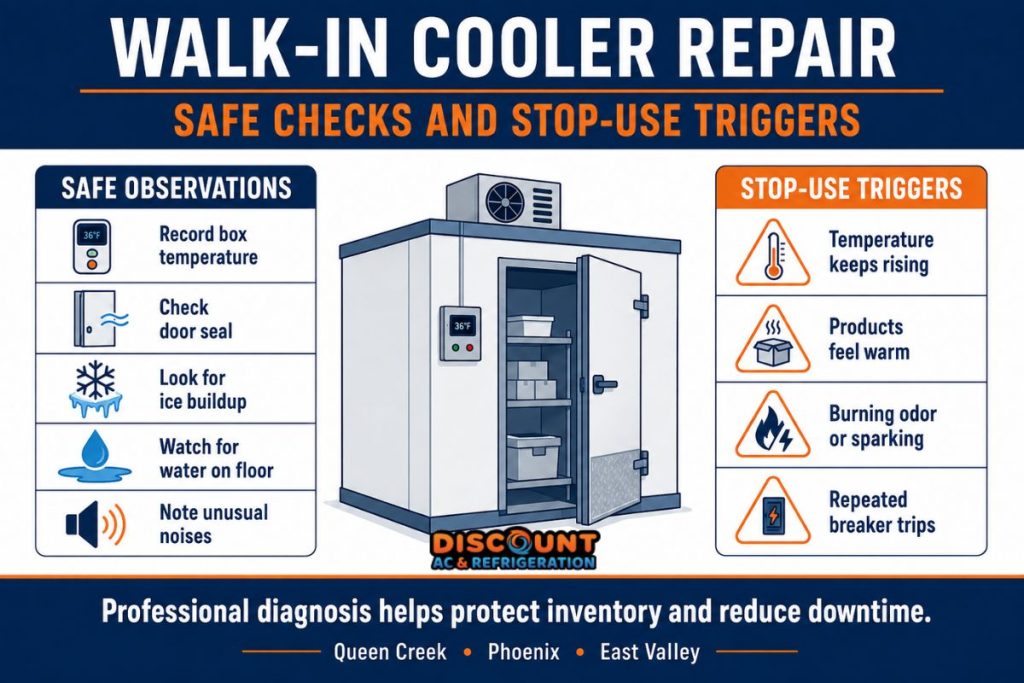
What You Can Safely Check
- Record the displayed temperature and compare it with previous readings.
- Confirm that the door is completely closed.
- Look for obvious gaps around the door gasket.
- Check whether employees have recently loaded a large quantity of warm product.
- Use your facility’s approved procedure to verify actual product temperatures when required.
If temperatures continue climbing despite the door being closed and normal operating conditions, the problem should be evaluated professionally rather than repeatedly changing the thermostat.
2. The Refrigeration System Seems to Run Constantly
A commercial refrigeration system will naturally run longer during periods of high demand. However, a cooler that seems to operate continuously without reaching its normal temperature may be compensating for a problem.
Possible causes can include restricted condenser airflow, dirty coils, deteriorated door seals, refrigerant circuit problems, control issues, fan problems, or a compressor that is no longer performing as expected.
The important observation for an employee is not diagnosing which component failed. Instead, note whether the operating pattern has changed.
If the cooler previously cycled off normally but now appears to run for extended periods while the temperature remains elevated, schedule a walk in cooler repair diagnosis.
3. Ice Is Building Up Where It Normally Does Not
Frost and ice can provide useful clues about what is happening inside a refrigeration system, but they should not automatically be interpreted as evidence that the unit is cooling correctly.
Unusual ice accumulation around the evaporator area, refrigerant lines, doors, ceilings, or other sections of the cooler can indicate moisture infiltration, airflow restrictions, defrost problems, control issues, or refrigeration circuit conditions that require testing.
Employees can document where the ice appears and whether it returns after normal operation. They should not chip ice from an evaporator coil with knives, screwdrivers, or other sharp tools because doing so can damage coils or refrigerant tubing.
4. The Walk-In Door Does Not Seal Correctly
Not every cooler problem begins with the compressor. Sometimes the refrigeration system is fighting heat and moisture that continuously enter through the door.
Check the gasket visually. Common warning signs include:
- Torn or cracked gasket material
- Sections that have pulled away from the door
- Visible gaps when the door is closed
- A door that does not align correctly
- Condensation or frost concentrated around the doorway
A damaged seal allows conditioned air to escape and warmer air to enter. It can also add moisture to the box, potentially contributing to frost and additional refrigeration load.
A technician can determine whether the issue is limited to the gasket or whether hinges, door alignment, heaters, controls, or other components should also be inspected.
5. You Hear New or Unusual Noises
Commercial refrigeration equipment is not silent. Fans, compressors, relays, and refrigerant movement all create normal operating sounds.
What deserves attention is a new sound or a clear change from the cooler’s normal sound.
Examples may include:
- Grinding
- Metallic rattling
- Repeated clicking
- Buzzing or humming that is stronger than usual
- Fan blades striking another surface
- Repeated attempts to start
A sound alone cannot reliably identify the defective component. For example, a buzzing sound may relate to several electrical or mechanical conditions. Record when the sound happens and whether temperatures change at the same time, then provide that information to the technician.
6. Water Is Appearing Inside or Around the Cooler
Unexpected water inside a walk-in cooler deserves investigation. The source may involve drainage, condensation, door infiltration, ice melting, or another refrigeration-related condition.
Water should never be ignored simply because the cooler still feels cold.
First, keep employees and customers away from slippery areas and protect products from contamination. Then observe where the moisture appears to originate without removing electrical panels or refrigeration components.
If water is near electrical equipment, wiring, disconnects, or energized components, avoid touching the affected area and have the system evaluated professionally.
7. Products Feel Warmer Than Normal Even Though the Display Looks Correct
This is one of the more important situations for restaurants and food-service operations because the controller display and actual product temperature are not necessarily the same thing.
A sensor may be reading air from one location while airflow problems create warmer areas elsewhere in the cooler. Product placement can also interfere with circulation.
If employees report that dairy, meat, prepared foods, produce, beverages, or other refrigerated products feel warmer than expected, follow your approved temperature-monitoring procedure instead of relying only on how the products feel.
When Food Safety Becomes the Priority
If time/temperature control for safety food is not being maintained at the required cold-holding temperature, treat the situation as a food-safety issue as well as an equipment issue. Follow your establishment’s food-safety procedures and applicable local requirements for evaluating, relocating, or disposing of affected products.
8. The Cooler Takes Much Longer to Recover After the Door Opens
A walk-in cooler naturally gains heat whenever employees open the door. After the door closes, however, a properly operating system should begin bringing conditions back toward the intended range.
Pay attention when recovery becomes noticeably different from the cooler’s previous behavior.
For example, if normal deliveries or kitchen traffic never caused a problem before but now produce prolonged temperature increases, there may be a developing refrigeration or airflow issue.
Before assuming the compressor has failed, a technician may evaluate:
- Condenser condition
- Evaporator airflow
- Fan operation
- Door infiltration
- Temperature controls and sensors
- Refrigerant circuit performance
- Electrical components
9. You Notice Burning Odors, Electrical Problems, or Repeated Breaker Trips
This warning sign requires a different response from ordinary temperature drift.
A persistent electrical or burning odor, visible damaged wiring, smoke, sparking, or repeated breaker trips should not be treated as a routine refrigeration inconvenience.
Do not repeatedly reset a breaker in an attempt to keep the cooler operating. Repeated trips indicate that the electrical condition requires proper diagnosis.
Stop-Use Trigger
If you observe smoke, sparking, a persistent burning or electrical odor, exposed damaged wiring, or another apparent electrical hazard, keep personnel away from the affected equipment and arrange professional service. Follow your facility’s electrical and emergency procedures rather than opening panels or attempting component-level repairs.
Walk-In Cooler Warning Signs at a Glance
| Warning Sign | What You Can Observe | Possible Area to Diagnose | Recommended Action |
|---|---|---|---|
| Rising temperature | Record temperatures and confirm door closure | Controls, airflow, refrigeration circuit, compressor | Schedule diagnosis promptly |
| Runs constantly | Compare current cycling with normal operation | Condenser, refrigerant circuit, door seal, controls | Professional inspection |
| Unusual ice buildup | Document location and amount of ice | Defrost, airflow, moisture infiltration, refrigeration system | Do not chip coils with sharp tools |
| Door does not seal | Look for gasket gaps, tears, or alignment issues | Gasket, hinges, door alignment | Repair before load increases |
| New noises | Identify when the sound occurs | Fans, compressor, electrical components | Schedule diagnostic service |
| Water or leaks | Observe location without opening panels | Drainage, condensation, ice, infiltration | Address slip and electrical hazards |
| Warm products | Verify using approved temperature procedures | Air distribution, controls, refrigeration capacity | Protect temperature-sensitive inventory |
| Slow recovery | Track recovery after normal door traffic | Airflow, condenser, refrigeration circuit | Professional evaluation |
| Burning odor or breaker trips | Observe without touching electrical equipment | Electrical system, motors, compressor components | Stop and request professional diagnosis |
When Should You Stop Using a Walk-In Cooler?
Not every refrigeration problem requires the same response. A damaged gasket with stable temperatures is different from a cooler experiencing an electrical hazard or one that cannot safely maintain temperature-sensitive inventory.
Business owners should consider the cooler unreliable until professionally evaluated when there is evidence of:
- Continually rising temperatures that do not recover
- Time/temperature control for safety foods being held outside applicable requirements
- Smoke, sparking, or a persistent electrical or burning odor
- Repeated electrical breaker trips
- Water interacting with electrical equipment
- A fan, motor, or other component producing severe mechanical noise
- Visible damage that could expose employees to moving or electrical components
Stopping use does not necessarily mean shutting off every refrigeration system in every situation. The correct action depends on the condition observed, the equipment design, facility procedures, and whether electrical or food-safety hazards exist.
When there is uncertainty, avoid dismantling the unit and contact a commercial refrigeration professional.
What a Professional Walk-In Cooler Diagnosis May Include
Professional walk in cooler repair starts with identifying why the system is failing rather than replacing parts based solely on symptoms.
Depending on the condition, a commercial refrigeration technician may examine:
- Box and product temperature conditions
- Thermostat or controller operation
- Temperature sensors
- Evaporator fan operation and airflow
- Condenser fan operation
- Condenser coil condition
- Compressor operating condition
- Electrical connections and components
- Refrigeration pressures and temperatures where appropriate
- Evidence of refrigerant loss
- Defrost controls
- Drainage
- Door seals and infiltration
This diagnostic approach matters because several different failures can produce the same symptom. A warmer-than-normal cooler, for example, does not automatically mean that it needs refrigerant or a new compressor.
Discount AC & Refrigeration also provides broader commercial refrigeration repair for businesses with walk-ins, reach-ins, commercial freezers, ice machines, and related equipment.
Why Arizona Heat Can Expose Refrigeration Problems
Commercial refrigeration equipment has to move heat away from the refrigerated space. When the environment surrounding the condenser becomes hotter, heat rejection becomes more demanding.
That does not mean that Arizona heat automatically causes a walk-in cooler to fail. Properly designed and maintained commercial refrigeration systems are expected to operate under their intended conditions.
However, demanding summer conditions can expose weaknesses that were less noticeable during milder weather. Restricted airflow, dirty condenser surfaces, deteriorated electrical components, marginal refrigerant conditions, failing fans, and other developing problems may become more apparent when refrigeration demand increases.
For businesses in Queen Creek, Phoenix, Gilbert, Mesa, Chandler, and surrounding communities, paying attention to changing equipment behavior before the busiest periods of the year can help identify problems before a complete loss of refrigeration occurs.
What Employees Can Check Without Attempting a Repair
Business owners do not need employees performing mechanical refrigeration work to catch problems early. A simple observation routine can provide valuable information.
Employees can safely document:
- Temperature readings at established intervals
- Whether the door closes and seals correctly
- Unexpected frost or ice locations
- Water on the floor
- New noises
- Unusual odors
- Whether fans sound different than usual
- Whether the cooler recovers after deliveries
- The date and time a problem first appeared
They should not remove electrical covers, handle refrigerant components, bypass controls, repeatedly reset breakers, or use sharp objects to remove ice from refrigeration coils.
These observations are useful because they give the technician a clearer picture of what happens before, during, and after the problem.
Repair the Cause, Not Just the Symptom
A walk-in cooler can show similar symptoms for very different reasons. Ice buildup may result from airflow or defrost issues. Long run times may involve heat infiltration or refrigeration performance. A warm box might originate with a sensor, fan, condenser, refrigerant circuit, compressor, or another component.
That is why commercial refrigeration troubleshooting should be based on measurements and system diagnosis rather than assumptions.
Replacing a component without confirming the underlying cause can leave the original problem unresolved.
For businesses where refrigeration failure threatens inventory or food safety, Discount AC & Refrigeration also offers emergency commercial refrigeration service for walk-ins and other commercial equipment.
Is Your Walk-In Cooler Showing Warning Signs?
If your cooler is struggling to maintain temperature, developing unusual ice, leaking water, making new noises, or showing other signs of refrigeration trouble, have the cause properly diagnosed before the condition becomes more serious.
CALL (480) 478-2616Frequently Asked Questions About Walk In Cooler Repair
Why is my walk-in cooler not getting cold enough?
A walk-in cooler can struggle to maintain temperature because of airflow restrictions, dirty condenser surfaces, fan problems, door infiltration, temperature-control issues, refrigeration circuit problems, or compressor-related conditions. A professional diagnosis is needed to determine which cause applies to your system.
At what temperature should a commercial walk-in cooler be kept?
The equipment setpoint depends on the products and application. For food establishments, time/temperature control for safety foods generally must be maintained at 41°F or below during cold holding. Businesses should follow applicable food codes and their approved food-safety procedures rather than relying exclusively on the cooler’s display.
Why does my walk-in cooler run constantly?
Long operating cycles can occur when refrigeration demand is high, but continuous operation combined with poor temperature recovery may indicate restricted airflow, heat infiltration, dirty condenser surfaces, control issues, refrigeration circuit problems, or another mechanical condition.
Why is ice building up inside my walk-in cooler?
Unusual ice formation may involve moisture entering through doors, airflow problems, evaporator conditions, drainage, or defrost and refrigeration-system issues. Avoid removing ice from coils with sharp tools because the coil or refrigerant tubing can be damaged.
Can I keep using a walk-in cooler that is getting warmer?
That depends on what is being stored and the actual product temperatures. Food businesses should follow applicable cold-holding requirements and their food-safety procedures. A cooler that cannot maintain required temperatures should not be relied upon to protect temperature-sensitive inventory.
Should I reset the breaker if my walk-in cooler keeps tripping it?
Repeated breaker trips should be professionally diagnosed rather than repeatedly reset. Breakers may trip because of an electrical or equipment condition that requires testing. If you notice smoke, sparking, damaged wiring, or a persistent burning odor, keep personnel away from the affected equipment and follow your facility’s safety procedures.
Does Arizona heat affect walk-in coolers?
Higher ambient temperatures can make heat rejection more demanding for refrigeration equipment. Properly designed systems should operate within their intended conditions, but demanding Arizona summer conditions can make existing airflow, condenser, electrical, or refrigeration problems more noticeable.
What should I check before calling a commercial refrigeration technician?
Record the cooler temperature, confirm that the door closes completely, note any ice or water, listen for unusual noises, document warning codes if present, and note when the problem started. Do not remove electrical panels or attempt to access refrigerant components.
Who provides walk in cooler repair in Queen Creek and Phoenix?
Discount AC & Refrigeration provides commercial walk-in cooler and freezer service for businesses in Queen Creek, Phoenix, and surrounding Arizona communities. For service, call (480) 478-2616.
When should I call for emergency refrigeration repair?
Request urgent professional assistance when a refrigeration failure is putting temperature-sensitive inventory at risk, temperatures continue rising without recovery, or there are electrical warning signs such as persistent burning odors, sparking, smoke, or repeated breaker trips.