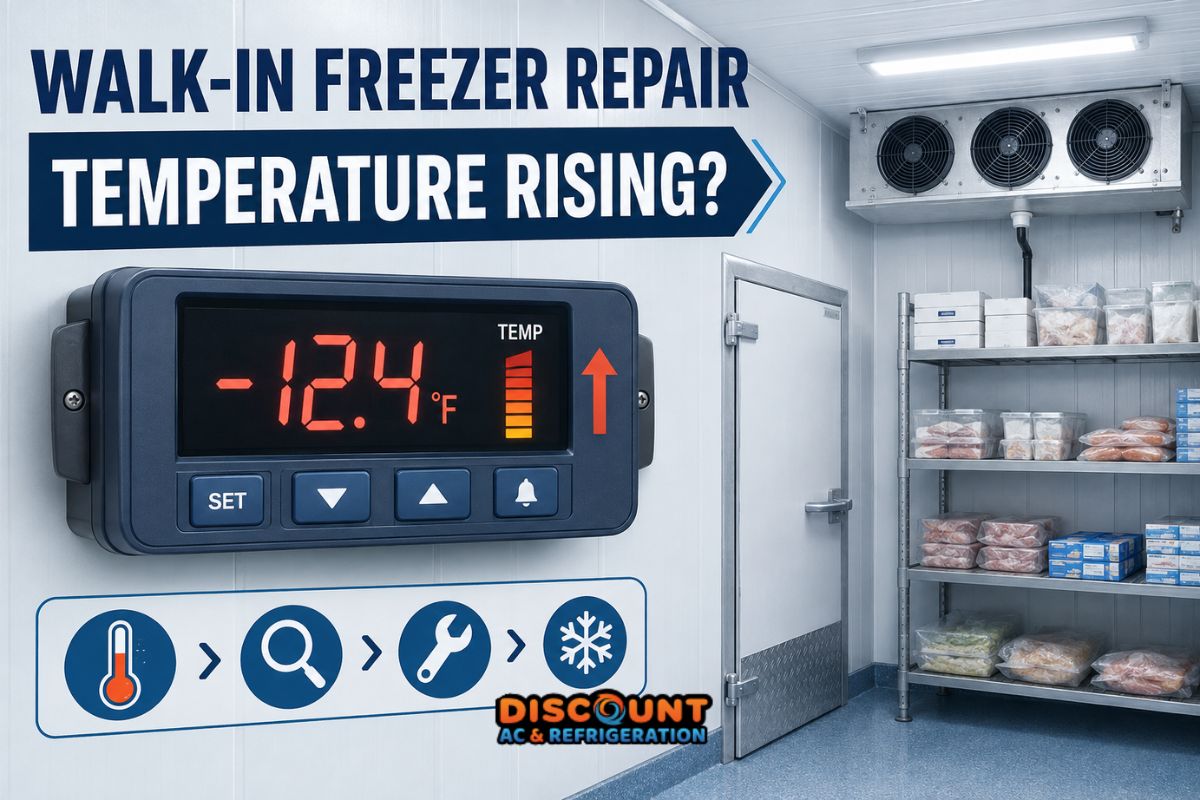
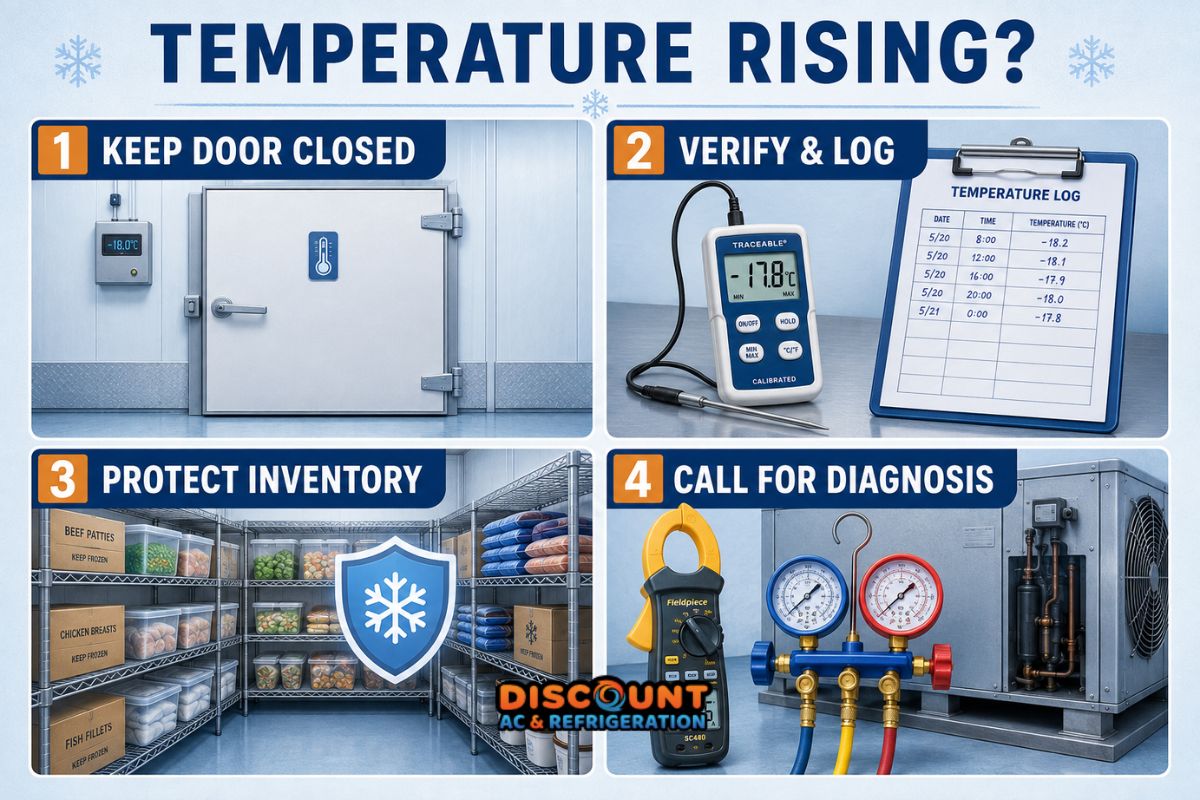
When a walk-in freezer temperature starts rising, keep the door closed, verify the reading with an independent thermometer, document the time and temperature, protect the inventory, and request professional walk in freezer repair. Do not repeatedly reset breakers, adjust refrigeration controls, or attempt to add refrigerant. These actions can create electrical, equipment, and food-safety risks without correcting the underlying failure.
What Should You Do When a Walk-In Freezer Temperature Rises?
A rising display does not always identify the source of the problem, but it should never be ignored. A failed door seal, incomplete defrost cycle, dirty condenser, damaged fan motor, inaccurate sensor, electrical fault, refrigerant problem, or compressor issue can all produce a similar symptom.
The safest response is to stabilize the situation before trying to determine the cause. Assign one employee or manager to coordinate the response so doors are not opened unnecessarily and temperature records remain consistent.
- Keep the freezer door closed. Every opening allows warm, humid Arizona air into the box and adds heat that the system must remove.
- Record the displayed temperature and time. Take a photograph of the controller or thermometer if possible.
- Confirm the reading independently. Use a calibrated appliance or product thermometer rather than relying only on the wall controller.
- Check whether the temperature is still increasing. A single unusual reading matters, but the rate and duration of the increase provide better diagnostic information.
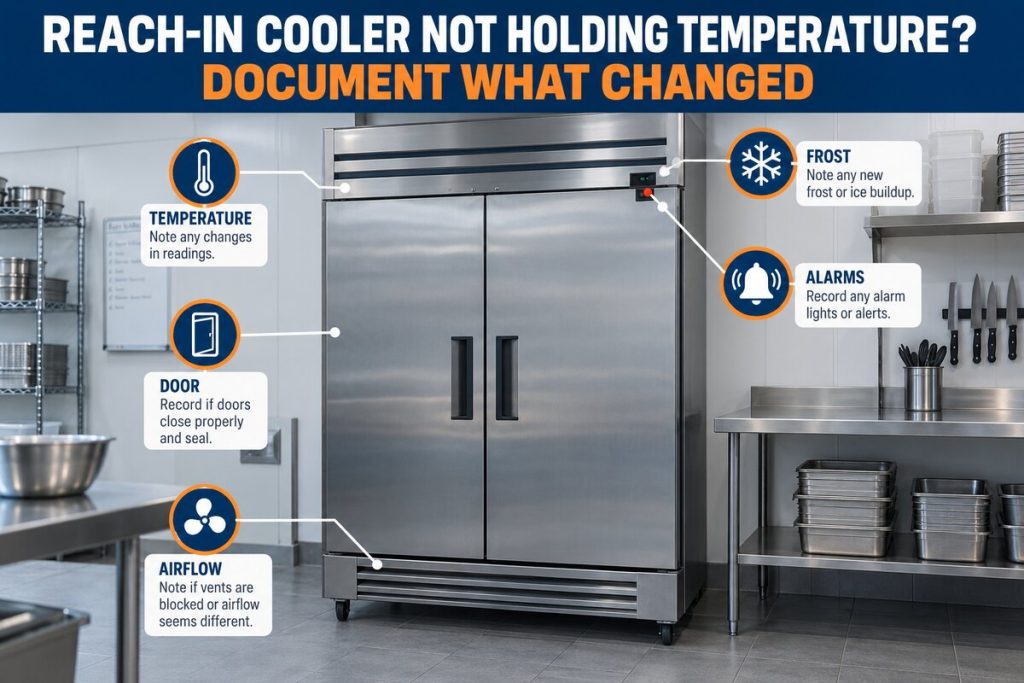
- Review recent activity. Note deliveries, heavy door traffic, a power interruption, maintenance work, unusual noises, frost, water, odors, or alarms.
- Start the inventory protection protocol. Separate affected inventory from confirmed-safe inventory and follow the product manufacturer’s and local food-safety requirements.
- Contact a refrigeration technician. Provide the equipment model, current temperature, normal setpoint, alarm history, and the time the problem began.
Protect the Inventory Before Troubleshooting the Equipment
The immediate goal is not simply to make the display number fall. It is to protect food, document the temperature excursion, and avoid mixing questionable inventory with unaffected products.
The FDA recommends maintaining a freezer at 0°F (-18°C). However, the safety decision for a specific product cannot be made from the air-temperature display alone. Air can warm more quickly than densely packed frozen products, and products near the door may be affected before items stored in the center.
According to the USDA, frozen food that still contains ice crystals or remains at 40°F or below may generally be refrozen or used, although quality can decline. This is general guidance—not a substitute for your approved food-safety plan, product-specific requirements, insurance instructions, or direction from the applicable health authority.
Inventory response protocol
- Keep the door closed and suspend nonessential access.
- Write down the time of the first alarm, the temperature, and each follow-up reading.
- Check representative product temperatures using a clean, calibrated thermometer.
- Identify high-risk, high-value, and temperature-sensitive products.
- Label or isolate inventory whose condition has not yet been confirmed.
- Do not judge safety by smell, appearance, or a partially frozen exterior.
- Do not move products into another unit unless that unit has adequate capacity and confirmed temperature stability.
- Preserve temperature logs, alarm reports, photographs, invoices, and disposal records.
- Follow your HACCP plan, company policy, insurer requirements, and local regulatory instructions.
For additional guidance, review the FDA’s information about safe refrigerator and freezer temperatures and the USDA’s freezing and food-safety guidance. Our article about the food-safety temperature danger zone also explains why time and documented product temperature matter.
Safe Observations You Can Make Before the Technician Arrives
A manager can collect useful information without opening electrical compartments or working on the sealed refrigeration circuit. These observations help the technician arrive with a clearer picture of the failure.
- Is the controller powered and displaying an error or alarm code?
- Is the temperature rising steadily, intermittently, or only after deliveries?
- Does the door close completely without being pushed?
- Is packaging preventing the door from sealing?
- Can you see torn, loose, hardened, or frosted door gaskets?
- Is frost concentrated around the door, ceiling, or evaporator area?
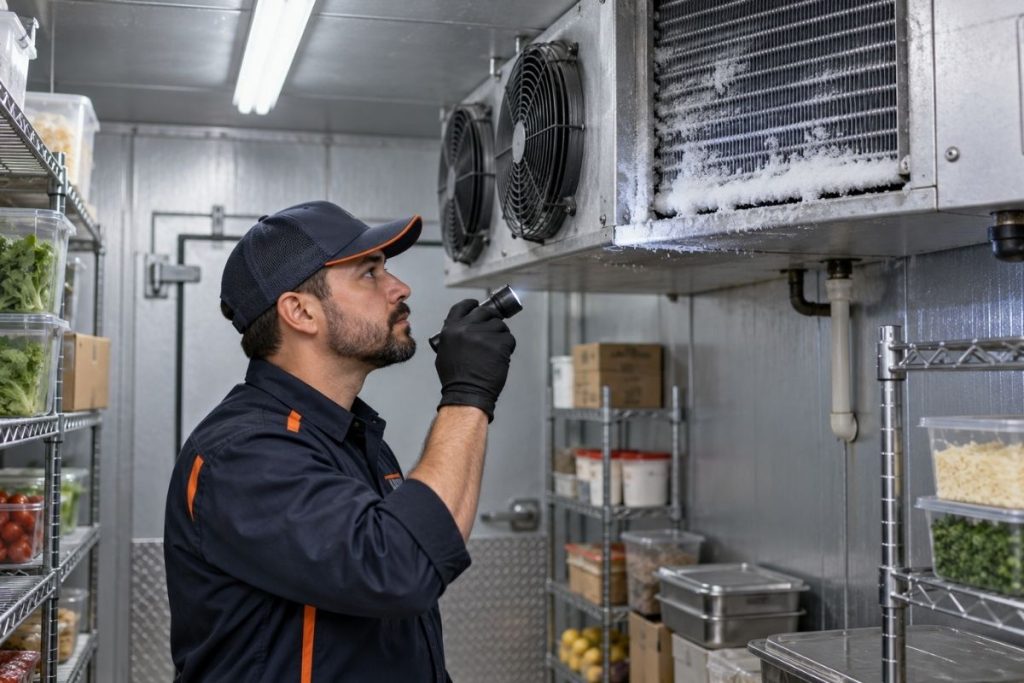
- Are evaporator fans operating, unusually noisy, or obstructed by ice?
- Can you hear the condensing unit running continuously or cycling abnormally?
- Is the condenser area blocked by boxes, grease, dust, or other debris?
- Was there a power outage, breaker event, cleaning, delivery, or service visit shortly before the temperature changed?
Do not chip ice from the evaporator with a knife or sharp tool. A punctured coil can release refrigerant and turn a manageable icing problem into a major repair. Do not pour hot water over electrical components, bypass a safety control, force a contactor closed, or repeatedly reset a breaker.
Common Causes of a Walk-In Freezer Temperature Increase
| Observation | Possible cause | Appropriate response |
|---|---|---|
| Frost around the door | Damaged gasket, misaligned hinges, weak closer, or frequent door traffic | Keep the door closed and schedule a seal and door-hardware assessment. |
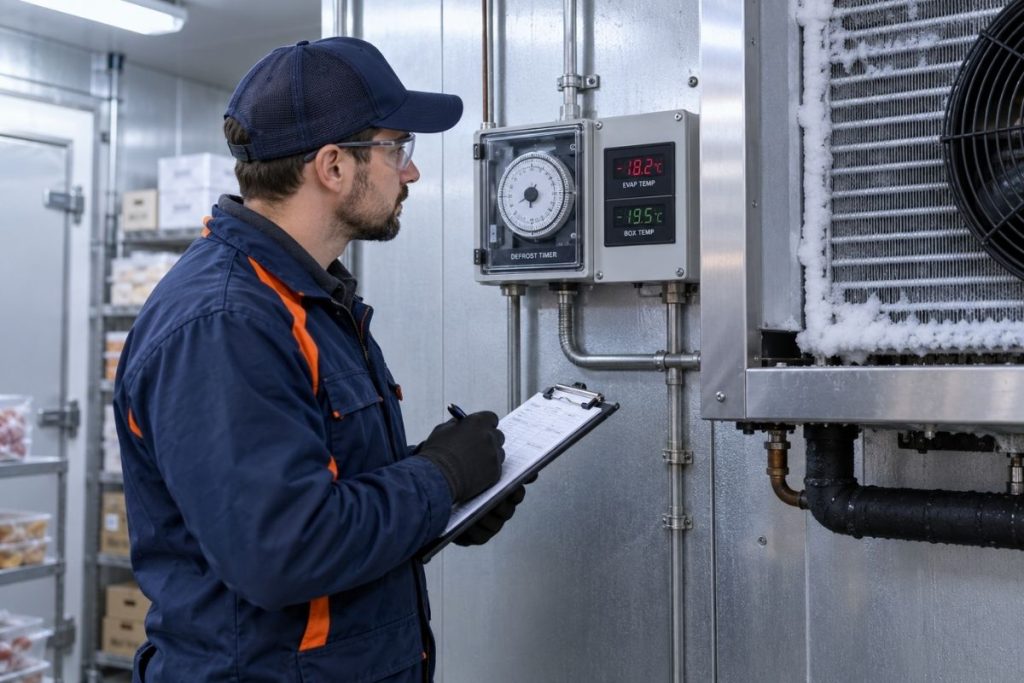
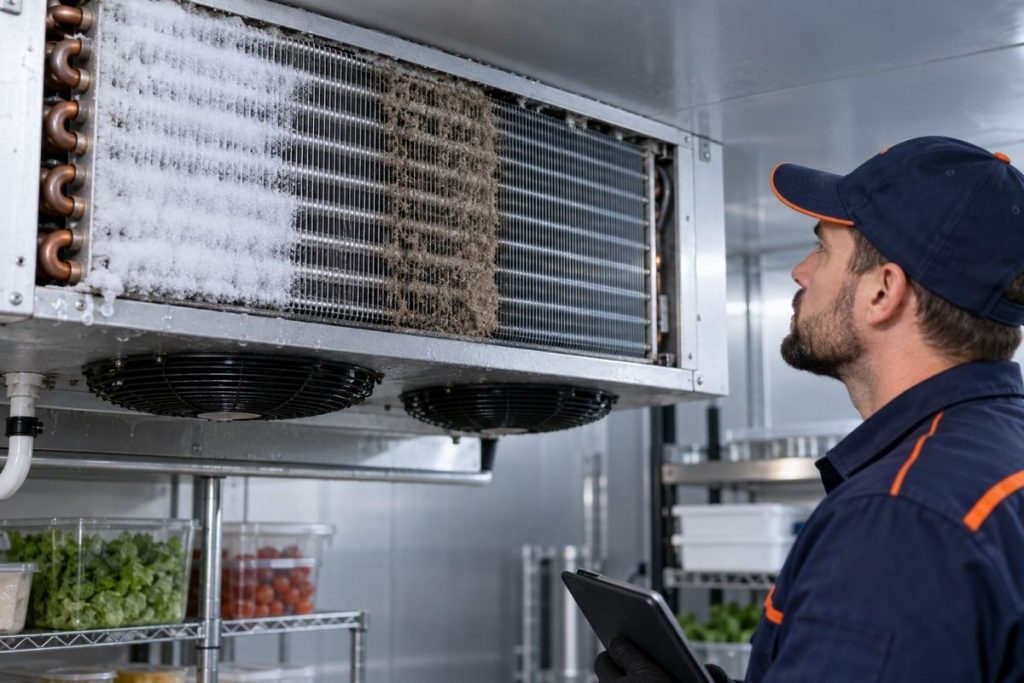
| Heavy ice on the evaporator | Defrost-control, heater, sensor, airflow, or moisture-infiltration problem | Do not chip the ice. Request diagnosis of the complete defrost system. |
| Unit runs but temperature rises | Dirty condenser, fan failure, refrigerant issue, high heat load, or compressor problem | Protect inventory and request operating-pressure and component testing. |
| Controller is blank | Power, disconnect, control-circuit, transformer, or controller fault | Follow the facility’s electrical safety procedure and call a qualified technician. |
| Temperature varies after deliveries | Extended door opening, warm product load, blocked airflow, or insufficient recovery | Document the load and recovery period; request service if normal temperature is not restored. |
| Different thermometers disagree | Sensor placement, calibration, wiring, or controller issue | Verify with a calibrated thermometer and have the controls tested. |
Door and gasket problems
A small gap around the door can allow a continuous stream of warm, humid air into the freezer. In Phoenix-area conditions, that moisture can become frost or ice around the gasket and evaporator. The compressor then runs longer while the box becomes harder to maintain.
A gasket replacement alone may not solve the problem if the hinge, closer, threshold, sweep, frame heater, or door alignment is also contributing. Our guide to walk-in freezer door-gasket maintenance explains how these components interact.
Defrost-system malfunction
A walk-in freezer needs a controlled defrost process to remove normal frost from the evaporator. A failed timer, control board, heater, termination sensor, drain heater, or related wiring can leave the coil blocked by ice. Airflow falls, temperature rises, and the system may continue operating without effectively cooling the room.
Simply melting the visible ice does not establish why it formed. The technician must test the defrost sequence and determine whether the cause is electrical, mechanical, control-related, or the result of warm-air infiltration.
Condenser airflow and Arizona heat
Commercial refrigeration equipment rejects indoor heat through the condenser. Dust, grease, restricted ventilation, a weak fan motor, or extreme ambient temperature can reduce that heat transfer. During Arizona’s hottest months, a marginal condenser problem may become visible as longer run times and gradual temperature loss.
This is one reason regular commercial preventive maintenance matters. Coil condition, electrical components, operating data, door hardware, drains, and controls should be assessed before peak-load conditions expose a weakness.
Refrigerant or compressor problems
Low refrigerant is not something a business owner should diagnose from temperature alone. Similar symptoms can come from restricted airflow, a metering-device problem, ice buildup, incorrect controls, or a failing compressor.
A technician should locate and evaluate the cause rather than treating refrigerant as a consumable that can simply be topped off. If the compressor is implicated, our commercial compressor replacement service explains the broader assessment required before replacement is recommended.
What Should a Walk-In Freezer Repair Technician Check?
A professional diagnosis should go beyond replacing the first component that appears suspicious. The technician should connect the temperature complaint to operating measurements and inspect the freezer as one complete system.
Information and operating history
- Normal setpoint and typical operating temperature
- Temperature trend and alarm history
- Time the problem began and rate of temperature increase
- Recent deliveries, cleaning, maintenance, or power events
- Previous repairs and recurring symptoms
- Equipment model, serial number, refrigerant type, and controller information
Physical and airflow inspection
- Door gasket, hinges, closer, threshold, sweep, and frame condition
- Evaporator and condenser coil condition
- Evaporator and condenser fan operation
- Ice pattern and evidence of air or moisture infiltration
- Product placement and blocked return or supply airflow
- Drain condition and evidence of refreezing
Controls, defrost, and electrical testing
- Temperature-sensor accuracy and placement
- Setpoint, differential, alarm limits, and controller sequence
- Defrost initiation, heaters, termination, and fan-delay operation
- Voltage, current draw, contactors, capacitors, relays, and connections
- Pressure and temperature safeties
- Evidence of overheating, arcing, or repeated overload trips
Refrigeration-system evaluation
- Compressor operation and electrical performance
- Operating pressures and corresponding temperatures
- Superheat and subcooling when applicable to the system design
- Refrigerant piping, insulation, oil traces, and potential leak indicators
- Expansion device or other refrigerant-flow restrictions
- System capacity compared with the current product and ambient load
The final explanation should identify the verified fault, contributing conditions, proposed correction, and any item that requires monitoring. For broader service information, visit our commercial refrigeration service hub or our guide to commercial refrigeration repair in the East Valley.
Repair or Replacement: What Determines the Recommendation?
A rising temperature does not automatically mean the freezer needs replacement. Many problems can be corrected through a targeted repair, control adjustment, airflow restoration, door repair, or defrost-system service.
The recommendation should consider:
- The exact failed component and underlying cause
- The condition of the compressor, coils, controls, wiring, and enclosure
- Equipment age and documented maintenance history
- Whether the problem is isolated or part of repeated failures
- Refrigerant type and availability of compatible parts
- Energy performance and ability to meet the actual load
- Door, panel, floor, and insulation condition
- The operational cost of another interruption
A written diagnosis is more valuable than an estimate based only on the symptom. If replacement becomes a realistic option, review the scope through our commercial refrigeration installation guide. We do not recommend using residential AC pricing as a substitute for a freezer-specific evaluation because equipment configuration and commercial operating requirements differ.
How to Reduce the Risk of Another Temperature Excursion
Preventive maintenance cannot eliminate every failure, but it can reveal deteriorating components before temperature control is lost. A practical program should combine technician inspections with simple operating records maintained by the facility.
- Record temperatures at consistent times and investigate unexplained drift.
- Test alarms and remote notifications according to the manufacturer’s instructions.
- Inspect door closing and gasket contact regularly.
- Keep products clear of evaporator discharge and return airflow.
- Do not block condensing equipment with inventory or stored materials.
- Schedule coil, fan, drain, control, and electrical inspections.
- Review defrost performance rather than increasing defrost time without diagnosis.
- Train employees to report frost, water, noise, odors, damaged doors, and alarm events.
- Maintain an updated emergency contact and inventory-transfer plan.
Frequently Asked Questions About Walk In Freezer Repair
Why is my walk-in freezer temperature rising?
Common causes include a door that is not sealing, evaporator icing, a failed defrost component, restricted condenser airflow, fan problems, inaccurate controls, refrigerant issues, electrical faults, or compressor trouble. A technician must test the system because several failures can create the same symptom.
What should I do first when my walk-in freezer gets warm?
Keep the door closed, record the time and temperature, verify the reading with a calibrated thermometer, begin your inventory protocol, and call a commercial refrigeration technician. Avoid changing controls or repeatedly resetting the equipment.
Can I reset the breaker to restart the freezer?
A breaker that has tripped can indicate an electrical fault or overloaded component. Repeated resets can increase equipment and fire risk. Follow your facility’s electrical safety procedure and have the cause evaluated by a qualified professional.
Can food be saved if the freezer temperature rises?
It depends on the product temperature, duration, condition, and applicable food-safety requirements. USDA guidance indicates that food that still contains ice crystals or remains at 40°F or below may generally be refrozen or used. Follow your approved food-safety plan and regulatory guidance.
Why is there ice on my walk-in freezer evaporator?
Ice may result from a defrost failure, fan problem, drain issue, damaged door seal, excessive door opening, sensor error, or another airflow or refrigeration problem. Do not remove ice with sharp tools because the evaporator coil can be punctured.
Why does the freezer run continuously without reaching its setpoint?
The system may be dealing with excess heat load, restricted condenser airflow, an iced evaporator, a fan failure, a door leak, a refrigerant-flow problem, or declining compressor performance. Operating measurements are necessary to identify the cause.
Can a damaged door gasket make a walk-in freezer warm?
Yes. A damaged or poorly aligned gasket allows warm, humid air into the freezer. However, the technician should also inspect the hinges, closer, threshold, sweep, door alignment, and frame condition rather than evaluating the gasket in isolation.
Should employees move inventory to another freezer?
Only move inventory under your facility’s approved response plan and after confirming that the receiving freezer has enough capacity and is maintaining the required temperature. Document product temperatures and keep affected inventory identified during the transfer.
What information should I give the repair technician?
Provide the current temperature, normal setpoint, time the problem began, temperature trend, alarms, unusual noises, frost or water observations, recent deliveries or power events, and the equipment model and serial number.
When should I request emergency walk-in freezer repair?
Request urgent service when the temperature continues to rise, alarms persist, the unit loses power, product condition may be affected, ice blocks airflow, or you notice electrical odors, smoke, sparking, severe vibration, or unusual compressor behavior. Review our emergency refrigeration service for additional information.
Is Your Walk-In Freezer Temperature Rising?
Protect your inventory and avoid guessing at the cause. Our team can inspect the freezer, document the operating condition, identify the verified fault, and explain the available repair options for your business in Phoenix, Queen Creek, Gilbert, Mesa, Chandler, and surrounding East Valley areas.
Call Discount AC & Refrigeration — (480) 478-2616You can also contact our refrigeration team online to provide the equipment information and temperature history.
Food-safety information in this article is general educational guidance. Product disposition must follow your facility’s approved food-safety procedures, manufacturer instructions, insurance requirements, and directions from the applicable regulatory authority. Electrical and sealed-system refrigeration work should be performed by qualified personnel.