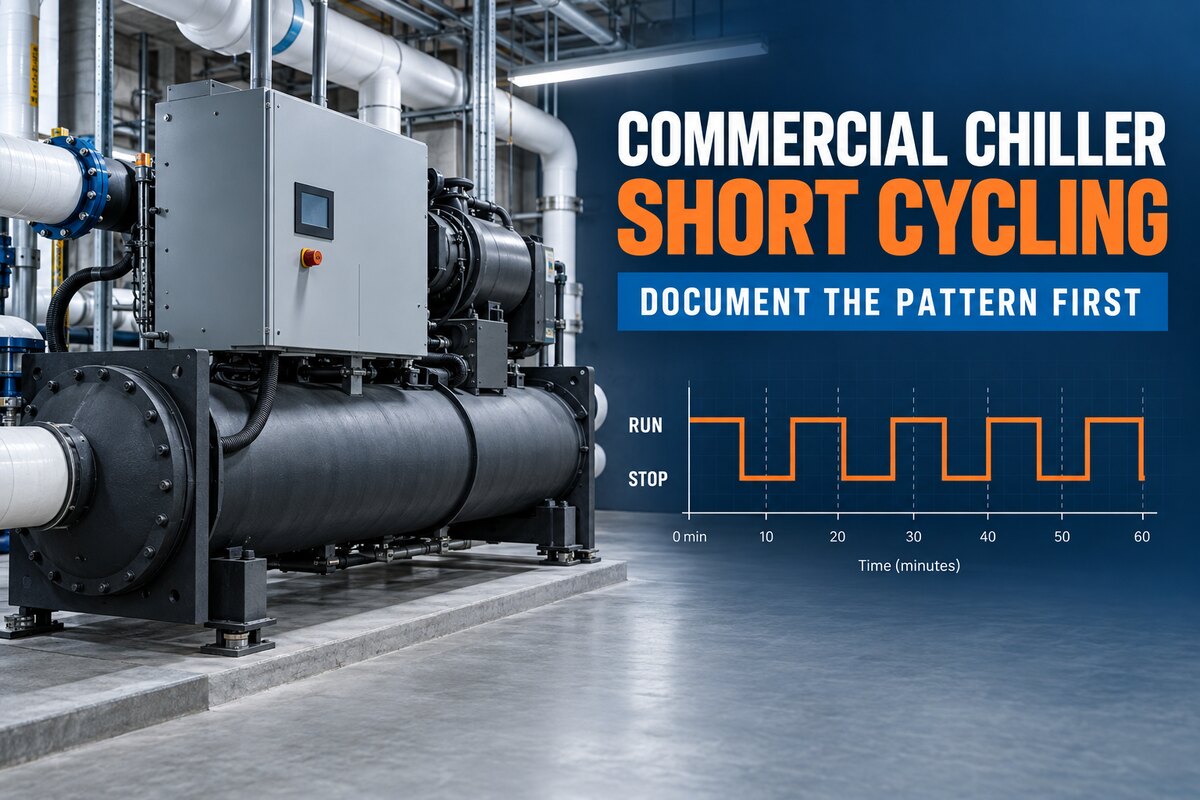
Commercial chiller short cycling means the machine starts and stops more frequently than expected for the current load and operating sequence. The pattern can increase wear, disrupt temperature control, and signal a problem with load, water flow, controls, heat rejection, electrical components, or the refrigeration circuit. The cycle pattern must be verified before anyone assumes a single cause.
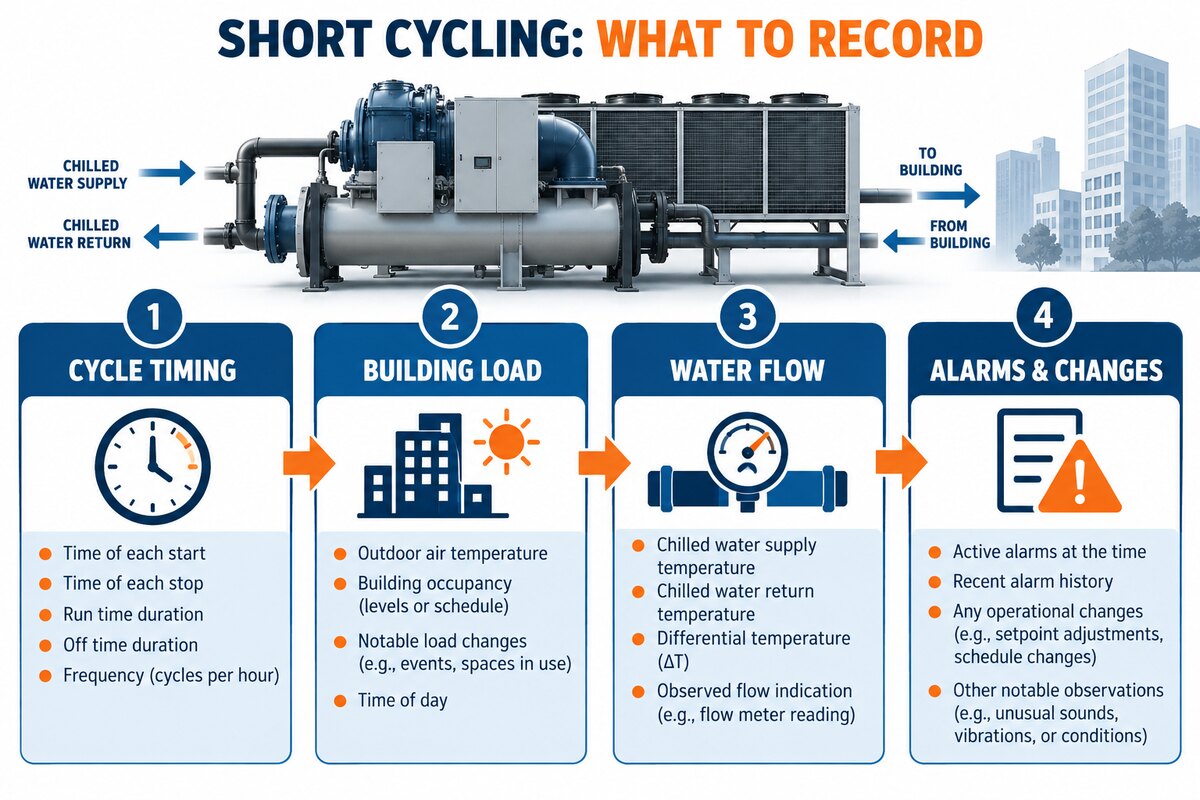
Facility personnel can provide valuable evidence by documenting what happens before, during, and after each cycle. Diagnosis should be completed by a qualified technician. Do not bypass a safety, force a contactor, change protected programming, open energized equipment, or add refrigerant based on cycling alone.
First Confirm the Pattern
Record the start time, stop time, run duration, off duration, displayed status, alarm history, outdoor temperature, building schedule, and affected zones. Compare the observation with the equipment’s established sequence. A lead chiller rotating normally, a staged machine responding to a light load, and a chiller stopping on a protective control are different events.
| Area | Facility observation | Professional scope |
|---|---|---|
| Cycle timing | Record start, stop, run time, off time, and recurrence. | Review controller history and verify the operating sequence. |
| Building load | Note occupancy, process demand, weather, and zones calling for cooling. | Evaluate load, staging, capacity control, and sensor inputs. |
| Water flow | Record visible pump status, displayed flow alarms, valve position indicators, and temperature trend. | Measure flow and pressure, inspect pumps/strainers, and verify valves and interlocks. |
| Heat rejection | Note outdoor conditions, tower or condenser status, and visible obstruction from approved areas. | Test fans, tower operation, condenser performance, controls, and related electrical components. |
Load and Staging Conditions
A chiller may cycle because the active load is smaller than the available capacity, because another machine is carrying the load, or because the control system is staging equipment too aggressively. Record the occupied schedule, recent tenant changes, process activity, weather, and any recent building automation changes. A technician can then compare the observed demand with the intended sequence.
Do not repeatedly lower setpoints to make the chiller stay on. That changes the evidence and may create unnecessary operation. The appropriate goal is stable control around the building’s approved operating requirements, not continuous compressor operation.
Water Flow and Distribution
Insufficient or unstable water flow can cause rapid temperature changes and protective shutdowns. Possible categories include pump operation, closed or modulating valves, air in the system, fouled strainers, control interlocks, sensor problems, or changing distribution demand. These possibilities require measurement, not assumption.
Facility staff can document pump status indicators, visible valve position indicators, flow-related alarms, and entering and leaving water temperatures shown by approved displays. Qualified personnel should perform pressure measurements, open strainers, work on pumps, adjust balancing devices, or access electrical components.
Controls and Sensor Inputs
Control systems decide when a chiller starts, unloads, stages, and stops. A drifting sensor, incorrect schedule, communication fault, unstable setpoint, minimum-run-time setting, or sequence conflict can create a cycling pattern. Document controller messages exactly and note whether the displayed reading agrees with other approved building records.
If cycling began after programming, occupancy, or equipment changes, include that date in the service request. The technician can review those changes while assessing the commercial chiller system and its relationship with the building automation system.
Condenser and Heat-Rejection Conditions
Air-cooled and water-cooled chillers reject heat differently, but both depend on effective heat transfer. High outdoor temperature, dust accumulation, fan problems, tower operation, water treatment conditions, or condenser restrictions can affect performance. Facility personnel should limit observations to approved, accessible areas and record the conditions present when cycling occurs.
Cleaning coils, opening condenser components, testing fan circuits, handling tower chemicals, or evaluating refrigerant pressures falls within professional service. A broader preventive maintenance program can identify heat-rejection issues before they appear as repeated operating complaints.
Electrical and Refrigeration Possibilities
Motor protection, voltage conditions, contactors, starters, variable-frequency drives, pressure safeties, refrigerant charge, metering devices, compressor capacity controls, and other internal components may contribute to short cycling. These systems contain hazardous voltage and pressurized refrigerant. They require qualified testing with proper procedures and equipment.
Stop and follow the site safety plan if there is smoke, a burning or melting-plastic odor, arcing, a major leak, severe vibration, or repeated protective shutdown. Loss of critical cooling may warrant the established escalation path and emergency service.
A Useful Short-Cycling Record
- Identify the exact chiller and controller.
- Record start and stop times for several cycles.
- Copy alarm wording without paraphrasing.
- Note outdoor temperature, occupancy, and process load.
- Record approved entering and leaving water temperature displays.
- List affected zones or processes.
- Document recent control, maintenance, or building changes.
- Preserve the log for the service technician.
For system-level diagnosis, review the building’s commercial HVAC services and provide the log through the contact page.
Separate Normal Cycling From a Developing Problem
Not every start and stop is abnormal. Chillers stage, unload, and rotate based on design and control logic. The concern is a meaningful change from established operation: shorter run times, more frequent starts, new alarms, reduced temperature stability, or cycling that appears only under certain loads. Compare the new pattern with prior logs instead of relying on memory.
Also identify whether the compressor, entire chiller, pump, condenser fan, or another component is cycling. Staff may describe all of these as the “chiller turning on and off,” but each observation points to a different part of the sequence. Exact controller status and visible equipment behavior help the technician interpret the complaint.
Why Repeated Resets Make Diagnosis Harder
Protective controls stop equipment when an input moves outside an allowed condition. Repeatedly clearing the alarm may remove timestamps, obscure the original sequence, and expose the system to the same condition again. Preserve the alarm history and follow the facility escalation plan. If a reset is permitted by the manufacturer and site policy, record who performed it, when, and what happened afterward.
What a Technician May Compare
Professional diagnosis may compare requested capacity with actual load, entering and leaving water temperatures, verified flow, pressure conditions, sensor readings, safety status, control commands, compressor loading, heat-rejection performance, electrical measurements, and service history. No single reading proves the cause. The relationship between values and their timing usually provides the useful evidence.
This is why a concise facility log has practical value. It narrows the time window, identifies the affected operating mode, and tells the technician which conditions should be recreated safely during testing.
Related Commercial HVAC Resources
- Discount AC & Refrigeration
- Commercial services
- Rooftop unit service
- Commercial AC installation
- Commercial refrigeration services
Frequently Asked Questions
Is short cycling always a compressor problem?
No. Load, flow, controls, sensors, heat rejection, electrical protection, and refrigeration conditions can produce similar patterns.
How many cycles should staff document?
Record enough cycles to show timing and recurrence without delaying escalation when alarms, critical cooling loss, or hazardous symptoms are present.
Can low building load cause cycling?
Yes. Capacity that is large relative to the active load can contribute, but the full sequence must be reviewed before reaching a conclusion.
Should we lower the setpoint to keep the chiller running?
No. Repeated setpoint changes can distort the pattern and may create unnecessary demand.
Can a flow problem make a chiller stop?
Yes. Unstable or inadequate flow can affect temperature and safety controls. Qualified personnel should measure and diagnose the water system.
Does hot Phoenix weather contribute?
High outdoor temperatures increase heat-rejection demand, but weather alone does not establish the cause of abnormal cycling.
Is it safe to reset the chiller?
Follow manufacturer and site procedures. Repeated resets are not a diagnostic method and can erase useful evidence.
What information helps the technician most?
Exact cycle times, alarms, temperatures, affected areas, load conditions, weather, equipment ID, and recent system changes provide useful context.
Document the Pattern Before It Disappears
Discount AC & Refrigeration can evaluate short-cycling patterns within the complete chiller and building HVAC system.