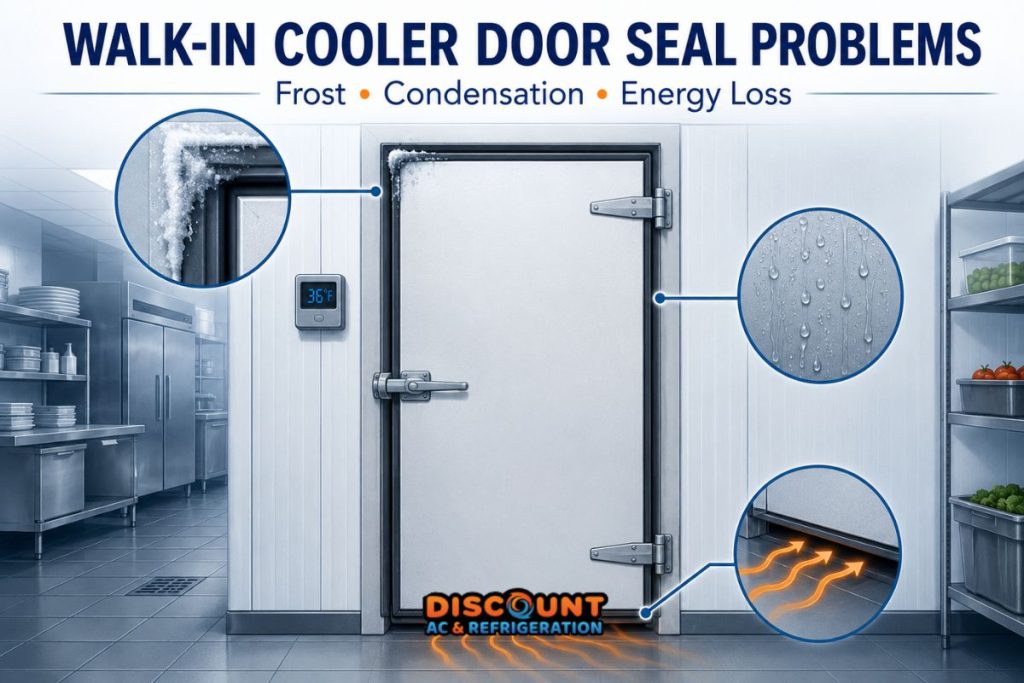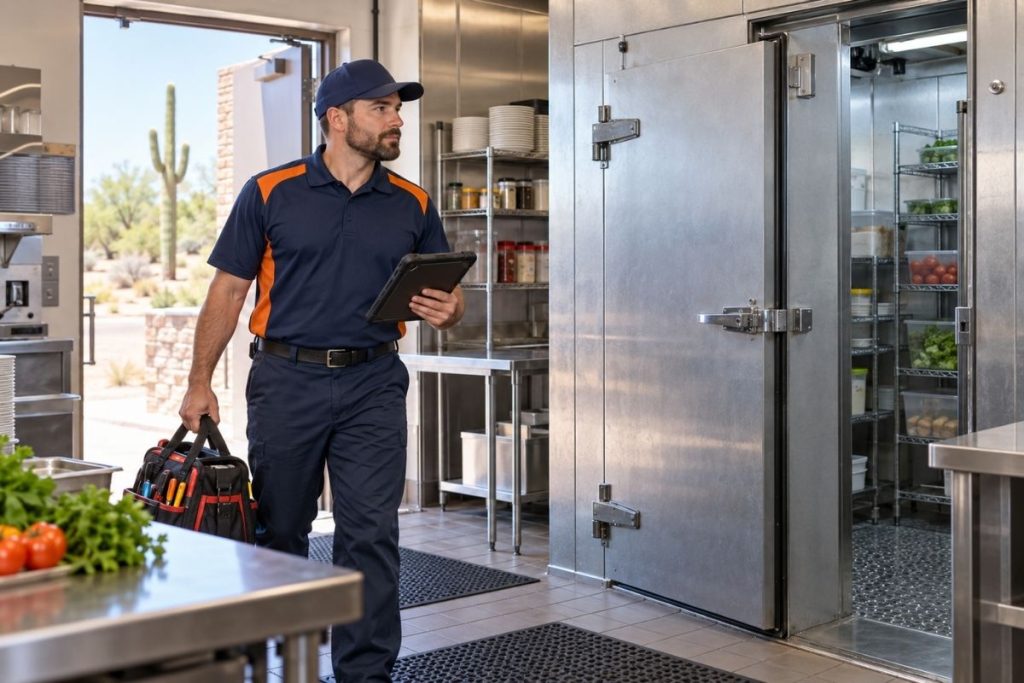
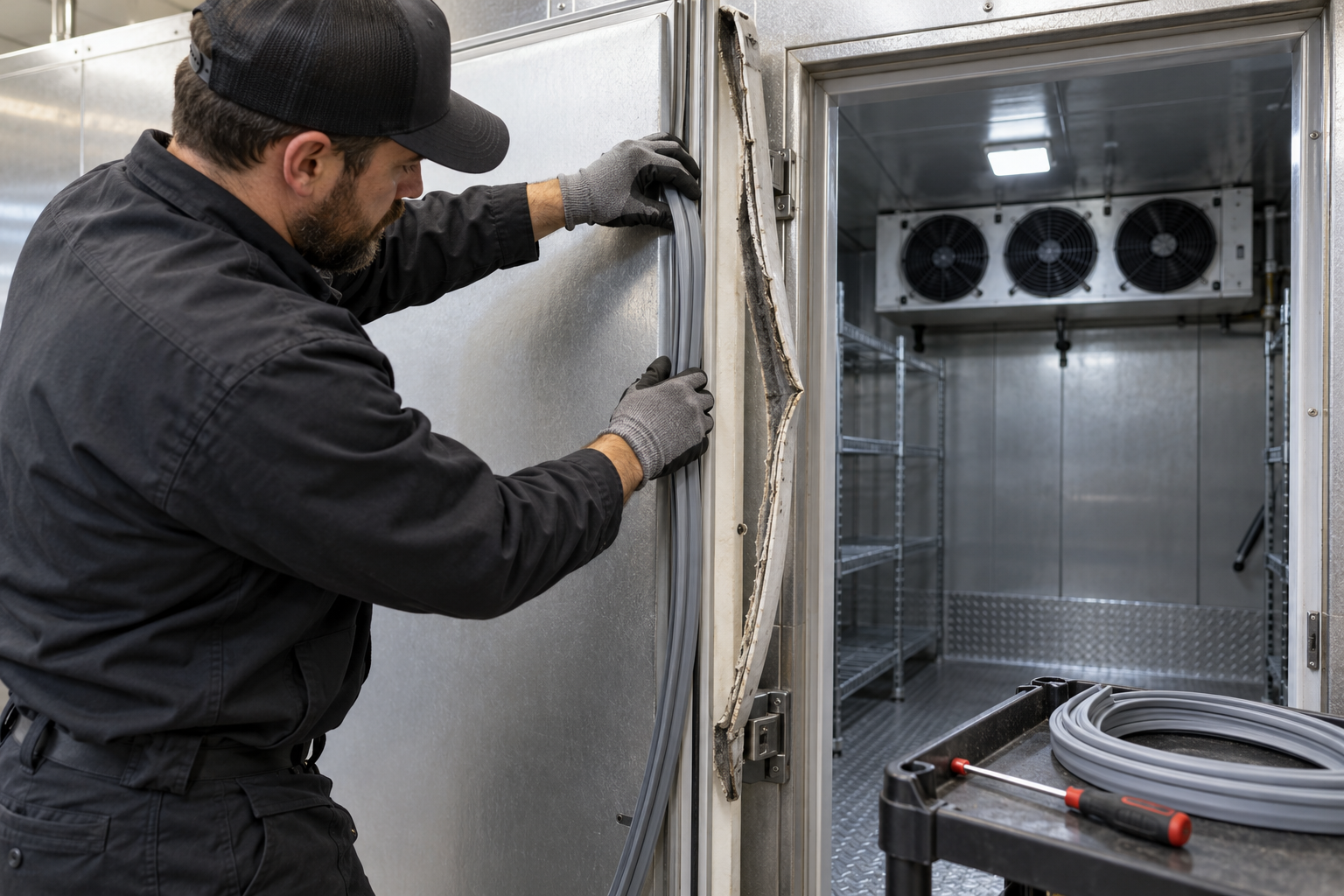
When a walk-in cooler warms after delivery, the cause may be door traffic, incoming product temperature or a temporary change in airflow, not necessarily a failed refrigeration component. A restaurant walk-in cooler may be steady all morning, then rise after a large delivery. That does not automatically mean the refrigeration system failed. Doors stay open longer, cartons arrive at different temperatures, staff rearrange shelves, and a large load changes how air moves. The right response is to document the event, verify receiving temperatures, protect food and determine whether the walk-in recovers normally. This article focuses on delivery-related load, not general walk-in repair or shelving efficiency. If the box does not recover after the doors close, book walk-in cooler repair in Phoenix to check the refrigeration side.
Separate the four temperatures that matter
When a walk-in cooler warms after delivery, first, the walk-in controller reports a sensor reading at one location. Second, an independent thermometer measures air where it is placed. Third, the food itself has a temperature that matters for safety. Fourth, incoming products have their own receiving temperature. These readings can differ. A cooler display returning to normal does not prove that a warm shipment was accepted safely or that every shelf is cold. Follow the receiving and cold-holding requirements in your food-safety plan and local rules; the FDA Food Code provides a model for retail food practices.
Why a walk-in cooler warms after delivery
The doorway becomes an air-exchange path
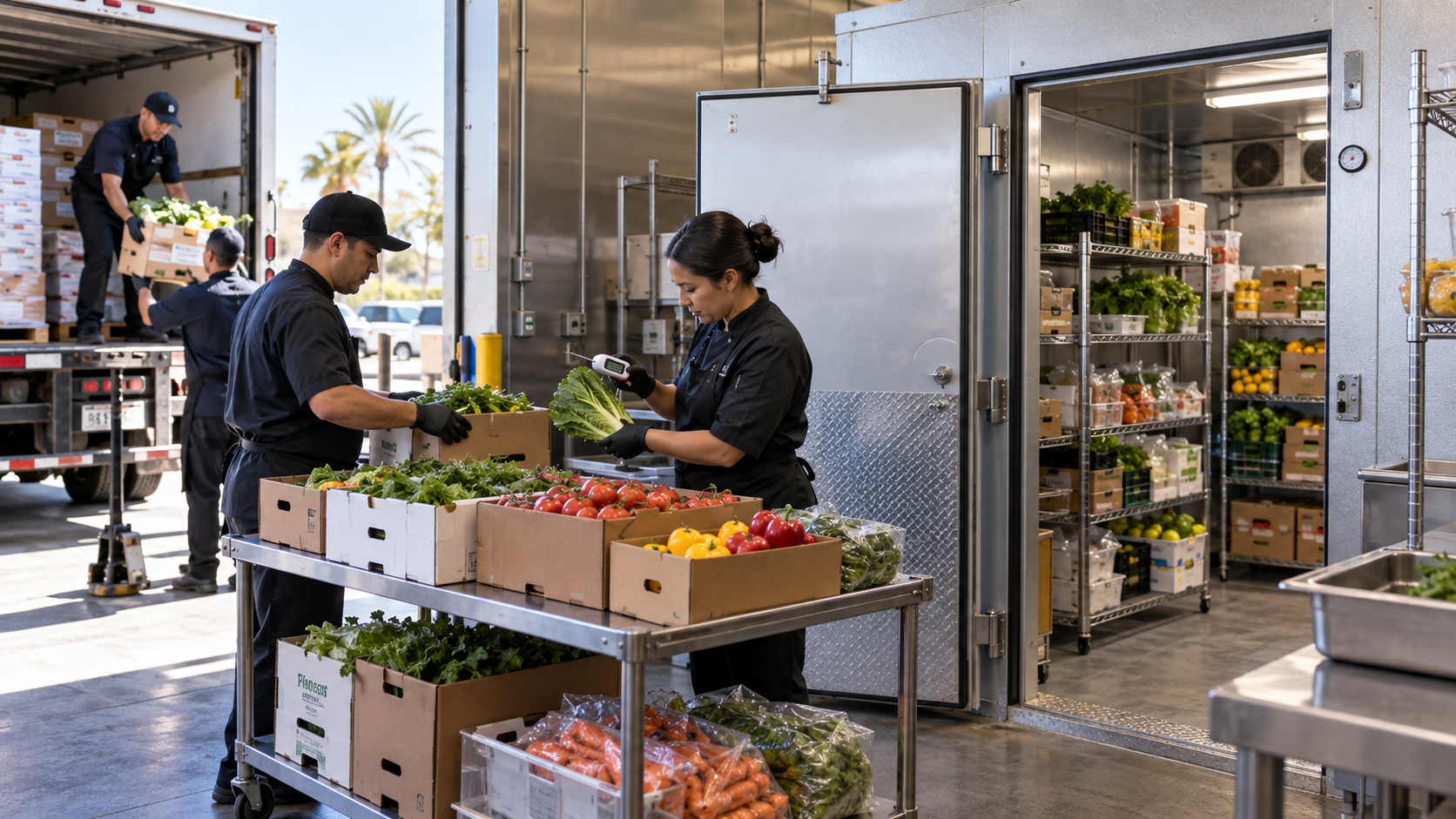
When a walk-in cooler warms after delivery, each long opening allows warm kitchen or outdoor air to enter. In Phoenix, the temperature difference can be substantial during hot weather. A delivery cart parked in the doorway may prevent the gasket from closing even when no one is actively moving boxes. Assign a receiver to coordinate batches, clear the threshold and close the door between trips. A strip curtain or suitable door management can help, but it does not replace proper receiving checks.
Incoming stock adds thermal load
When a walk-in cooler warms after delivery, cold storage equipment must remove heat that enters with people, products and air. If products arrive warmer than expected, the walk-in may need longer to recover. Do not use the cooler as a substitute for an approved rapid-cooling process for hot prepared food. Check incoming items according to your receiving procedure before accepting them and record exceptions. The goal is to avoid putting a questionable shipment into storage and discovering the issue later.
Boxes can interrupt airflow
A walk-in cooler warms after delivery more readily when, even if the unit is functioning, tightly packed cartons can create warm pockets or block the evaporator’s return and supply paths. Keep clearances required by the equipment and your food-safety plan. Place products on appropriate shelving rather than against a fan housing or a drain. This is distinct from the broader question of long-term walk-in stacking efficiency: during a delivery, staff need a temporary staging sequence that keeps air moving while stock is being sorted.
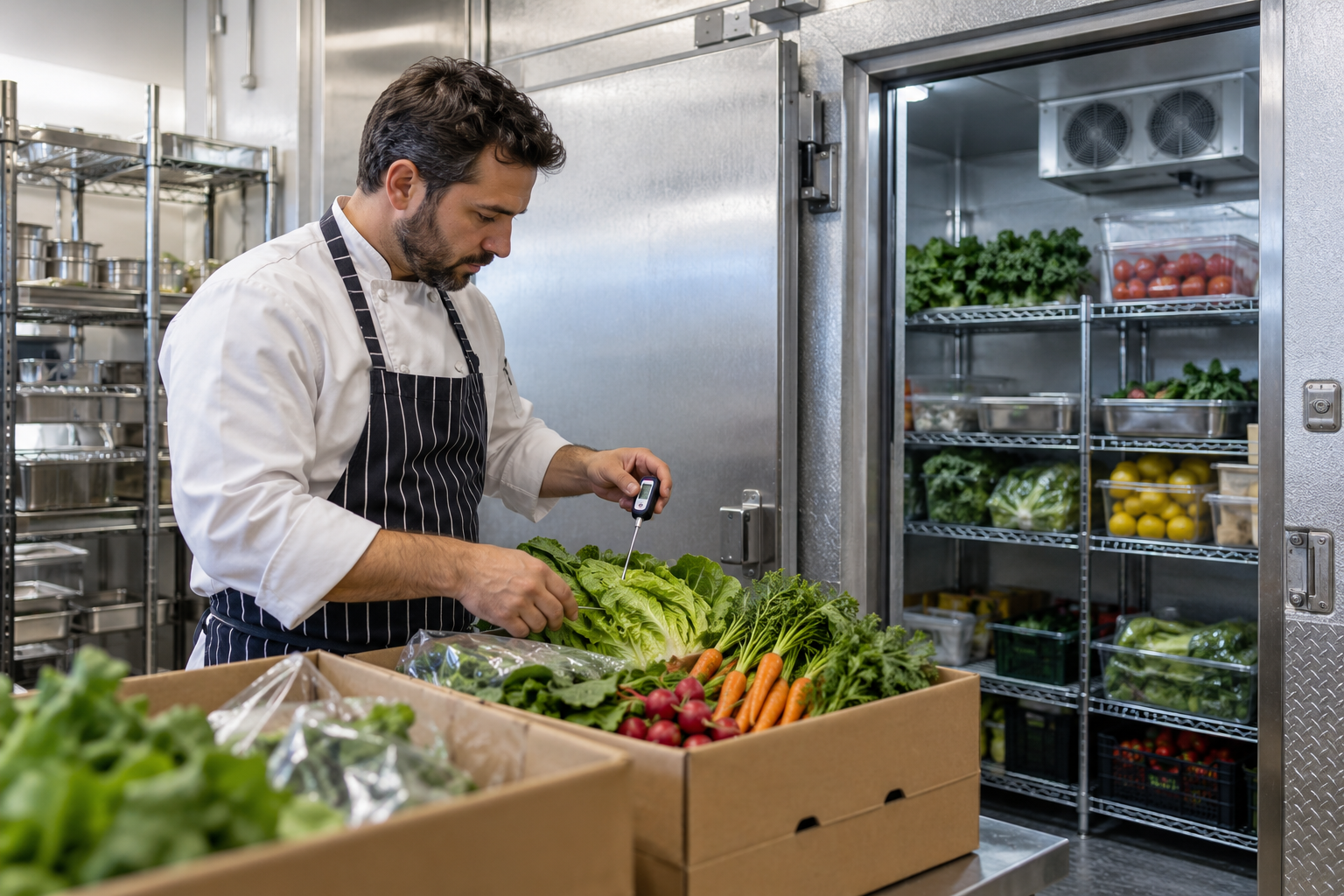
A receiving routine for large restaurant refrigerators
- Prepare before the truck arrives. Clear staging space, check the walk-in door and confirm thermometers and receiving forms are ready.
- Record the baseline. Note time, controller reading and an independent air reading. If the room was already trending warm, record that before adding new stock.
- Inspect the shipment. Follow the establishment’s approved methods for checking product condition and temperature. Separate items with damaged packaging, unexpected warmth or uncertain history.
- Move accepted stock in planned batches. Avoid leaving the door propped open while paperwork is completed. Keep access lanes and air paths clear.
- Record recovery. Note when the final load entered, when the door closed, and how the room and representative products behaved afterward.
- Escalate exceptions. If temperatures are outside the approved range or recovery is abnormal, involve the manager and a refrigeration professional as appropriate.
When a walk-in cooler warms after delivery, it can be useful to record door-open time and delivery size for a few weeks. That comparison establishes what is normal for this specific restaurant and helps distinguish a larger-than-usual delivery from declining equipment performance.
When is recovery too slow?
When a walk-in cooler warms after delivery, there is no responsible universal number of minutes that fits every walk-in. Room size, product mass, incoming temperature, door traffic, ambient conditions and refrigeration capacity all matter. Compare the event to the same equipment under similar loads. If recovery takes progressively longer, temperatures remain elevated after the door is closed, alarms recur, or food temperatures fail your safety plan, investigate promptly. Do not keep lowering the setpoint to compensate; that can hide a fault and may freeze sensitive items.
A professional may review condenser condition, evaporator airflow, controls, door closure and the refrigeration cycle. Restaurant staff can provide the delivery timeline and temperature log without working on electrical or refrigerant components. See the company’s commercial refrigeration services for the appropriate service path.
How to avoid turning one delivery into an all-day problem
If a walk-in cooler warms after delivery, schedule large deliveries so trained staff are available to receive them promptly. Keep the doorway clear; do not let drivers or kitchen employees use the walk-in as a temporary staging room. Separate paperwork from the loading process. Label shelves and locations so stock can be placed without extended searching. If multiple deliveries arrive together, prioritize perishable products and use the restaurant’s approved receiving sequence.
Review the walk-in’s actual capacity with a refrigeration contractor when the business grows. A kitchen that has doubled its daily volume may now ask the same cooler to handle longer door openings and larger thermal loads than it was designed for. That does not necessarily call for a new unit, but it does justify a capacity and workflow review before recurring warm events threaten inventory.
What to document before calling for service
When a walk-in cooler warms after delivery, provide the equipment model, room setpoint, independent air reading, representative food readings, approximate load size, arrival and door-close times, and whether the same issue occurs on ordinary days. Note alarms, visible ice, unusual sounds and recent changes to shelving or kitchen ventilation. A technician can then test the equipment against real operating conditions instead of guessing from a single display number.
Seven checks for a large-delivery temperature rise
1. Capture a baseline before unloading
Record the cooler’s controller reading and an independent air reading before the truck arrives. If the room is already warmer than its normal pattern, the delivery did not create the entire problem. Note the time, the active equipment alarms and whether the unit has been recovering from breakfast or lunch service. A baseline lets a technician compare like with like instead of blaming every later increase on the shipment.
2. Verify the incoming product before storage
The restaurant’s receiving procedure should identify what to inspect, how to measure and who can reject a shipment. Check representative items with an appropriate thermometer, observe packaging and record exceptions. A walk-in cooler warms after delivery more readily when cartons arrive above expected temperature. Putting warm or questionable products away first and checking them later makes both food-safety review and equipment diagnosis more difficult. Follow applicable local requirements for decisions about acceptance.
3. Observe the door without slowing the crew
Write down when the first cart crosses the threshold, when the last cart enters and how long the door remains open between trips. A door that appears shut may be held ajar by a cart, loose gasket or misplaced box. Designate a receiver to move stock in batches and close the door during paperwork. Record unusual circumstances such as a delayed truck, summer heat at a loading dock or simultaneous kitchen traffic. These details help explain why a particular day differs from normal.
4. Keep air paths open during temporary staging
Plan a landing area that does not block the evaporator intake, supply airflow, door swing or drain. A room can have a normal sensor reading while a densely packed corner remains warmer. Avoid piling cartons on the floor or pushing a load against the cooler wall where cleaning and circulation are impaired. Place accepted food on approved shelving promptly. If the room has no safe staging space, reduce the batch size rather than forcing a larger cart into the cooler.
5. Compare independent air and product readings
A spike on one controller does not establish how a shipment or stored food behaved. Measure in the places and at the intervals specified by the restaurant’s food-safety plan. Keep incoming product checks separate from stored-product checks; they answer different questions. A receiving log should show item, time, temperature and disposition, while the room log shows the air trend. If a safety decision is uncertain, escalate to the responsible manager and local authority rather than treating a later normal display as proof.
6. Watch recovery, not just the peak
A walk-in cooler warms after delivery in many ordinary operations, but the recovery pattern should be compared with the same room under similar loads. Note the time the door closes and whether air readings fall steadily afterward. A longer plateau, repeated alarm or worsening trend over several deliveries warrants investigation. A contractor can evaluate controls, door closure, airflow and capacity. Staff should not bypass alarms or lower the thermostat to make the display appear normal.
7. Use the data to improve the workflow
At the weekly operations meeting, compare delivery size, receiving time and recovery time. Look for changes after a new vendor, menu expansion or staffing shift. Adjust staging and receiving practices where possible. If the cooler is routinely asked to hold more inventory than its layout can accommodate, discuss capacity with a refrigeration professional. The goal is not to stop every brief air fluctuation; it is to prevent recurring prolonged warming and unsafe handling.
A useful delivery log for restaurant managers
Start with the date, cooler identifier and pre-delivery room reading. Record vendor, approximate number of carts or cases, first and last door-opening times, representative receiving temperatures, any rejected items and when the door remained closed. Add the controller trend and independent readings during recovery. Note anything unusual: a broken door closer, large hot-food load, blocked shelf or overnight alarm. Include the name of the manager who reviewed exceptions.
For a walk-in cooler that warms after delivery only on certain days, the log can expose a pattern. Perhaps two trucks arrive together on Friday, staff complete paperwork while the door is propped open, or a new product line arrives warmer than previous stock. That observation is more actionable than assuming the compressor is undersized. If the same temperature trend appears on days without deliveries, it is stronger evidence that the delivery is not the sole driver.
How loading changes the heat balance
Warm air entering through an open door adds one load. Incoming products add another. Employees, lighting and repeated door openings add more. Meanwhile, refrigeration equipment removes heat at a finite rate under its operating conditions. A large shipment can temporarily exceed the removal rate even when the system is working. That does not excuse unsafe food temperatures; it explains why measuring product condition and room recovery separately matters.
Moist air entering the room can also create condensation or frost under some conditions. A little moisture after a busy delivery is different from persistent ice that restricts airflow. Do not scrape evaporator coils, alter defrost settings or perform refrigerant work as a kitchen task. Record what you see and ask a technician to diagnose recurring frost, water or abnormal operation. Keeping the door shut and the threshold clear is a safe operational step; component repair is not.
What a service visit can determine
A commercial refrigeration technician can compare the measured room trend with the setpoint, assess door hardware, inspect airflow and evaluate whether the refrigeration system is operating as designed. The service request should include the delivery log and a description of ordinary days. A short visit outside delivery hours might miss the pattern, so share actual timestamps. If the restaurant has recently increased volume, ask whether the current room layout, shelving and cooling capacity still match its operations.
When a walk-in cooler warms after delivery and then fails to recover, act on the food-safety plan while arranging service. Do not continue loading the room merely because a technician is coming. Move at-risk stock only to verified appropriate storage and document the transfer. The restaurant’s manager owns food disposition; the contractor owns equipment diagnosis and repair.
Training staff without slowing receiving
Give receivers a one-page routine: thermometer ready, staging space clear, door not propped, product checks documented, questionable items segregated, final door close recorded. Explain why each step matters. A receiver who understands the difference between air temperature and product temperature is less likely to accept a warm shipment simply because the cooler display looked normal.
Review the routine with new hires and delivery partners. A driver may be focused on unloading quickly while kitchen staff are focused on putting cases away; neither should skip the receiving decision. Assign a single person to confirm acceptance before the product enters storage. When the restaurant is short staffed, plan smaller batches rather than leaving the door open while one person handles both paperwork and shelving.
Separate a normal event from an unresolved problem
Review three or more comparable deliveries rather than relying on a single unusually busy day. If the peak and recovery curve are similar each time, the manager has a baseline to improve through door control and staging. If the curve grows worse while delivery size and traffic remain similar, request inspection. A walk-in cooler warms after delivery for multiple possible reasons, and the trend alone does not identify a failed part. Record the pattern and let a qualified technician test the equipment.
At the same time, make food-safety decisions from product checks and applicable rules, not from the shape of the air-temperature graph. A cooler can eventually return to its setpoint even if a shipment was received at an unacceptable temperature. Keep a separate record for incoming items, existing inventory and the room. The separation helps managers act safely while giving service personnel useful operating data.
Frequently Asked Questions
Is a brief air-temperature spike after a delivery normal?
It can occur when doors open, but the relevant question is whether food remains within your approved safety conditions and whether the room recovers as expected.
Can a walk-in cooler rapidly chill hot prepared food?
Do not assume so. Use approved cooling methods and equipment under your food-safety plan; a holding cooler may not have capacity for a large hot load.
Should staff lower the thermostat on delivery days?
Not as a routine workaround. Record the event and review door management, incoming product temperatures and equipment capacity.
Does the controller prove the entire shipment is cold?
No. The controller measures at its sensor. Check products using the restaurant’s receiving and monitoring procedures.
When should a restaurant call a refrigeration contractor?
Call if the room fails to recover, alarms persist, temperature trends worsen, or the unit behaves abnormally despite proper door and loading practices.
Discuss your restaurant’s walk-in performance
If large deliveries repeatedly warm your restaurant’s walk-in cooler, call Discount AC & Refrigeration at (480) 478-2616. Share the delivery and temperature log so the team can evaluate the actual operating pattern.