If your air conditioner is running nonstop but the air from the vents never turns truly cold on a 110°F Phoenix afternoon, low refrigerant is one of the first things people suspect. The search for an AC Freon recharge usually starts right there—warm air, high energy bills, and a system that just can’t keep up.
Here’s the part most homeowners don’t hear up front: an air conditioner does not use up refrigerant the way a car burns gas. Your system is a sealed loop, so if the level is low, it’s because refrigerant is escaping through a leak. A recharge can get you cold air again, but unless the leak is found and repaired, that expensive refrigerant will slowly bleed back out. This guide explains what refrigerant does, how to spot a low charge, why a recharge alone isn’t the finish line, and how professional leak detection protects your system and your wallet.
What Refrigerant Actually Is
Refrigerant is the fluid that makes cooling possible. “Freon” is technically a brand name—like calling every tissue a Kleenex—but most people use it to mean whatever refrigerant runs through their AC. Whatever you call it, its job is to absorb heat from the air inside your home and carry it outside, over and over, in a continuous cycle.
Inside your system, refrigerant constantly changes between a liquid and a gas. It evaporates in the indoor coil to pull heat out of your air, then gets compressed and condensed in the outdoor unit to release that heat outside. If this heat-transfer loop runs short on refrigerant, the whole process weakens—which is often why an AC ends up blowing hot air even though the fan is clearly running.
Freon, R-410A, and What’s in Your System Today
Which refrigerant your AC uses depends mostly on its age, and the industry is in the middle of a big transition:
- R-22 (the original “Freon”). Found in older systems installed before roughly 2010. U.S. production of R-22 ended in 2020, so it’s now scarce and costly to recharge.
- R-410A. The standard for most systems installed over the last 15 years. As of January 2025, manufacturers stopped building new R-410A residential systems, but servicing and recharging existing R-410A units is still perfectly legal.
- R-454B and R-32. The low-emission refrigerants now used in new air conditioners and heat pumps going forward.
Knowing which refrigerant you have matters, because it heavily affects the cost of a recharge. An older R-22 system is expensive to refill and is usually a candidate to weigh against replacement. If your unit is aging and struggling, our guide to the signs you need AC replacement in Phoenix can help you decide whether another repair is worth it.
Signs Your AC Is Low on Refrigerant
A low charge rarely announces itself with a single dramatic symptom. Instead, it shows up as a cluster of clues that get worse as the leak grows. Here are the ones our technicians see most across Phoenix and the East Valley.
Warm or lukewarm air from the vents. With too little refrigerant, the system can’t pull enough heat out of your air. The fan still blows, but the air feels room temperature instead of cold.
The AC runs constantly and never hits the set temperature. A low system struggles to reach the thermostat setting, so it runs long cycles—or never shuts off—while the house stays warm.
Ice on the refrigerant line or indoor coil. This is a classic sign. Low refrigerant drops the coil’s pressure and temperature below freezing, so humidity freezes into ice on the copper line set or the coil. Frozen equipment can blow warm air until it thaws.
A hissing or bubbling sound. A hiss can be refrigerant escaping through a leak under pressure; a bubbling or gurgling noise can point to a leak in the lines.
Higher electric bills. A refrigerant-starved system runs far longer to do the same work, and your summer power bill climbs even though nothing about your habits changed.
Rising indoor humidity. When the system can’t cool properly, it also can’t pull moisture out of the air the way it should, so rooms feel sticky and damp.
Quick Diagnosis: Is It Low Refrigerant or Something Else?
Low-refrigerant symptoms overlap with other common failures, so this table helps you narrow things down before you call:
| What you notice | Low refrigerant? | What to do |
|---|---|---|
| Warm air, fan running normally | Likely | Turn off, schedule a diagnosis |
| Ice on the copper line or coil | Very likely | Shut it off, let it thaw, then call a pro |
| Hissing or bubbling near the lines | Active leak | Call a licensed technician |
| Outdoor unit silent, indoor fan on | Unlikely | See our AC won’t turn on guide |
| Weak airflow, dirty filter | Unlikely | Replace the filter first |
| Long run times plus high bills | Possible | Get a professional charge check |
Turn it off before it costs more. Running an AC that’s low on refrigerant makes the compressor work harder and hotter. Because the compressor is the most expensive part in the system, a small leak you ignore today can snowball into a major repair. If you spot ice or hear hissing, shut the system down and book same-day AC repair in Phoenix before the strain spreads.
Why an AC Freon Recharge Isn’t the Final Fix
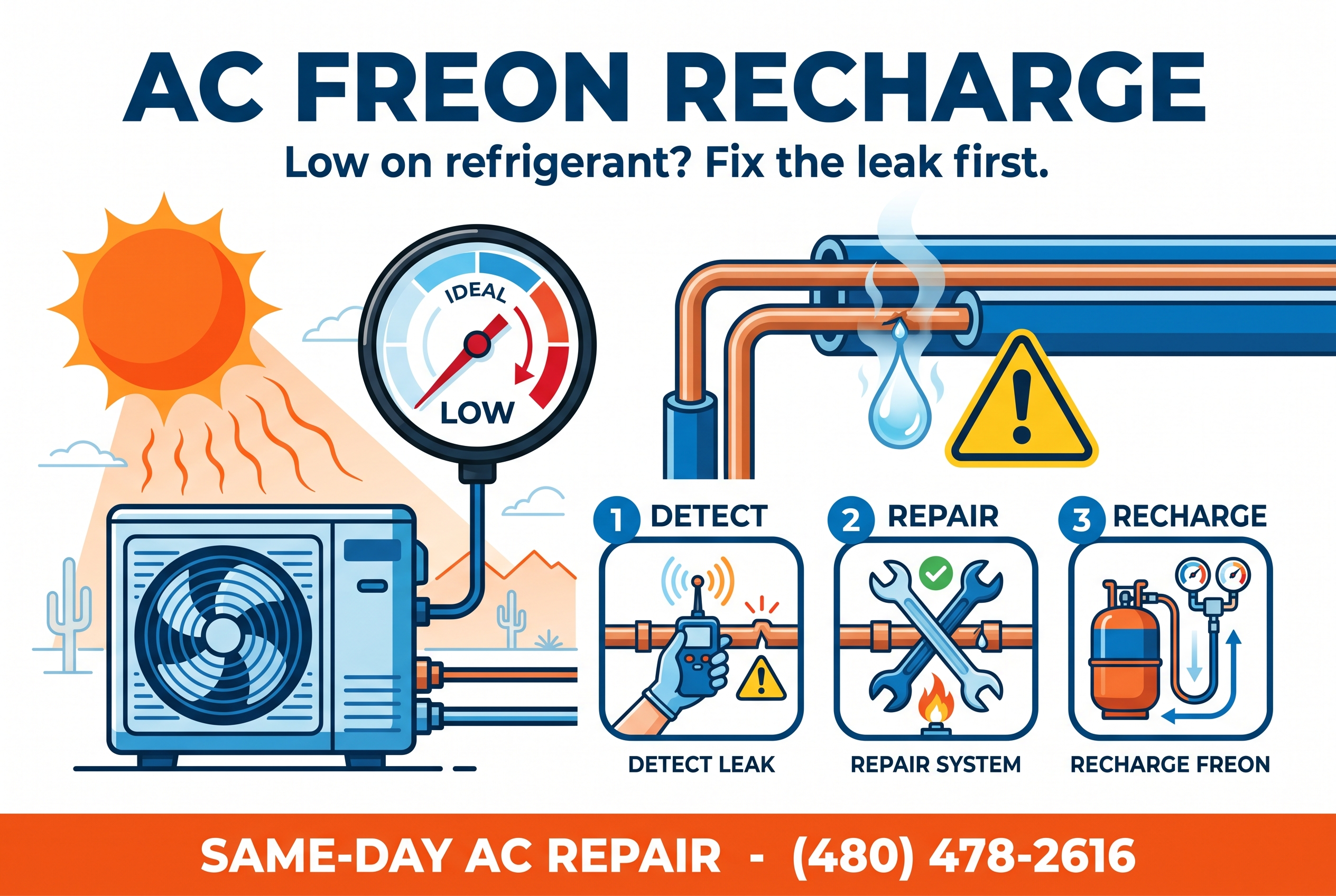
This is the most important thing to understand before you pay for a recharge: adding refrigerant to a leaking system is a temporary patch, not a repair.
Because your AC is a sealed loop, a low charge always means refrigerant is escaping somewhere. If a technician simply “tops off” the system without finding and sealing that leak, three things happen. The refrigerant you just paid for slowly leaks back out, so you’re cooling fine for a few weeks or months and then right back to warm air. You spend money again on the next recharge. And every ounce that escapes is released into the environment, which is exactly what federal refrigerant rules are designed to prevent.
There’s a regulatory side to this too. Anyone who opens a refrigerant circuit—even just to add refrigerant—is required to hold EPA Section 608 certification, and best practice under the EPA’s refrigerant program is to locate and repair the leak rather than repeatedly recharge a system that’s venting refrigerant. For larger commercial and refrigeration equipment, leak repair is a firm federal requirement. That’s why a reputable company won’t just sell you a refill and drive off—the responsible path is to diagnose the leak first.
A recharge done the right way is part of a real repair: the technician finds the leak, fixes it, then recharges the system to the manufacturer’s exact specification. Recharging matters because both too little and too much refrigerant damage the system—an overcharged unit is just as harmful as an undercharged one. Getting the charge dialed in precisely is one of the checks included in a seasonal AC maintenance tune-up, which is the cheapest way to catch a small leak before it strands you in July.
Professional Refrigerant Leak Detection
Finding a refrigerant leak isn’t guesswork—licensed technicians use proven methods to pinpoint exactly where the system is losing charge. A thorough diagnosis usually involves one or more of these:
- Electronic leak detectors. A handheld “sniffer” that reacts to refrigerant in the air, moved slowly along the coil, line set, and connections to find the source.
- UV dye tracing. A fluorescent dye is added to the system; after it circulates, the technician scans with a UV light and the dye glows at the leak point.
- Bubble and pressure testing. A soap solution reveals bubbles at a leak under pressure, while pressure gauges confirm whether the system is holding its charge.
- Coil and connection inspection. Evaporator coils, the copper line set, and service valves are the most common leak locations, especially as fittings age in Arizona’s heat.
Once the leak is found, the fix depends on where it is—a fitting can be tightened or resealed, a valve replaced, or a corroded coil repaired or swapped out. After the repair, the technician evacuates the system, recharges it to spec, and verifies that pressures and temperatures are back to normal.
Phoenix’s extreme heat is hard on refrigerant systems. Sustained high temperatures, sun exposure on the outdoor unit, and years of expansion and contraction all work joints and coils loose over time, which is why refrigerant leaks are a common summer call here. If you’ve been through this once already and your system keeps needing refrigerant, it may be time to weigh a bigger repair against a new, more efficient unit—and for after-hours breakdowns, our emergency AC repair guide for Arizona walks through your options.
Same-Day AC Refrigerant Service in Phoenix
In Arizona’s heat, a no-cool call can’t wait days for an appointment. Discount AC & Refrigeration provides same-day refrigerant diagnosis, leak repair, and recharging across Phoenix and the East Valley—Gilbert, Mesa, Chandler, Tempe, Scottsdale, and Queen Creek.
When our team arrives, we:
- Test the system’s charge and confirm whether low refrigerant is really the cause—instead of just selling a refill.
- Locate the leak with professional detection tools and give you an upfront price before any work starts.
- Repair the leak, recharge to the manufacturer’s spec, and verify the system is cooling correctly before we leave.
We’re a licensed Arizona contractor (ROC 361623) available 6 AM to midnight, seven days a week. If your AC is blowing warm air or you suspect it’s low on refrigerant, call (480) 478-2616 or request service online and we’ll get your home cold again. Not sure whether it’s refrigerant or an electrical part like a failing AC capacitor? Our technicians will pinpoint the real problem the first time, whether you’re in Phoenix or nearby Gilbert.
Frequently Asked Questions
How do I know if my AC needs a Freon recharge?
The most common signs are warm air from the vents, an AC that runs constantly without reaching the set temperature, ice on the copper refrigerant line or indoor coil, a hissing or bubbling sound, higher-than-normal electric bills, and sticky indoor humidity. Because these symptoms overlap with other issues, the only way to confirm a low charge is a professional gauge test.
How often should an AC need a Freon recharge?
Ideally, never on a routine basis. An air conditioner is a sealed system that doesn’t consume refrigerant, so if yours needs a recharge every season, it has a leak that should be found and repaired. Repeated recharges are a sign the underlying problem hasn’t been fixed.
Can I recharge my AC with Freon myself?
It’s not advisable, and in most cases not legal. Anyone who opens a refrigerant circuit must hold EPA Section 608 certification, and adding the wrong amount—too much or too little—damages the system. DIY “recharge kits” also skip the critical step of finding the leak, so the refrigerant just escapes again.
Why does my AC keep losing refrigerant?
Because there’s a leak. Common leak points are the evaporator coil, the copper line set, and aging service valves and fittings. Phoenix’s heat and years of expansion and contraction gradually work these joints loose, so refrigerant slowly escapes until the leak is professionally located and repaired.
Is R-410A or R-22 refrigerant still available?
Yes, but with differences. R-410A is still fully legal to service and recharge, even though new R-410A systems are no longer manufactured as of 2025. R-22, the older “Freon,” stopped U.S. production in 2020 and is now scarce and expensive—so R-22 systems are often better candidates for replacement than repeated recharges.
How much does an AC Freon recharge cost?
It depends on the refrigerant type and how much the system needs. Recharging a modern R-410A system costs less than refilling an older R-22 unit, since R-22 is now scarce. Remember that a recharge without leak repair is only temporary, so ask for an upfront, all-in price that includes finding and fixing the leak.