Dirty ice is a health violation waiting to happen. If your commercial ice machine hasn’t been professionally cleaned in the last 6 months, you’re likely producing ice contaminated with biofilm, mold, and bacteria — and your customers are consuming it. This guide walks you through exactly how commercial ice machine cleaning should be done, step by step, so your kitchen stays compliant, your equipment lasts longer, and your guests stay safe.
Why Commercial Ice Machine Cleaning Is Non-Negotiable
The FDA and local health departments classify ice as a food product. That means your ice machine is subject to the same sanitation standards as your prep surfaces and cookware. Yet most restaurant owners don’t realize their machine is overdue for a deep clean until an inspector flags it — or worse, a customer gets sick.
Common culprits hiding inside neglected machines:
- Slime and biofilm — A sticky bacterial layer that coats internal components
- Pink or black mold — Thrives in cool, damp environments like evaporator plates
- Mineral scale — Calcium and lime deposits that reduce ice production and damage components
- Listeria and E. coli — Both have been documented in commercial ice machines with poor sanitation practices
The solution isn’t complicated. It just requires the right products, the right steps, and a consistent schedule.
Step-by-Step: How to Clean and Sanitize Your Commercial Ice Machine
Step 1 — Turn Off and Empty the Machine
Switch the unit to the “wash” or “clean” cycle if available. Remove all ice from the bin and discard it. Never clean a machine while it’s actively producing ice.
Step 2 — Remove and Soak Removable Parts
Take out the ice bin, water curtains, and any removable panels. Soak them in a food-safe ice machine cleaner solution (follow manufacturer dilution ratios — typically 1–2 oz per gallon of warm water at 70–90°F).
Step 3 — Run the Cleaning Cycle with Descaler
Add the recommended amount of nickel-safe ice machine cleaner directly into the water trough or per your unit’s cleaning port. Allow the machine to run a full cleaning cycle — this typically takes 20–45 minutes depending on the model (Manitowoc, Hoshizaki, Ice-O-Matic, etc.).
The descaler breaks down mineral deposits and scale on the evaporator plates, water distribution tubes, and pump assembly.
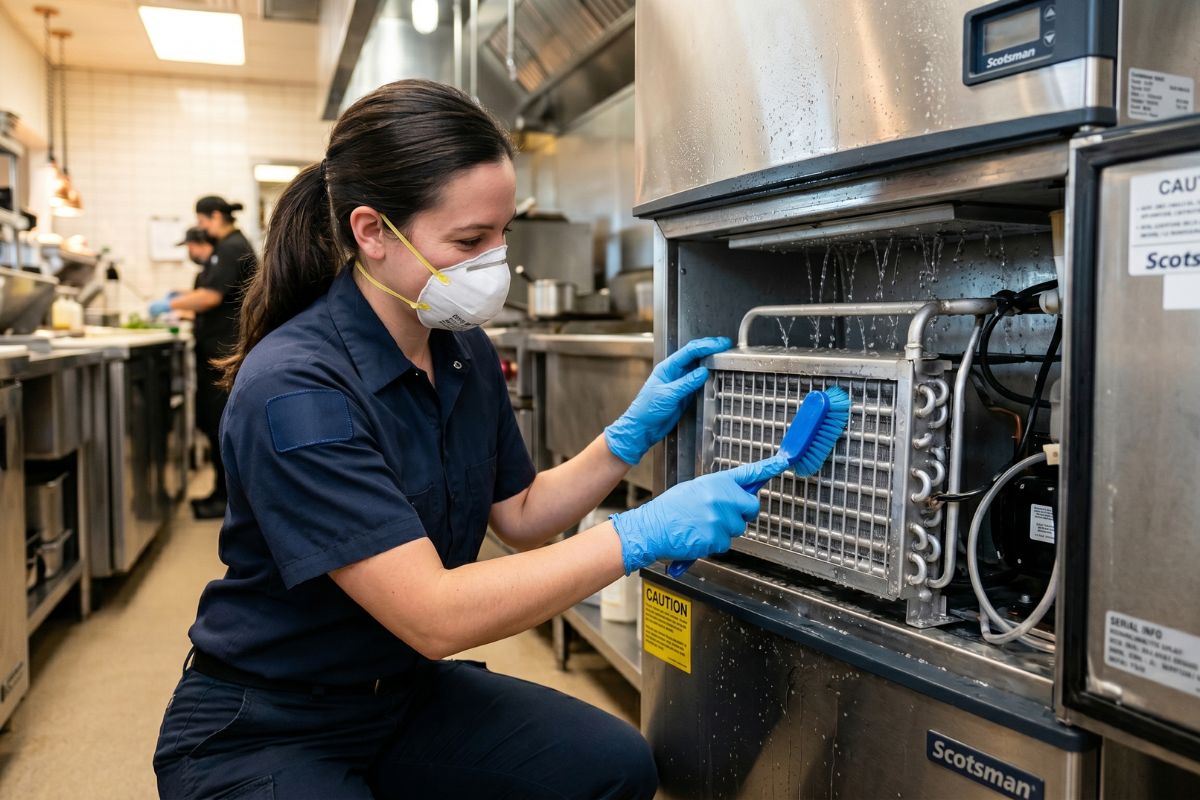
Step 4 — Scrub Internal Surfaces
Using a soft-bristle brush (never metal), manually scrub:
- Evaporator plate surfaces
- Water distribution tubes
- Float valves
- Interior bin walls
- Door gaskets and seals
This is where most DIY cleanings fall short. The brush work is critical for removing biofilm the chemical alone won’t fully eliminate.
Step 5 — Rinse Thoroughly
Run at least two full rinse cycles with clean water before moving to sanitization. Residual cleaner left in the system can affect ice taste and may cause equipment damage.
Step 6 — Apply Food-Safe Sanitizer
Mix an EPA-registered sanitizer (quaternary ammonium or bleach-based, per the manufacturer’s specs) and apply to all internal food-contact surfaces. Allow to air dry — do not rinse after sanitizing.
Step 7 — Reassemble and Restart
Reinstall all cleaned components, close the unit, and restart ice production. Discard the first two or three batches of ice produced after cleaning as a precaution.
Commercial Ice Machine Cleaning & Maintenance Schedule
🧊 Commercial Ice Machine — Cleaning & Maintenance Schedule
| Task | Frequency | Responsible | Priority |
|---|---|---|---|
| Wipe down exterior & bin door | Weekly | In-house staff | Routine |
| Clean air filter (air-cooled units) | Monthly | In-house staff | Routine |
| Inspect water lines & float valve | Every 3 months | Certified technician | Important |
| Condenser coil cleaning | Every 3–6 months | Certified technician | Important |
| Full descaling cycle | Every 6 months | Certified technician | Critical |
| Deep sanitizing (disassembly + scrub) | Every 6 months | Certified technician | Critical |
| Water filter replacement | Every 6 months | Technician or staff | Critical |
| Full preventative maintenance inspection | Annually | Certified technician | Critical |
| High-volume units (500+ lbs/day) | Every 3 months | Certified technician | Critical |
Common Mistakes That Contaminate Your Ice Supply
Even well-intentioned cleaning routines fail when these errors creep in:
- Using the wrong cleaner — Bleach-only cleanings won’t remove scale; descaler-only won’t sanitize
- Skipping the scrub step — Chemicals work on dissolving, not removing biofilm mechanically
- Not changing the water filter — A clogged or expired filter reintroduces minerals and sediment immediately after cleaning
- Cleaning in food-production mode — Chemical residue in ice is a health code violation
- Ignoring the condenser coil — A dirty coil raises operating temperatures, reduces efficiency, and accelerates component wear
Signs Your Ice Machine Needs an Emergency Cleaning Right Now
Don’t wait for the 6-month mark if you notice any of the following:
- Ice has an off taste or odor
- You see pink, black, or orange discoloration inside the bin
- Ice production has dropped noticeably
- The machine runs louder or longer than usual
- You’ve had a recent health inspection flag
These are symptoms of contamination or mechanical stress — and they won’t resolve on their own.
When to Call a Certified HVAC & Refrigeration Technician
DIY cleaning handles routine maintenance. But a certified technician is required when:
- You need documentation for a health inspection
- The machine has internal mold that has spread beyond the bin
- Electrical or refrigerant components need service
- Your unit is under commercial warranty (DIY cleaning can void it)
- You’re experiencing ice production failure or temperature irregularities
A trained tech will use commercial-grade sanitizers, calibrated water testing, and a full component inspection that goes far beyond what a standard cleaning kit covers.
❓ Frequently Asked Questions — Commercial Ice Machine Cleaning
Keep Your Ice Clean, Your Kitchen Compliant, and Your Customers Safe
Commercial ice machine cleaning isn’t a task to postpone. Every week without proper sanitation is a week your customers consume ice from a potentially contaminated source — and a week closer to a costly health code violation or equipment failure.
Call our certified refrigeration and HVAC team in the Phoenix metro area today. We provide scheduled commercial ice machine cleaning, emergency sanitization services, and full preventative maintenance contracts for restaurants, hotels, and food service facilities across Arizona.
📞 Schedule your service inspection now — same-week availability.