The science of clear ice comes down to dissolved gases and minerals — how your ice machine handles them during the freezing process determines whether your ice is crystal-clear and slow-melting, or opaque, fast-melting, and affecting the flavor of every drink you serve.
Walk into any upscale bar in Scottsdale or Gilbert and look at the ice in a cocktail. Chances are it’s clear — almost glass-like. Walk into a facility where the ice machine hasn’t been serviced in two years and the ice looks white and cloudy, breaks apart easily, and gives drinks a faint off-taste. The difference isn’t cosmetic. It’s chemistry — and it has direct implications for food service quality, equipment performance, and your bottom line.
If you own or manage a restaurant, bar, hotel, or commercial kitchen in the Phoenix East Valley, understanding the science of clear ice tells you a lot about what your ice machine is actually doing inside, and what happens when it starts to fail. Our licensed technicians at Discount AC & Refrigeration have been servicing commercial ice machines, walk-in coolers, and refrigeration systems across Gilbert, Mesa, Chandler, Queen Creek, and Tempe for over 20 years — and ice quality is one of the most overlooked indicators of commercial refrigeration health.
What Is the Science of Clear Ice, Exactly?
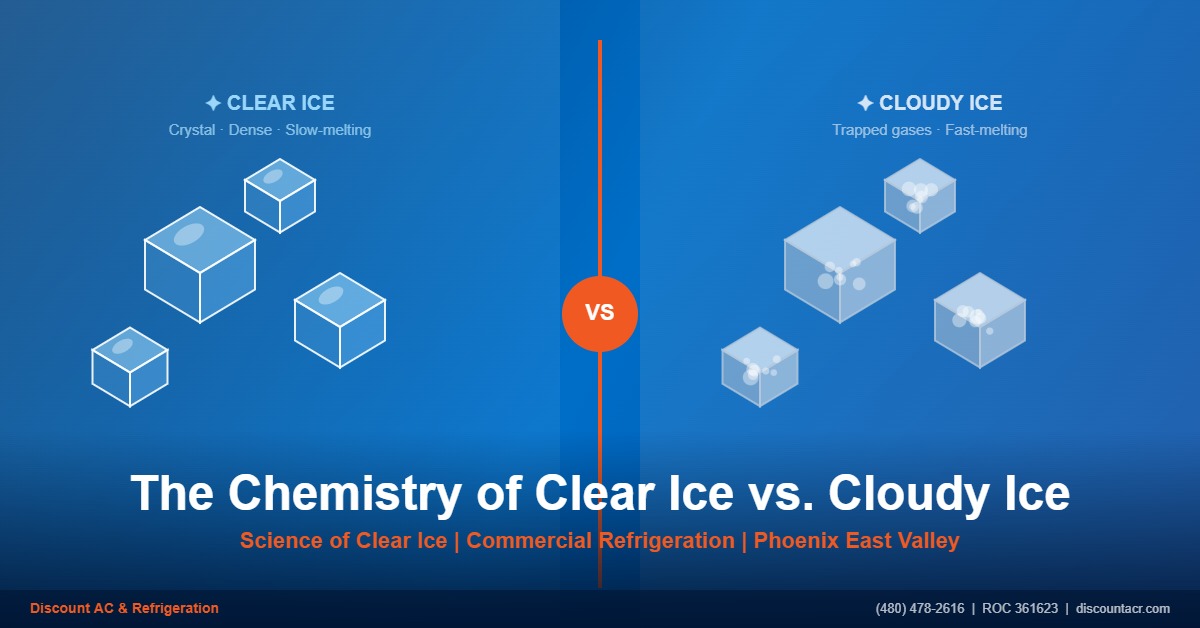
Clear ice forms when water freezes slowly and directionally — pushing dissolved oxygen, nitrogen, and mineral ions ahead of the freezing front rather than trapping them inside the ice crystal structure. The result is a dense, highly organized crystal lattice with almost no internal scattering surfaces. Light passes through it cleanly, giving it that transparent appearance.
Cloudy ice forms when water freezes too quickly or in all directions at once. As ice crystals form rapidly, they trap:
- Dissolved gases (oxygen, nitrogen, CO₂) as microscopic bubbles
- Dissolved minerals (calcium, magnesium, silica from hard water) as fine particles
- Impurities from unfiltered or poorly maintained water supply lines
Each trapped bubble or mineral particle scatters light, making the ice appear white and opaque. It also creates weak points in the crystal structure — which is why cloudy ice chips, cracks, and melts faster than clear ice.
This isn’t just a visual issue. The FDA Food Code classifies ice as a food, and the chemical composition of your ice directly affects flavor. Trapped gases and minerals can produce a subtle metallic or stale taste that customers notice in water, cocktails, and sodas — even if they can’t identify the source.
Why Does Commercial Ice Quality Matter More in Arizona?
The desert environment of Phoenix and the East Valley creates conditions that make ice quality more difficult to maintain — and more important to get right.
Hard water is the norm here. Greater Phoenix has some of the hardest municipal water in the country, with total dissolved solids (TDS) often running between 400–800 mg/L depending on your city source and the season. High TDS means more minerals available to get trapped in ice crystals, accelerating cloudy formation and leaving scale buildup inside your ice machine’s evaporator plates and water distribution system.
Ambient heat puts mechanical stress on refrigeration systems. When outdoor temperatures reach 110–115°F, your ice machine’s condenser works significantly harder to reject heat. If airflow around the condenser is restricted — common in tight back-of-house kitchens — condensing temperatures rise, the refrigeration cycle becomes less efficient, and the water flow rate across evaporator plates changes. This can shift your machine from a controlled directional freeze to a chaotic rapid freeze, producing cloudier ice even when the water itself is filtered.
Demand spikes in summer. During peak summer months, restaurants and bars in Gilbert, Mesa, and Chandler can see ice consumption jump 30–50% over winter levels. Running a commercial ice machine at or above its rated capacity for extended periods reduces cycle time per cube — which, again, favors fast freezing and cloudy output.
Our team at Discount AC & Refrigeration handles ice machine service calls across the East Valley year-round, and summer always brings the highest volume of calls related to ice quality and output volume drops.
How Commercial Ice Machines Produce Clear Ice
Modern commercial ice machines solve the science of clear ice problem through engineering. The two dominant methods are:
Controlled Directional Freezing
The most common approach in commercial undercounter and modular ice machines. Water flows in a continuous sheet across refrigerated evaporator plates. Because the water is always moving, dissolved gases have a path to escape before the ice front catches them. Freezing happens from the cold side of the plate outward — a controlled, directional process that produces dense, clear cubes.
This is why water quality matters: scale buildup on evaporator plates interrupts the water sheet, creating dry spots where freezing becomes chaotic and localized. NSF International recommends ice machine cleaning and descaling every six months — and every three months in hard-water markets like Phoenix.
Harvest Cycle Management
At the end of each freeze cycle, the machine runs a brief defrost to release cubes from the evaporator. If the harvest cycle is too short (often caused by a failing hot gas valve or a refrigerant charge issue), cubes don’t release cleanly and partially re-freeze — bonding with new water that freezes quickly and traps gases. The result is irregular, partially cloudy cubes with bonded clusters.
A well-maintained machine with properly calibrated harvest timing produces consistent, uniform cubes — one of the clearest indicators of a healthy refrigeration system.
Water Filtration: The First Line of Defense
Before the refrigeration system even plays a role, your incoming water quality determines how hard the science of clear ice has to work against mineral interference.
A properly sized inline carbon block filter reduces chlorine and organics. A scale inhibitor cartridge (phosphate-based or template-assisted crystallization) prevents calcium and magnesium from depositing on evaporator surfaces without removing minerals entirely — which matters because fully softened water can produce over-soft ice that sticks together.
Key filtration specs for Arizona commercial operations:
- Replace filter cartridges every 6 months or per manufacturer’s gallon rating, whichever comes first — hard Phoenix-area water clogs filters faster than in softer-water markets
- Monitor TDS at the machine inlet — target below 200 mg/L for optimal clarity and equipment longevity
- Install a pre-filter housing with a rated micron rating of 5 or less for sediment removal upstream of your scale inhibitor
Water filtration maintenance is part of the commercial refrigeration preventive maintenance plan our technicians perform for restaurants, hotels, and food-service operations across the East Valley.
Signs Your Ice Machine Is Failing the Science of Clear Ice Test
If your commercial ice machine has started producing noticeably cloudier, smaller, or off-tasting ice, that’s not just an aesthetic problem. These are diagnostic signals:
- Smaller cubes or incomplete freeze → Low refrigerant charge or a failing thermostatic expansion valve (TXV)
- Cloudy ice despite clean water → Scale buildup on evaporator plates or a harvest cycle that’s too short
- Ice with an off-taste or odor → Biological growth (biofilm or mold) inside the bin, water distribution tray, or evaporator
- Low ice output in summer → Condenser coils need cleaning; ambient air temp around the machine is too high
- Ice bonding into large clumps → Bin thermostat failure or ice storage temps above 32°F
Any of these symptoms calls for a professional inspection. Our licensed team — available 6 AM to Midnight, 7 days a week — serves commercial clients throughout Gilbert, Mesa, Chandler, and the broader Phoenix area. You can reach us at (480) 478-2616 for same-day service or to schedule preventive maintenance.
Clear Ice and Commercial Refrigeration Standards
Ice machines in food-service settings are regulated under Arizona Department of Health Services (ADHS) guidelines, which align with FDA Food Code requirements. Key compliance points:
- Ice contact surfaces must meet NSF/ANSI 12 certification for material safety
- Ice storage bins must be cleaned and sanitized at minimum every 6 months
- Ice machines must be installed per manufacturer clearance requirements — particularly important for condenser airflow in high-ambient Arizona environments
- Any machine used in licensed food-service operation in Arizona must be maintained in a way that prevents contamination of ice as a food product
Discount AC & Refrigeration operates under Arizona ROC License 361623 and follows all applicable state standards for commercial refrigeration service and installation. When you need a contractor you can document for your health inspection file, we’re the team East Valley food-service operators trust. Check our verified Google profile to see what local restaurants, hotels, and facility managers say about our service.
Keep Your Ice Machine Producing Clear, Safe Ice Year-Round
The science of clear ice isn’t magic — it’s controlled engineering plus proper maintenance. In Arizona’s hard-water, high-heat environment, that maintenance window is tighter than in most markets. A machine that produces perfect ice in January can be struggling by July without a mid-year inspection.
Our licensed HVAC and refrigeration technicians at Discount AC & Refrigeration provide complete commercial refrigeration service across the East Valley — from ice machine descaling and filter replacement to full refrigerant system diagnosis and compressor replacement. Whether you’re running a busy restaurant in Gilbert, a hotel in Chandler, or a craft brewery in Mesa, we’ll keep your ice production consistent and your equipment running at rated capacity.
Call us at (480) 478-2616 — available 6 AM to Midnight, 7 days a week. Or contact us online to schedule a service call. Ask about our Refer & Earn program — refer a fellow business owner and earn rewards when they become a client.
| Ice Problem | Likely Cause | Recommended Action |
|---|---|---|
| Cloudy or white ice cubes | Scale buildup on evaporator plates; rapid freeze cycle; high mineral content in water | Descale evaporator; replace water filter; check TDS at inlet — target <200 mg/L |
| Small or incomplete cubes | Low refrigerant charge; failing TXV; shortened freeze cycle | Refrigerant system diagnosis; TXV inspection; verify freeze cycle timing |
| Off-taste or odor in ice | Biofilm or mold in bin, water tray, or evaporator; expired carbon filter | Full sanitization of ice machine and bin; replace carbon block filter |
| Low ice output in summer | Dirty condenser coils; high ambient temperature; restricted airflow | Clean condenser; verify minimum clearance per spec; improve room ventilation |
| Ice clumping or bonding together | Bin thermostat failure; storage temperature above 32°F; frequent door opening | Inspect and replace bin thermostat; check door seals and bin insulation |
What is the science of clear ice and why does it matter for restaurants?
Clear ice forms when water freezes slowly and directionally, pushing dissolved gases and minerals out of the crystal structure. The result is denser, slower-melting ice that doesn’t dilute drinks quickly. Your commercial refrigeration system plays a direct role in achieving it for restaurants across the Phoenix East Valley.
Why is my ice machine producing cloudy ice all of a sudden?
Sudden cloudiness usually points to scale buildup on evaporator plates, an expired water filter, or a refrigeration issue shortening the freeze cycle. Arizona’s hard water makes scale especially common. Call (480) 478-2616 for same-day diagnosis — available 6 AM to Midnight.
How often should a commercial ice machine be cleaned in Arizona?
NSF recommends every 6 months minimum. In Phoenix — where water TDS runs 400–800 mg/L — we recommend every 3–4 months for high-volume operations. Our preventive maintenance plans include ice machine service for East Valley restaurants.
Does water hardness affect ice clarity in the Phoenix area?
Yes — significantly. Phoenix-area water has high calcium and magnesium levels, meaning more minerals get trapped in ice crystals. A properly sized inline filter with a scale inhibitor keeps TDS below 200 mg/L at the machine inlet for optimal clarity and equipment longevity.
Why does my ice machine produce less ice in the summer?
At 110–115°F, your condenser works much harder to reject heat. Dusty coils or restricted airflow cause capacity to drop. A spring condenser cleaning as part of commercial refrigeration maintenance prevents most summer output losses in Gilbert and Mesa.
Is cloudy ice a food safety concern?
Cloudy ice from dissolved gases or hard water is generally safe. However, ice with an off-taste or odor can signal biofilm or mold — a critical violation under FDA Food Code and Arizona ADHS inspections. If your ice has any off-smell, call (480) 478-2616 immediately.
What water filter do I need for my commercial ice machine in Arizona?
For Arizona hard water: a two-stage setup with a 5-micron sediment pre-filter plus a carbon block/scale inhibitor cartridge (TAC media works well). Replace every 6 months or per manufacturer’s gallon rating — whichever comes first.
How do I schedule ice machine service in Gilbert or the East Valley?
Call (480) 478-2616 — available 6 AM to Midnight, 7 days a week across Gilbert, Mesa, Chandler, Queen Creek, and Tempe. Or submit a service request online. Licensed technicians (ROC 361623) for everything from descaling to full compressor repair.
Ready to Upgrade Your Ice Quality?
The science of clear ice is straightforward — directional freezing, proper water filtration, clean evaporator plates, and a refrigeration system running at peak efficiency. In the Phoenix East Valley, achieving that consistently means staying ahead of hard water scale, summer heat load, and high-demand cycles that push machines past their rated capacity.
The good news: all of these variables are manageable with the right service partner. Our licensed technicians at Discount AC & Refrigeration have helped restaurants, bars, hotels, and food-service facilities across Gilbert, Mesa, Chandler, and Queen Creek maintain ice quality that holds up through Arizona summers — without emergency breakdowns or failed health inspections.
Call us at (480) 478-2616 — available 6 AM to Midnight, 7 days a week. Or contact us online to schedule service. Ask about our Refer & Earn program and earn rewards when a fellow business owner you refer becomes a client.
Is Your Commercial Ice Machine Producing Cloudy or Low-Quality Ice?
Our licensed HVAC and refrigeration technicians (ROC 361623) diagnose and service commercial ice machines across Gilbert, Mesa, Chandler, and the Phoenix East Valley — available 6 AM to Midnight, 7 days a week.