Choosing a MERV filter for a Phoenix home means balancing particle capture with the airflow the AC system needs.
Phoenix homeowners often buy the highest-rated air filter they can find, hoping to capture more dust. A finer filter may capture smaller particles, but it can also resist airflow if the filter area, cabinet, and blower were not designed for it. The right choice is not a universal MERV number. It is the highest filtration level your particular system can use while maintaining the airflow required by its manufacturer.
This guide focuses on the trade-off between filtration and airflow. It does not replace a diagnosis of a cooling problem or a discussion of whether duct cleaning is worthwhile. If you already notice weak airflow, unusual noise at the return, or a frozen coil, have the system evaluated before experimenting with denser filters. For airflow problems that a filter change does not solve, book AC repair in Phoenix.
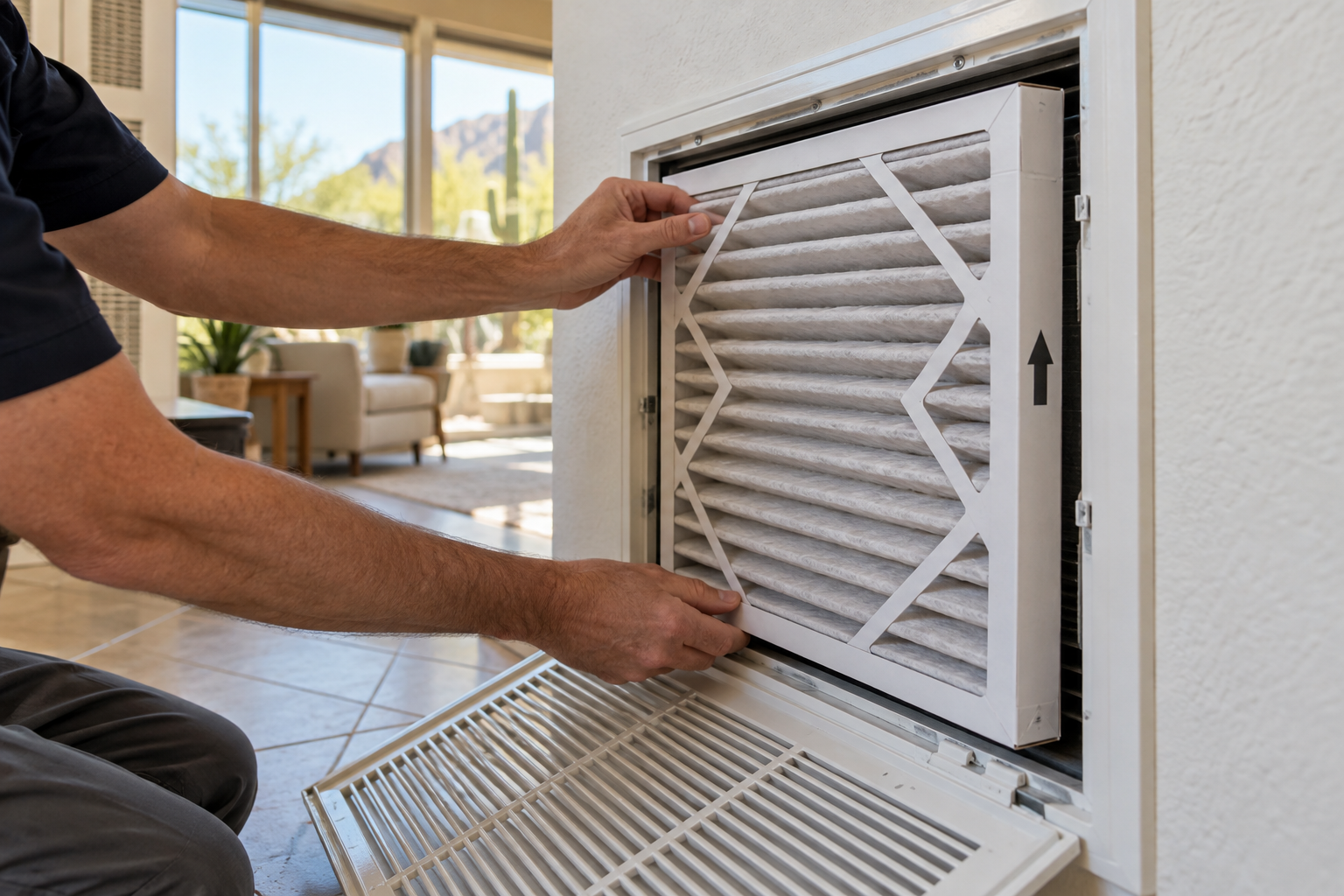
What MERV measures, and what it does not
MERV stands for Minimum Efficiency Reporting Value. Higher numbers describe better capture of specified particle sizes under a standardized test. The rating does not tell you whether the filter fits your cabinet correctly, how much surface area it has, or what pressure drop it creates at your system’s airflow. Two filters with the same MERV rating can behave differently because of thickness, pleat design, and face area.
In a desert home, visible dust makes filtration feel urgent. Yet a filter has a second job: it must let enough return air reach the equipment. When airflow is restricted, the blower works against greater resistance. Cooling performance can fall, rooms may become uneven, and the evaporator may be more susceptible to freezing under some operating conditions. None of those symptoms is proof that the filter alone caused the problem, but filter choice belongs in the diagnosis.
MERV 8, 11 and 13: how to compare them
MERV 8
This is a common baseline for household dust and larger particles. It may create less resistance than a denser alternative in the same size, but a poorly fitting or heavily loaded MERV 8 filter still performs badly. Inspect the rack for gaps that allow air to bypass the filter.
MERV 11
MERV 11 offers finer capture than MERV 8 in the test categories, making it a possible middle ground for some homes. Whether it is appropriate depends on the filter design and measured pressure drop. Do not assume a one-inch filter and a deep media cabinet perform alike.
MERV 13
MERV 13 can capture more fine particles, but it needs adequate filter area and system capacity. A technician may find that a larger media filter cabinet allows better filtration without excessive resistance. Simply forcing a dense filter into an undersized return does not solve the underlying design constraint.
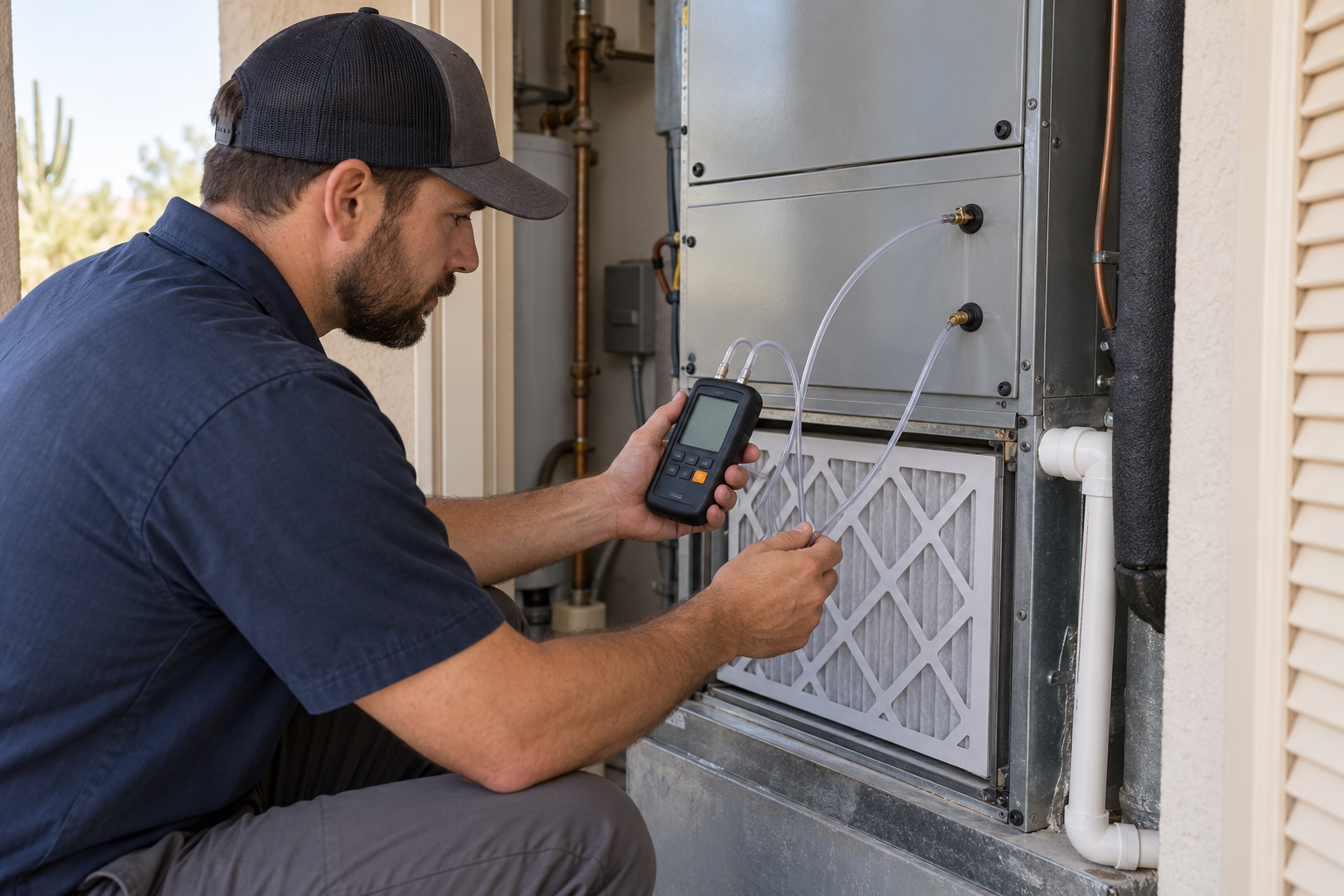
The measurements that settle the question
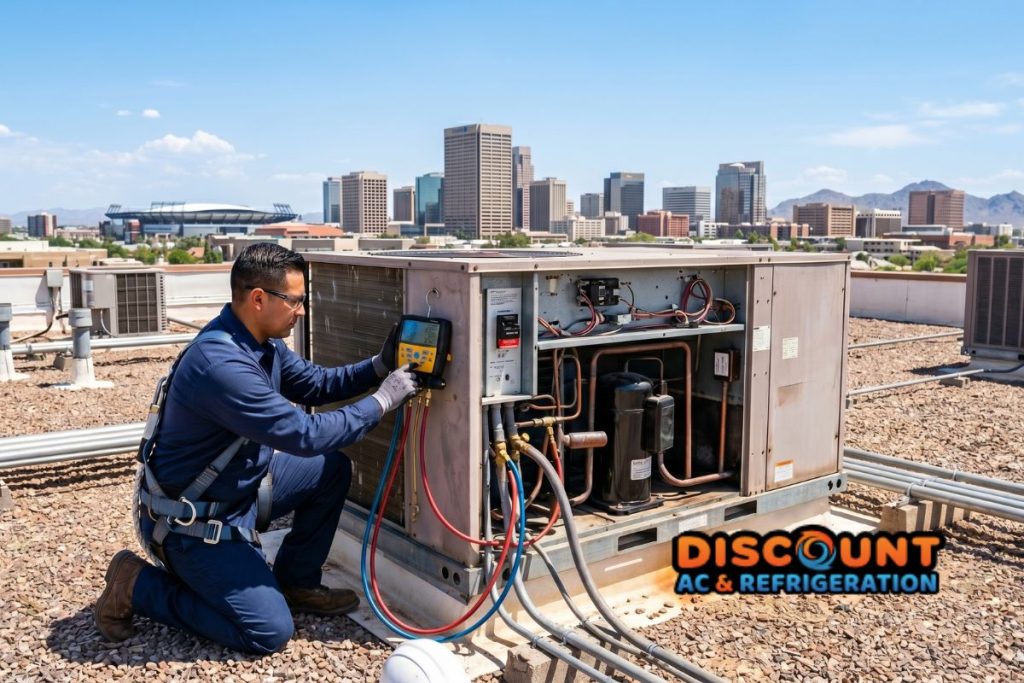
A professional can measure total external static pressure and pressure drop across the filter under normal operation. Those numbers are compared with equipment specifications and the rest of the duct system. The blower, return grille, coil, and supply ducts all contribute resistance. If a system is already near its airflow limit, a higher-MERV filter may not be the first upgrade to make.
Ask for the measurement before and after a proposed change. Also ask whether the filter size, cabinet depth, and replacement interval suit your home’s conditions. Our residential AC diagnostics can evaluate airflow together with cooling performance; the indoor air quality service covers filtration options.
A practical filter routine for Phoenix homes
Start with the size and type recommended for the installed system. Write the installation date on the frame and inspect the filter regularly rather than relying on a calendar alone. Dust exposure, pets, construction activity, occupancy, and operating hours all change how quickly a filter loads. Replace it when it is dirty according to the manufacturer’s instructions; do not wash a disposable filter unless it is explicitly designed to be washed.
Keep supply registers and returns unobstructed. If one room remains dusty while the rest of the home is comfortable, inspect whether air bypasses the filter or leaks through the duct system. Filtration and ventilation work as a system. For a general view of the company’s home services, see residential HVAC solutions.
How to choose a MERV filter without guessing
Start with the equipment manual and the exact filter dimensions printed on the existing frame. A MERV filter rating describes particle capture in a standard test; it is not a substitute for the manufacturer’s allowable airflow range. The U.S. Environmental Protection Agency explains MERV ratings and advises choosing MERV 13, or as high as the system fan and filter slot can accommodate. That qualification matters: the correct choice for a specific house must be checked against its equipment and ductwork.
Before replacing a filter, note its thickness as well as length and width. A deep pleated media filter may provide more surface area than a one-inch product, but a deeper cabinet cannot be assumed to fit the existing return. Check the airflow arrow on the frame and make sure the filter seats against the rack rather than bowing or leaving gaps. Air that bypasses the filter can carry dust toward the coil even when the media itself has a high rating.
What to ask during a service visit
Ask the technician to record total external static pressure and the pressure difference across the filter at the system’s normal operating speed. Request the manufacturer’s acceptable range and an explanation of whether the filter, return path, coil, or supply ductwork accounts for the restriction. A single pressure reading without a comparison to the equipment specifications is not a complete answer. If a denser filter is proposed, a before-and-after measurement is more useful than choosing solely by a package label.
Tell the technician whether the system whistles at the return, freezes, cycles for long periods, or leaves rooms uneven. Those observations help determine whether the MERV filter is involved or whether another issue needs attention. Do not remove the filter and run the system for an extended period as a workaround; that can expose the indoor coil to dust. If airflow is already weak, consider a professional assessment before buying a box of replacement filters.
When a portable air cleaner may be more practical
If a particular bedroom needs additional particle reduction but the central system cannot accommodate a higher-efficiency filter, a properly sized portable air cleaner may be an option. It works in the room where it is used rather than requiring the central blower to move all of the home’s air through a denser filter. This does not repair duct leaks or replace ventilation, but it can separate a room-specific air-quality goal from a central-system airflow constraint. The EPA’s Guide to Air Cleaners in the Home discusses both portable units and HVAC filtration.
Filter fit matters as much as the number on the package
Even an efficient MERV filter cannot capture air that passes around its edges. Before choosing a new rating, look at how the existing filter sits in the rack. The cardboard frame should be the size specified for the opening, and the filter should not be crushed, folded, or propped up with improvised materials. A visible gap beside the frame suggests bypass. Dust streaks downstream of the rack can be another clue, although a technician should distinguish current leakage from old deposits.
Measure the actual slot rather than estimating from the return grille. Nominal filter sizes and actual dimensions can differ. If the filter goes behind a grille, check that the grille closes without bending the frame. If the equipment has more than one return, identify each filter location before ordering replacements. Some homes use a central filter at the air handler, while others use filtered return grilles; adding filters in both places without a design review can increase resistance.
The airflow arrow should point toward the equipment. Installing the filter backward does not usually make particles pass through a magical one-way barrier, but it can affect how the media is supported when the blower runs. A wet, damaged, or collapsed filter should be replaced with a suitable product and the cause of moisture or deformation investigated. Do not tape over large bypass gaps in a way that obstructs the return opening or prevents safe servicing.
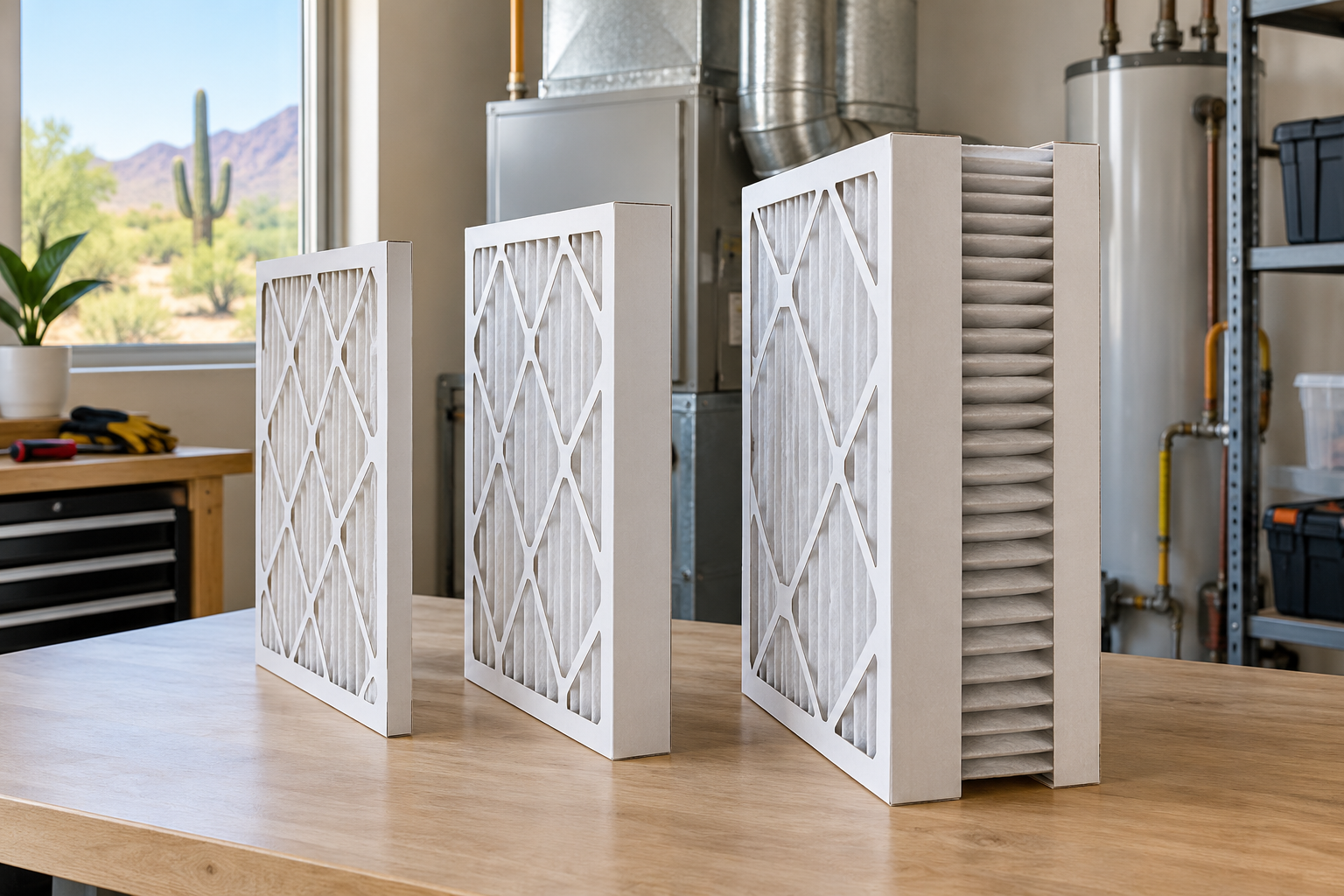
Why two MERV 13 products can behave differently
The MERV number is an efficiency classification; it is not a universal pressure-drop specification. Filter media, pleat count, depth, and face area differ across products. As air moves through a filter, resistance also changes with airflow rate and with dust loading. A deeper pleated filter can offer more effective media area, but only if the cabinet and installation support it. Product data for pressure drop at a stated airflow rate can help a technician compare options more meaningfully than the rating alone.
That is why a MERV filter comparison should hold the operating conditions as steady as possible. A clean new filter and a heavily loaded old one do not create a fair side-by-side test. Blower speed, cabinet doors, return grilles, and fan mode should be the same for both measurements. If the system uses a variable-speed blower, it may compensate for resistance up to a point, so a homeowner cannot infer the whole result from room noise alone.
There is no honest single answer that MERV 8 is always safe and MERV 13 is always too restrictive. The EPA advises using a higher-efficiency filter when the system can accommodate it. The point of the airflow check is to identify that condition for the specific equipment rather than turn a useful recommendation into a blanket rule.
Dusty home, clean filter: what else to check
Persistent dust does not automatically call for a higher MERV filter. Dust can enter through open doors, leaky building-envelope joints, and attached garages; it can be generated indoors by activity and fabrics. A return duct leak may pull dusty attic or wall-cavity air into the system. A loose filter rack can let particles bypass otherwise adequate media. If dust appears soon after cleaning or concentrates near certain vents, identify the pattern before paying for more expensive filters.
Also distinguish settled dust from airborne particles. A filter only captures particles carried through it while the blower operates. A portable cleaner may help in a specific occupied room, while source control and building maintenance address other routes. Neither central nor portable filtration substitutes for fixing a moisture problem, a dirty coil, or damaged ductwork. For persistent comfort or airflow complaints, a technician should look at the whole system, not just the filter slot.
Seasonal decision checklist for a Phoenix home
Before peak summer cooling, confirm the system’s required filter dimensions and the manufacturer’s airflow guidance. Inspect the installed filter and note its age, condition, and fit. Record whether the return makes a new whistling sound, whether supply airflow feels weaker than before, and whether any room develops a new temperature difference after a filter change. These observations are useful when you call for service, but they do not replace measurements.
During dusty weather or nearby construction, inspect more often because loading may accelerate. After a storm or renovation, check for an obvious buildup rather than waiting for a fixed calendar date. Keep a short record of the product model, MERV rating, installation date, and any symptoms. If the air handler has a pressure indicator, follow the equipment’s instructions; do not assume a visual inspection alone reveals the exact pressure drop.
When evaluating an upgrade, ask: Is the filter slot large enough? Is the return path already undersized? What did the pressure measurement show with the existing clean filter? Would a larger media cabinet or duct correction be more effective than placing a dense one-inch filter in the same opening? Those questions protect both comfort and filtration goals. A MERV filter should be chosen as part of an HVAC system, not as an isolated shopping decision.
Sample questions for comparing filter proposals
When one provider recommends a new MERV filter and another warns against it, ask each to explain the measurement behind the recommendation. What is the blower’s rated airflow range? What was the measured total external static pressure? What portion of the resistance occurs across the existing filter, and how did that reading change with a clean replacement? A clear written answer lets you compare proposals without relying on a vague claim that a particular rating is always best.
Ask whether the return grille and ductwork can deliver enough air when the filter is clean and when it begins to load. If the return is undersized, increasing filter area may be a better path than reducing the MERV rating. If the cabinet allows a deep media filter, request the product’s pressure-drop data at the intended airflow. A larger surface area can change the practical trade-off, but actual system measurements should confirm the result.
Be cautious about claims that a higher rating will eliminate all dust, allergens, or odors. Particle capture depends on size, airflow, runtime, fit, and maintenance. Gas and odor control involve different media and source management. A central MERV filter only treats air passing through the HVAC system. If a specific room is the concern, ask whether a portable cleaner and source control would be more suitable than changing every return filter in the house.
Finally, ask what follow-up is included. Will the technician document the proposed MERV filter model and size, verify that the return grille closes correctly, and recheck pressure after installation? Will they explain a sensible inspection interval for the household’s dust conditions? These practical details turn a filter purchase into a measurable maintenance decision. If symptoms persist after the change, return to the full airflow and cooling diagnosis rather than purchasing successively denser products without evidence.
A final check is the date of the last airflow test. A system changed by duct repairs, a new blower, or a different filter cabinet should be evaluated under its current configuration. Keep the MERV filter model and pressure readings with service records so future replacements match the tested setup. If a new filter makes noise or comfort noticeably worse, report the change promptly rather than waiting through a full cooling season.
Frequently Asked Questions
Is MERV 13 always better for a Phoenix AC?
It can filter finer particles, but it is not always a suitable drop-in choice. Verify airflow and pressure drop on the actual system before upgrading.
Can a dirty filter increase cooling costs?
A loaded filter can restrict airflow and make the system work less effectively. The cost impact depends on the equipment and conditions, so it should not be estimated from filter appearance alone.
Do thicker filters last longer?
A deep media filter often has more surface area, but service life varies by product and dust load. Follow the manufacturer’s guidance and inspect it regularly.
What if my AC gets noisy after a filter change?
A new whistling sound at the return may indicate greater resistance or a poor fit. Recheck that the correct size was installed and request a professional airflow assessment if the sound persists. Call Discount AC & Refrigeration at (480) 478-2616.